isCoreLibraryDesugaringEnabled Nears End of Life
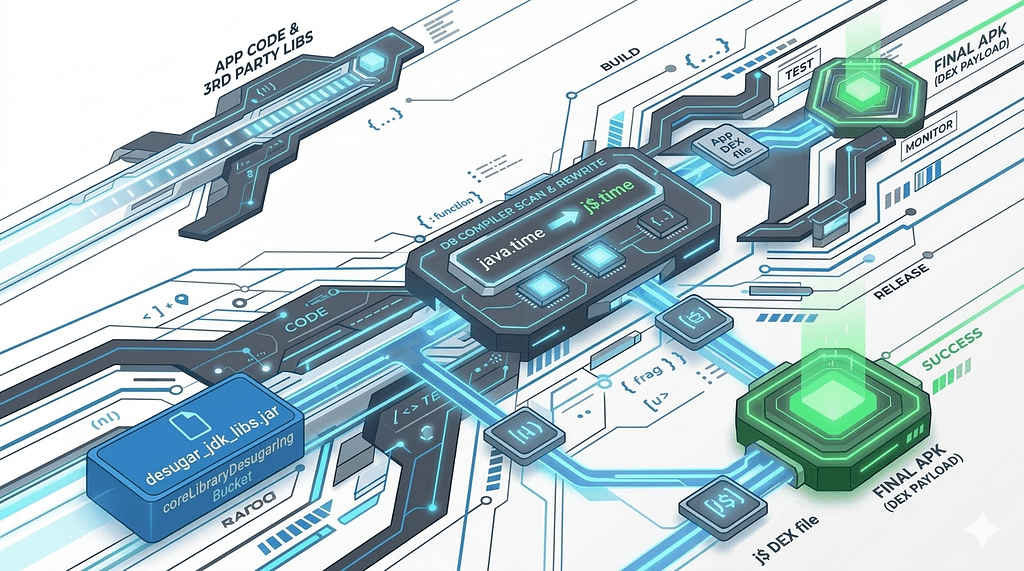
isCoreLibraryDesugaringEnabled and desugar_jdk_libs 2.1.3 are being phased out as Google modularizes Android system updates, ending the j$ namespace workaround for java.time on legacy devices.
Why it matters
For years, Android engineers have relied on isCoreLibraryDesugaringEnabled to bridge the gap between modern Java APIs and old devices. The flag triggers the D8 compiler to rewrite application bytecode at build time, redirecting calls to java.time and java.util.stream into a backported library packaged under the j$ namespace. This let applications target minSdk versions well below API 26 without crashing on firmware that permanently lacked those classes. However, the article reveals that this compatibility layer now levies a hidden performance tax on modern flagship devices, turning a once-essential stopgap into active technical debt that affects startup and runtime efficiency.
What changed
Google introduced desugar_jdk_libs, currently at version 2.1.3, as a fully compliant OpenJDK backport stripped of modern JVM dependencies and low-level native kernel hooks. When you enable the flag and add the coreLibraryDesugaring dependency, the compiler executes two distinct translation tasks: syntax desugaring breaks down modern language features like lambdas into compatible instructions, while API desugaring injects entire framework definitions that old operating systems never shipped inside their system images. The artifact mirrors standard packages like java.time under j$.time.LocalDateTime to avoid namespace collisions with frozen system libraries. Now, as Google moves toward system modularization, the architecture that permanently locked Java libraries inside factory firmware is being dismantled, making the build-time rewriting strategy obsolete for newer devices.
What to watch
If your module-level build.gradle.kts still sets isCoreLibraryDesugaringEnabled to true, audit whether your minSdk genuinely requires the shim. Rising adoption of recent Android versions means the j$ redirection may be unnecessary overhead for your user base. Watch for official deprecation signals from the Android Gradle Plugin team and test builds with the flag removed on devices running API 26 and above. Removing the artifact where possible will shrink your APK footprint and eliminate the runtime penalty on newer hardware.
Interview question
What is the primary drawback of keeping isCoreLibraryDesugaringEnabled enabled for an app whose user base has largely migrated to API 26+ devices?
- a.It blocks the app from receiving modular system updates pushed by Google Play.
- b.It causes the APK to bundle duplicate native kernel hooks for every architecture.
- c.It prevents the D8 compiler from rewriting lambda expressions into compatible bytecode.
- d.It subjects newer devices to an unnecessary runtime performance penalty via the j$ namespace shim.Correct
Why? this is the answer
The card states that the j$ backport levies a hidden performance tax on modern flagship devices, hurting startup and runtime efficiency. Option B misleads readers who recall the mention of native kernel hooks, but the card explicitly says the backport is stripped of them.
Just read this? Test yourself on what you have been reading.
Read the original → proandroiddev.com
- #android
- #gradle
- #java
- #backward-compatibility
- #build-tools
You just looked this up. Could you explain it out loud?
That is the part interviews actually test. Tezvyn takes questions like this one and gives you what the interviewer is really checking, the answer that lands, and the mistake that ends the conversation, in the four minutes before your next meeting.
The iPhone app is on the way
We are building it. Until it lands, nothing here is held back from you: every interview card, your saved cards, streaks and the job board all work in Safari, plus hundreds of free practice quizzes of thirty questions each. Sign in and it all carries over to the app the day it arrives.
Want it as an icon? Tap Share at the bottom of Safari, then Add to Home Screen. It opens full screen and the cards you have read stay available offline.
We are hiring for this. Open roles that interview on android — each one lists the topics its interview covers.
See open roles