Skip to content
tezvyn:

Multivariate Testing: Find Which UI Changes Interact
Source: nngroup.comHardHow cards are made

Multivariate Testing: Find Which UI Changes Interact

Multivariate testing finds the best *combination* of UI changes, not just which single design wins. Use it to see how a new headline interacts with a new button on a high-traffic page. The footgun: it requires far more traffic than A/B testing to get a.

Why it exists

A simple A/B test can tell you if a new page design is better, but it can't tell you why. If you changed the headline, image, and button copy all at once, you won't know which change (or combination) was responsible for the lift. Multivariate testing was designed to solve this attribution problem for incremental improvements.

The mental model

Think of multivariate testing (MVT) not as comparing Page A to Page B, but as testing every combination of your changes. Instead of one big change, you test multiple smaller changes simultaneously to see how they interact. It tells you not just that a change worked, but which specific element contributed the most to the outcome.

How it works

You identify UI elements to change (variables) and create different versions for each (variants). The system then creates all possible combinations of these variants (variations). For example, testing two headlines and three button colors creates 2 x 3 = 6 total variations. Live traffic is split among all these variations, and the conversion rate for each is measured to find the winning combination and the impact of each individual element.

When to use it

Use MVT to make incremental improvements to an existing, high-performing, high-traffic page. It's ideal for fine-tuning critical conversion points like product pages or signup forms. It provides deep insights into how different UI elements influence user behavior in combination with each other.

When not to use it

Do not use MVT for radical redesigns; a standard A/B test is better for comparing two fundamentally different concepts. The biggest footgun is traffic. Because you split your audience into many small groups, MVT requires a very large volume of users to achieve statistically significant results in a reasonable amount of time. It is not suitable for low-traffic sites or pages.

One canonical example

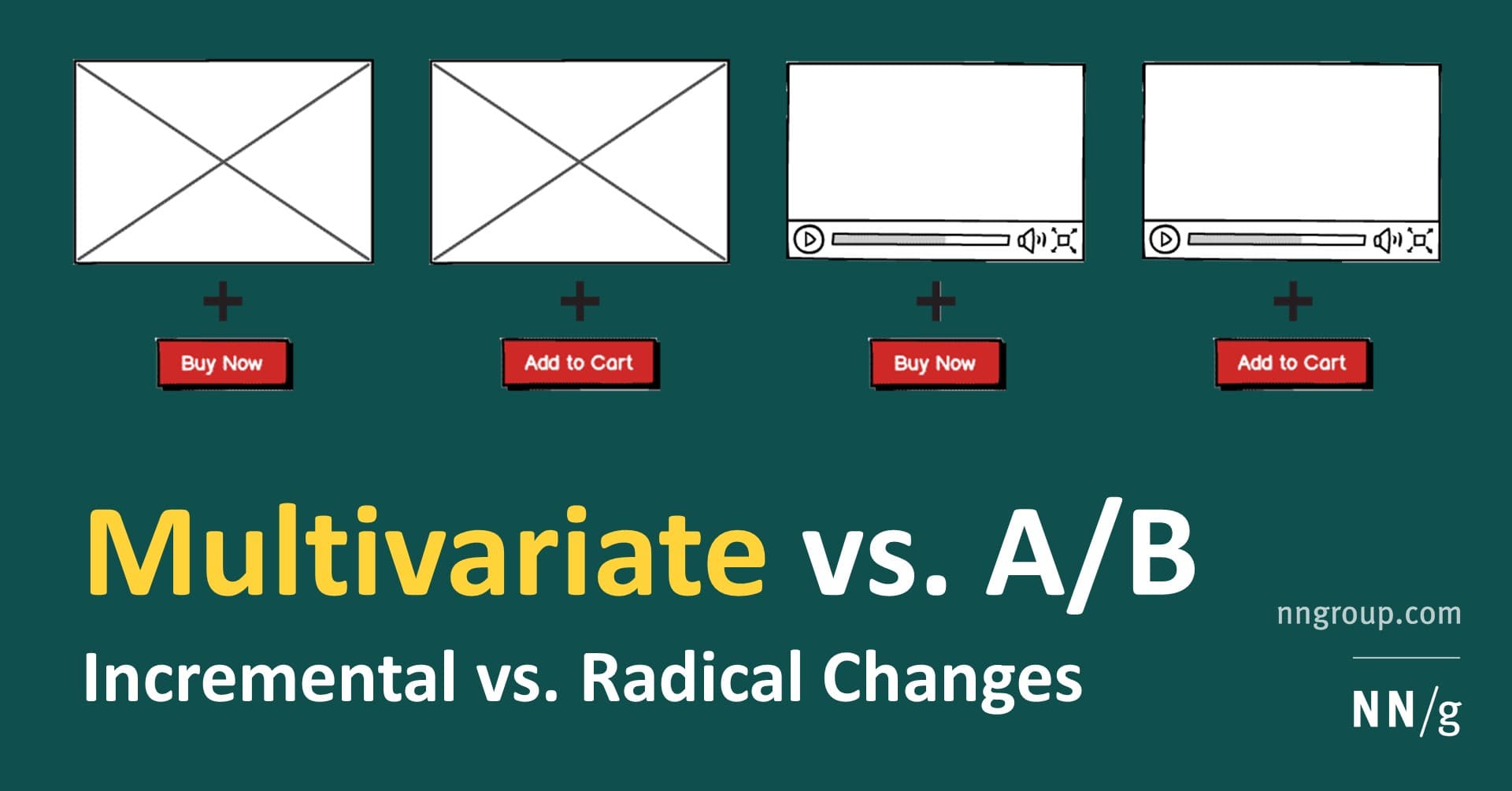
An e-commerce site wants to optimize its product page. They test two variables: the product visual (variants: static image vs. video) and the call-to-action label (variants: "Add to Cart" vs. "Buy Now"). This creates four variations to test. The MVT reveals not only if video is better than an image overall, but which specific combination, like video + "Add to Cart", drives the most conversions.

Interview question

What unique insight does Multivariate Testing (MVT) provide compared to a simple A/B test?

  • a.It reveals how different UI elements interact to influence user behavior.Correct
  • b.It determines the overall best-performing radical redesign for a page.
  • c.It quickly yields statistically significant results with minimal user traffic.
  • d.It is best suited for initial testing of entirely new page concepts.
Why?

MVT's core purpose is to understand how multiple UI elements interact and contribute to an outcome, which A/B tests cannot do. It is explicitly stated not to be for radical redesigns or low-traffic scenarios, making those options incorrect.

Just read this? Test yourself on what you have been reading.

Read the original → nngroup.com

You just looked this up. Could you explain it out loud?

That is the part interviews actually test. Tezvyn takes questions like this one and gives you what the interviewer is really checking, the answer that lands, and the mistake that ends the conversation, in the four minutes before your next meeting.

The iPhone app is on the way

We are building it. Until it lands, nothing here is held back from you: every interview card, your saved cards, streaks and the job board all work in Safari, plus hundreds of free practice quizzes of thirty questions each. Sign in and it all carries over to the app the day it arrives.

Want it as an icon? Tap Share at the bottom of Safari, then Add to Home Screen. It opens full screen and the cards you have read stay available offline.

Get it on Google PlayiPhone app coming soon

We are hiring for this. Open roles that interview on ux — each one lists the topics its interview covers.

See open roles