Open Card Sorting: Map Your User's Brain
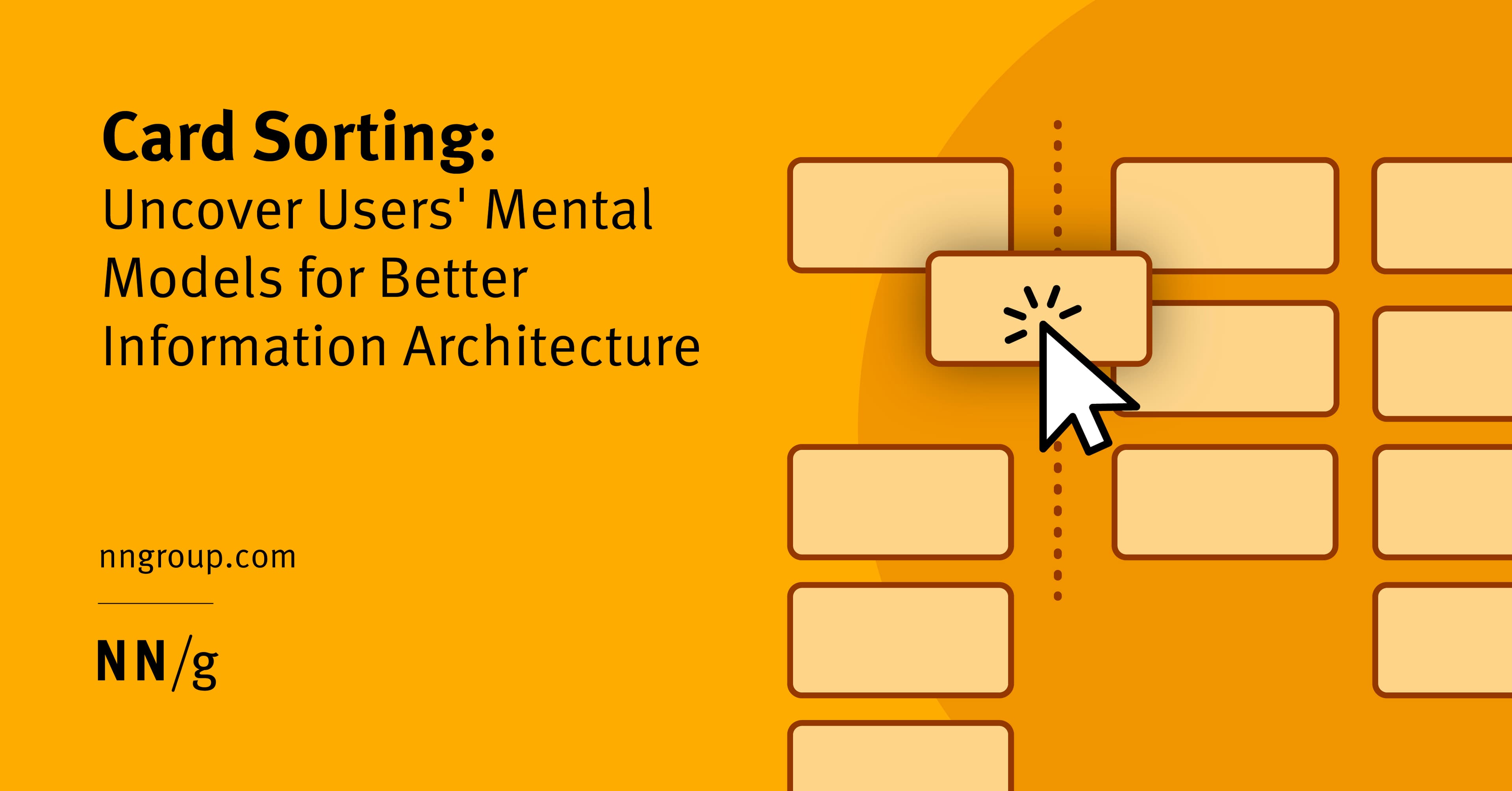
Open card sorting reveals how users mentally group your content. You give them topics on cards and ask them to sort them into groups they create and name. It's ideal for designing intuitive navigation.
Why it exists
Internal teams often organize a website based on company structure or technical jargon, not user logic. This creates a disconnect where users can't find what they're looking for. Open card sorting was invented to systematically uncover users' own mental models for organizing information, providing a foundation for an intuitive site structure.
The mental model
Think of it as observing someone organize your messy garage. You give them a pile of items (your site's content on cards) and ask them to put things into boxes and label the boxes themselves. You're not looking for one 'right' way to organize; you're looking for patterns in how different people create order from your chaos.
How it works
The process has four steps. First, you prepare 30-50 'cards,' each representing a single page, topic, or feature. Second, you ask a participant to sort these cards into piles that make sense to them. Third, you have them create a name for each pile they made. This step is what makes the sort 'open.' Finally, you analyze the data across all participants, often with specialized software, to identify common groupings and popular category names.
When to use it
Use open card sorting when designing a new information architecture from scratch or when redesigning a site that users find confusing. It's perfect for discovering how to group content, products, or services in a way that feels natural to your audience, helping you build navigation that works.
When not to use it
Do not use card sorting to evaluate an existing site structure; a method called tree testing is better for that. The method's value also depends entirely on the quality of the cards. If your card labels are ambiguous or poorly chosen, you will get ambiguous and useless results (garbage in, garbage out).
One canonical example
A car rental company wants to categorize its 26 vehicle models. Instead of using industry terms like 'economy' and 'full-size,' they run an open card sort. Participants get cards for each car. They might create groups like 'Family Trips,' 'Good on Gas,' and 'Off-Road Fun.' This reveals that users think in terms of goals and use cases, not technical classifications, providing a clear, user-centered direction for the website's navigation.
Interview question
For which scenario is open card sorting most appropriate?
- a.Assessing the usability of an existing website's navigation menu.
- b.Prioritizing new features to be added to an application.
- c.Discovering how users intuitively group content for a new site structure.Correct
- d.Deciding on the visual hierarchy and layout of individual web pages.
Why? this is the answer
Open card sorting is specifically designed to uncover users' mental models for organizing information, making it ideal for designing new information architectures. It is not used for evaluating existing site structures, which is better handled by methods like tree testing.
Just read this? Test yourself on what you have been reading.
Read the original → nngroup.com
- #ux research
- #information architecture
- #mental models
You just looked this up. Could you explain it out loud?
That is the part interviews actually test. Tezvyn takes questions like this one and gives you what the interviewer is really checking, the answer that lands, and the mistake that ends the conversation, in the four minutes before your next meeting.
The iPhone app is on the way
We are building it. Until it lands, nothing here is held back from you: every interview card, your saved cards, streaks and the job board all work in Safari, plus hundreds of free practice quizzes of thirty questions each. Sign in and it all carries over to the app the day it arrives.
Want it as an icon? Tap Share at the bottom of Safari, then Add to Home Screen. It opens full screen and the cards you have read stay available offline.
We are hiring for this. Open roles that interview on ux research — each one lists the topics its interview covers.
See open roles