Skip to content
tezvyn:

The Design Critique: Improving Work with Focused Feedback
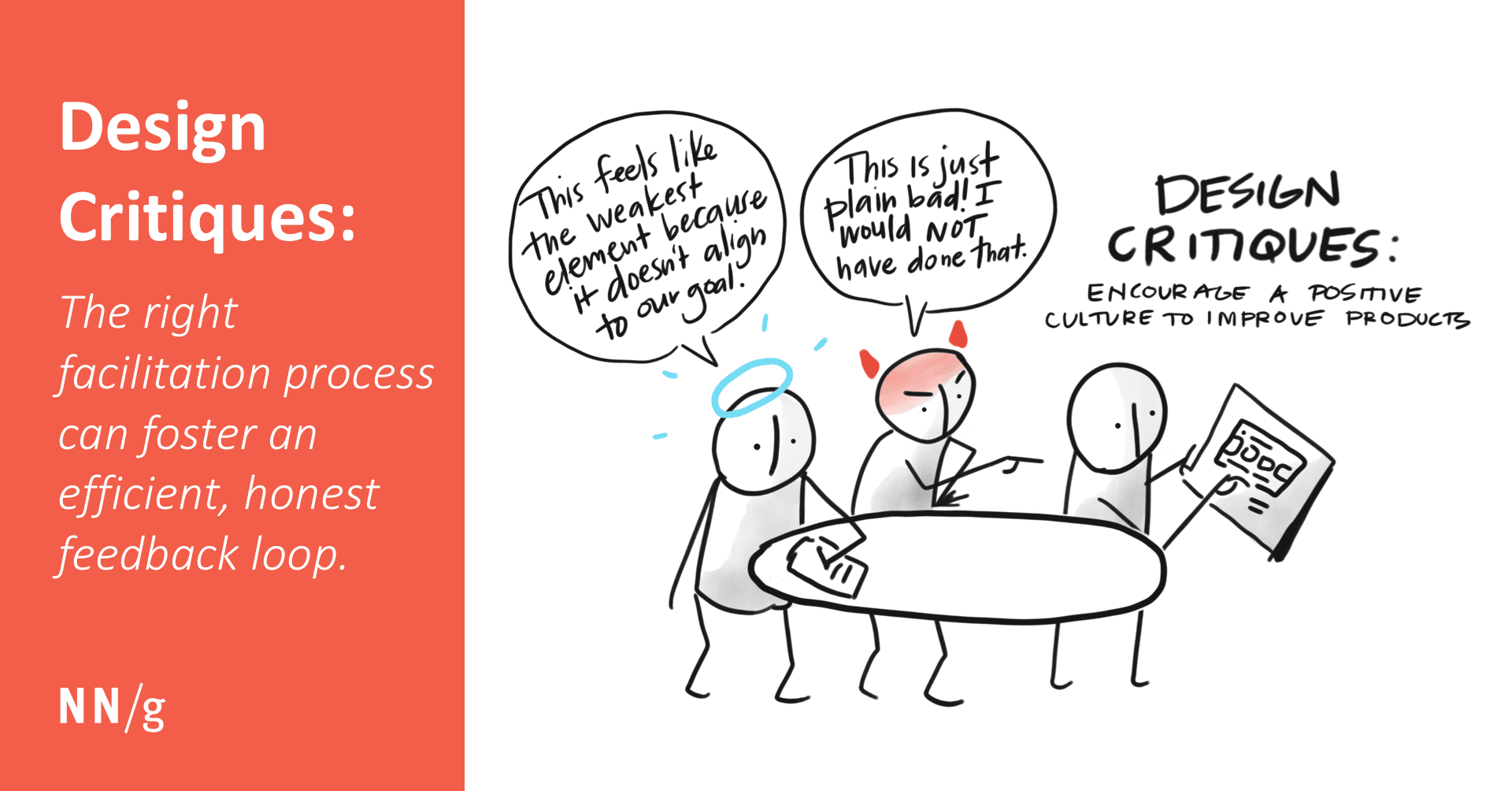
Source: nngroup.comMediumHow cards are made

The Design Critique: Improving Work with Focused Feedback

A design critique is a structured conversation to measure a design against its goals, not a session for subjective opinions. It helps get early feedback on feasibility or catch inconsistencies.

Why it exists

Sharing unfinished work is uncomfortable, but getting feedback is essential to improve it. Without a structured process, feedback sessions can become tense, subjective, and unproductive. Design critiques create a safe, efficient, and honest feedback loop to improve the quality of the final product.

The mental model

Think of a design critique as a collaborative analysis, not a judgment of taste. The group's goal is to analyze whether a design meets its stated objectives. It is a conversation, not a command. The presenter shares the work and its goals, and critiquers offer informed perspectives to help improve it. This is different from a design review, which is typically a final evaluation or approval gate.

How it works

An effective critique has two key roles: the presenter, who shares the design, and the critiquers, who provide feedback. The process hinges on three principles. First, establish a clear scope for the conversation to keep it focused. Second, agree on the design objectives and user needs beforehand; all feedback must be grounded in these goals. Third, foster a conversation rather than issuing commands or directives, which kills open discussion.

When to use it

Use critiques at any stage of the design process, often multiple times for the same design as it iterates. They are perfect for getting early, cross-disciplinary feedback. For example, involving developers early allows them to spot technical feasibility issues before time is wasted. Involving multiple designers helps catch inconsistencies across a large product's overall user experience. This practice also builds team consensus and trust.

When not to use it

Avoid using the critique format for final sign-offs or approvals; that's better suited for a 'design review' meeting. A critique is also ineffective if the design's objectives and user problems are not yet defined. Without this foundation, feedback becomes subjective and baseless, leading to arguments based on personal taste rather than user needs.

One canonical example

A designer is working on a new checkout flow and holds a critique with another designer, a PM, and an engineer. The presenter first states the goals: 'Reduce checkout time by 15% for guest users.' They then walk through the wireframes. The engineer points out that a proposed API for address validation is costly and might slow down the page, suggesting an alternative. The other designer notes that a button style is inconsistent with other parts of the app. The feedback is specific and tied directly to the stated goals and system constraints.

Interview question

Which statement best highlights the fundamental difference between a design critique and a design review?

  • a.A design critique is an informal brainstorming session, while a design review is a structured meeting for project updates.
  • b.A design critique is conducted by a single designer, while a design review involves the entire design team.
  • c.A design critique aims to collaboratively improve a design, while a design review serves as a gate for final evaluation and approval.Correct
  • d.A design critique focuses on gathering subjective opinions, whereas a design review assesses objective metrics.
Why?

The card states that a design critique is a collaborative analysis to improve a design, while a design review is a final evaluation or approval gate. Option D is incorrect because the card explicitly states that critiques are not for subjective opinions but for measuring against goals.

Just read this? Test yourself on what you have been reading.

Read the original → nngroup.com

You just looked this up. Could you explain it out loud?

That is the part interviews actually test. Tezvyn takes questions like this one and gives you what the interviewer is really checking, the answer that lands, and the mistake that ends the conversation, in the four minutes before your next meeting.

The iPhone app is on the way

We are building it. Until it lands, nothing here is held back from you: every interview card, your saved cards, streaks and the job board all work in Safari, plus hundreds of free practice quizzes of thirty questions each. Sign in and it all carries over to the app the day it arrives.

Want it as an icon? Tap Share at the bottom of Safari, then Add to Home Screen. It opens full screen and the cards you have read stay available offline.

Get it on Google PlayiPhone app coming soon

We are hiring for this. Open roles that interview on ui design — each one lists the topics its interview covers.

See open roles