The Hybrid GTM Model: PLG Meets Enterprise Sales
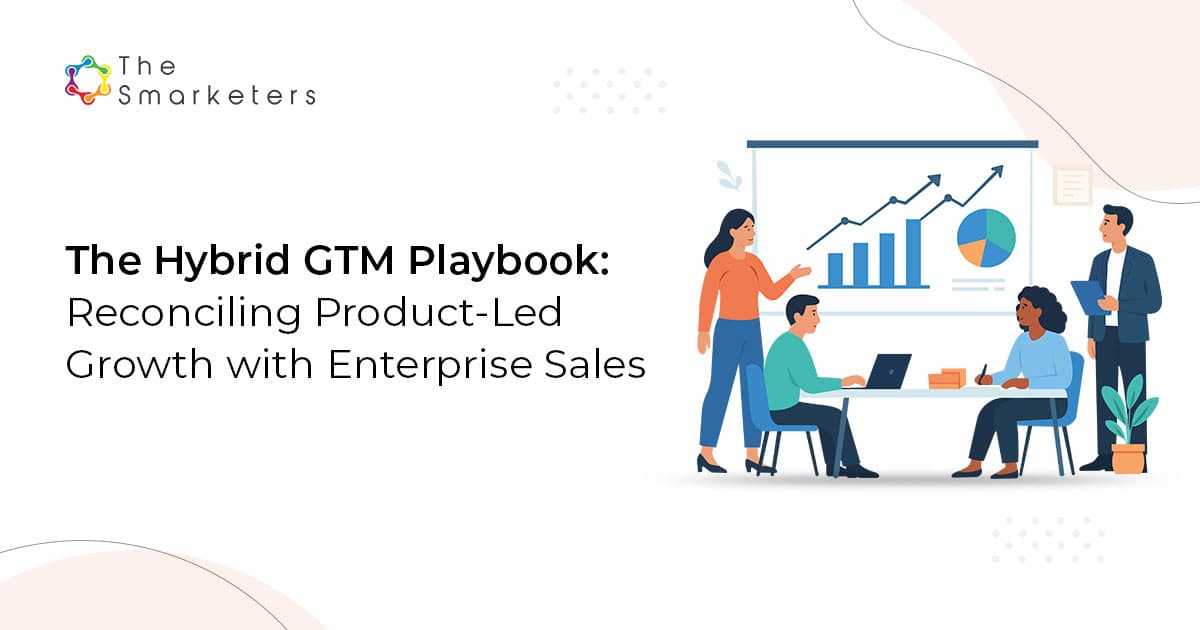
A hybrid go-to-market model blends a self-serve product with a sales team, letting users start on their own and bringing in sales for big deals. B2B SaaS uses this for efficiency, but the footgun is creating friction if the handoff isn't seamless.
Why it exists
Pure product-led growth (PLG) struggles to capture high-value enterprise deals, while a pure sales-led motion is expensive and ignores the modern buyer's expectation of a self-serve trial. As venture funding tightens and customer acquisition costs rise, B2B companies need a more efficient way to grow. The hybrid model was born from this pressure to serve both small-scale users and large enterprises efficiently.
The mental model
Think of a hybrid GTM as two tracks sharing one product. Track one is a low-friction, self-serve highway for individuals and small teams who can sign up and pay with a credit card. Track two is a high-touch, guided lane for large enterprise accounts. The system's intelligence lies in building well-marked on-ramps from the highway to the guided lane when an account shows signs of high potential.
How it works
A user signs up for a free or low-cost plan. The system monitors product usage for signals that indicate expansion potential, like adding many users, hitting feature limits, or collaborating across departments. When an account crosses a predefined threshold, it becomes a Product-Qualified Lead (PQL) or Product-Qualified Account (PQA). This triggers a handoff to the sales team, who then engages with a warm, context-aware conversation about the value of an enterprise plan, not a generic cold call.
When to use it
This model is ideal for B2B SaaS companies where the product provides immediate value to an individual but becomes more valuable as it spreads through an organization. It's a fit for companies in the 10M-200M ARR range whose product can act as its own lead generation engine, attracting users who eventually need a larger, sales-assisted contract.
When not to use it
A hybrid model is overkill for products with no enterprise use case or for complex software that requires months of guided implementation and has no viable self-serve entry point. If your Annual Contract Value (ACV) is consistently too low to support the cost of a sales team, a pure PLG motion is more economical.
One canonical example
A company like Slack allows teams to start for free. As an organization's usage grows, they add more users and share more data, eventually needing features like single sign-on, compliance exports, and dedicated support. This organic usage pattern signals a PQA. Slack's sales team can then approach the company with a data-backed proposal for an upgrade to their Enterprise Grid plan, turning bottom-up adoption into a top-down, high-value contract.
Interview question
For which B2B SaaS scenario is a Hybrid Go-to-Market (GTM) model most appropriate?
- a.The product has a very low Annual Contract Value (ACV) and primarily targets individual users without an enterprise upgrade path.
- b.The product offers immediate value to individuals but gains significant organizational value, generating product-qualified leads for sales.Correct
- c.The company seeks to eliminate all sales team expenses by relying solely on self-serve acquisition for all customer segments.
- d.The software requires extensive, months-long implementation and is exclusively sold to large enterprises.
Why? this is the answer
The hybrid GTM model is ideal when a product provides immediate value to individuals but becomes more valuable as it spreads through an organization, allowing sales to engage with warm, product-qualified leads. Options A and D describe scenarios better suited for a pure PLG model due to low ACV or a desire to eliminate sales, while option D describes a complex product requiring a pure sales-led approach from the start.
Just read this? Test yourself on what you have been reading.
Read the original → thesmarketers.com
- #go-to-market
- #plg
- #b2b
- #sales
- #growth
You just looked this up. Could you explain it out loud?
That is the part interviews actually test. Tezvyn takes questions like this one and gives you what the interviewer is really checking, the answer that lands, and the mistake that ends the conversation, in the four minutes before your next meeting.
The iPhone app is on the way
We are building it. Until it lands, nothing here is held back from you: every interview card, your saved cards, streaks and the job board all work in Safari, plus hundreds of free practice quizzes of thirty questions each. Sign in and it all carries over to the app the day it arrives.
Want it as an icon? Tap Share at the bottom of Safari, then Add to Home Screen. It opens full screen and the cards you have read stay available offline.
We are hiring for this. Every open role lists the topics its interview covers, so you can prepare for the real thing rather than guessing.
See open roles