The K-Factor: Measuring Your Product's Viral Growth
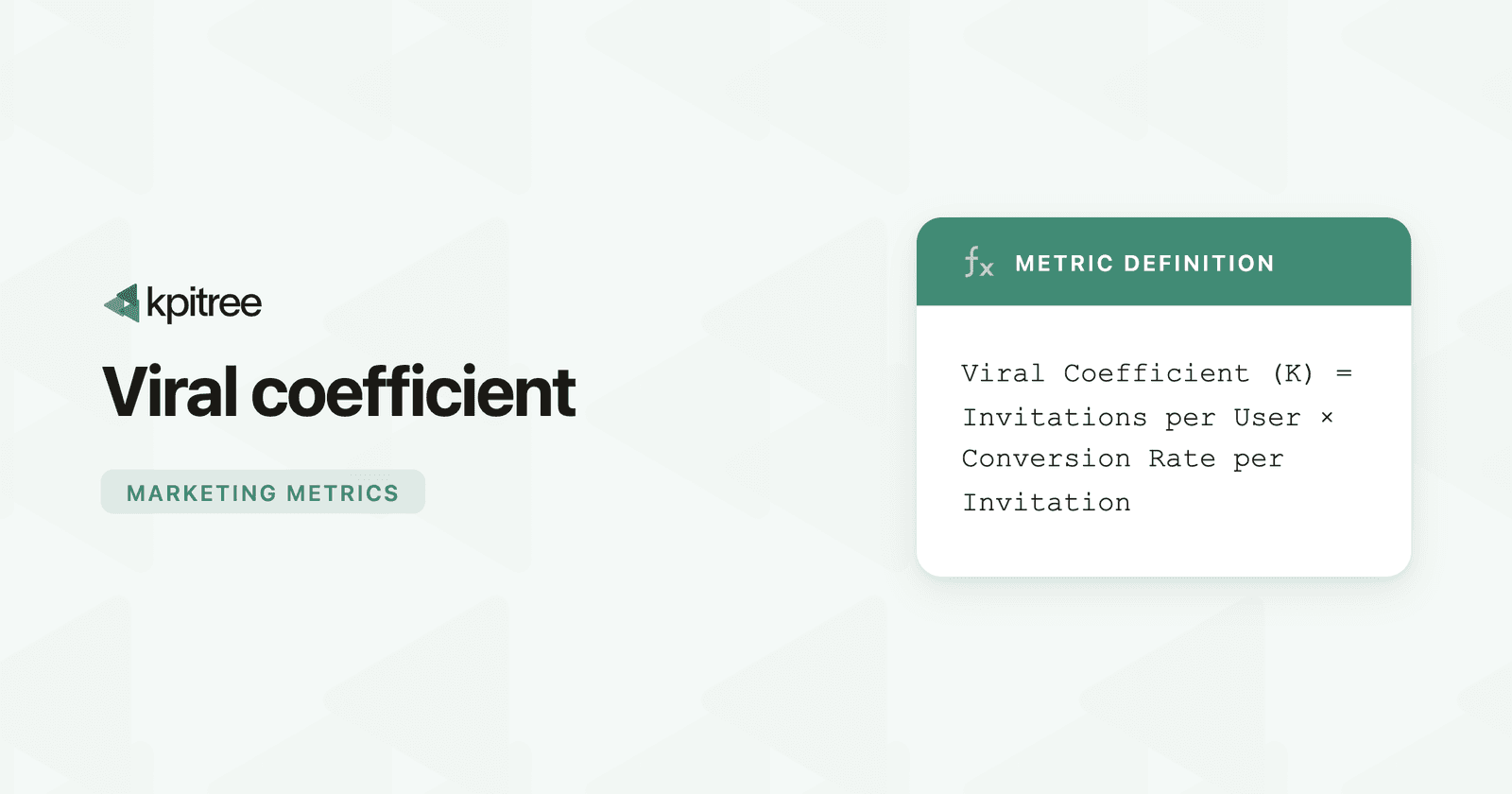
The Viral Coefficient (K-factor) measures how many new users each existing user generates. It's key for products with referrals or sharing. The common mistake is chasing K > 1; even K=0.5 is valuable, as it effectively halves your acquisition cost.
Why it exists
To quantify a product's organic, user-driven growth. Instead of just saying "we have word-of-mouth," the K-factor puts a number on it, allowing teams to measure and improve how effectively users spread the product. It separates the growth that comes from existing users from the growth that comes from paid marketing.
The mental model
Think of it like the R0 number in epidemiology. If an infected person (an existing user) infects, on average, 0.5 other people (new users), the disease (your product) won't spread exponentially on its own but will still have a significant reach beyond the initial group. The K-factor measures this "contagiousness" of your product.
How it works
The formula is K = (Invitations per User) × (Conversion Rate per Invitation). If an average user sends 5 invites and 10% of those people sign up, your K-factor is 5 * 0.10 = 0.5. This means every two users bring in one additional user for free. This metric must be paired with the Viral Cycle Time—the time it takes for a new user to invite others—as a fast cycle time with K=0.8 grows much faster than a slow one.
When to use it
Use the K-factor to measure the effectiveness of referral programs, sharing features, and collaborative loops. It's a key metric for consumer apps like Dropbox and B2B tools like Slack where inviting others is part of the experience. It helps justify investment in these features by showing how they reduce the blended customer acquisition cost (CAC).
When not to use it
Don't apply it to products with no natural mechanism for users to invite or share. A single-player, offline utility app or a highly specialized enterprise tool sold via a traditional sales force won't have a meaningful K-factor. Focusing on it in these contexts is a distraction from more relevant growth levers.
One canonical example
Early Dropbox offered users extra storage for referring friends. If a user invited an average of 4 friends (Invitations = 4) and 25% of those friends installed Dropbox to get their own bonus storage (Conversion = 0.25), the K-factor was 4 * 0.25 = 1.0. This meant every user brought in exactly one new user, creating powerful growth. Even when K is below 1.0, it still dramatically amplifies other growth efforts.
Interview question
What is a key implication of a product achieving a K-factor of 0.5?
- a.The product will experience exponential growth, even without further marketing efforts.
- b.It significantly reduces the blended customer acquisition cost by generating free users.Correct
- c.Each existing user, on average, generates one new user, doubling the user base over time.
- d.It primarily indicates that the product's viral cycle time is exceptionally fast.
Why? this is the answer
The card highlights that even a K-factor of 0.5 is valuable because it effectively halves the acquisition cost by generating free users. Exponential growth requires a K-factor greater than 1, making option A incorrect.
Just read this? Test yourself on what you have been reading.
Read the original → kpitree.co
You just looked this up. Could you explain it out loud?
That is the part interviews actually test. Tezvyn takes questions like this one and gives you what the interviewer is really checking, the answer that lands, and the mistake that ends the conversation, in the four minutes before your next meeting.
The iPhone app is on the way
We are building it. Until it lands, nothing here is held back from you: every interview card, your saved cards, streaks and the job board all work in Safari, plus hundreds of free practice quizzes of thirty questions each. Sign in and it all carries over to the app the day it arrives.
Want it as an icon? Tap Share at the bottom of Safari, then Add to Home Screen. It opens full screen and the cards you have read stay available offline.
We are hiring for this. Open roles that interview on growth — each one lists the topics its interview covers.
See open roles