Skip to content
tezvyn:

UX Sampling: Convenience vs. Probability
Source: nngroup.comMediumHow cards are made

UX Sampling: Convenience vs. Probability

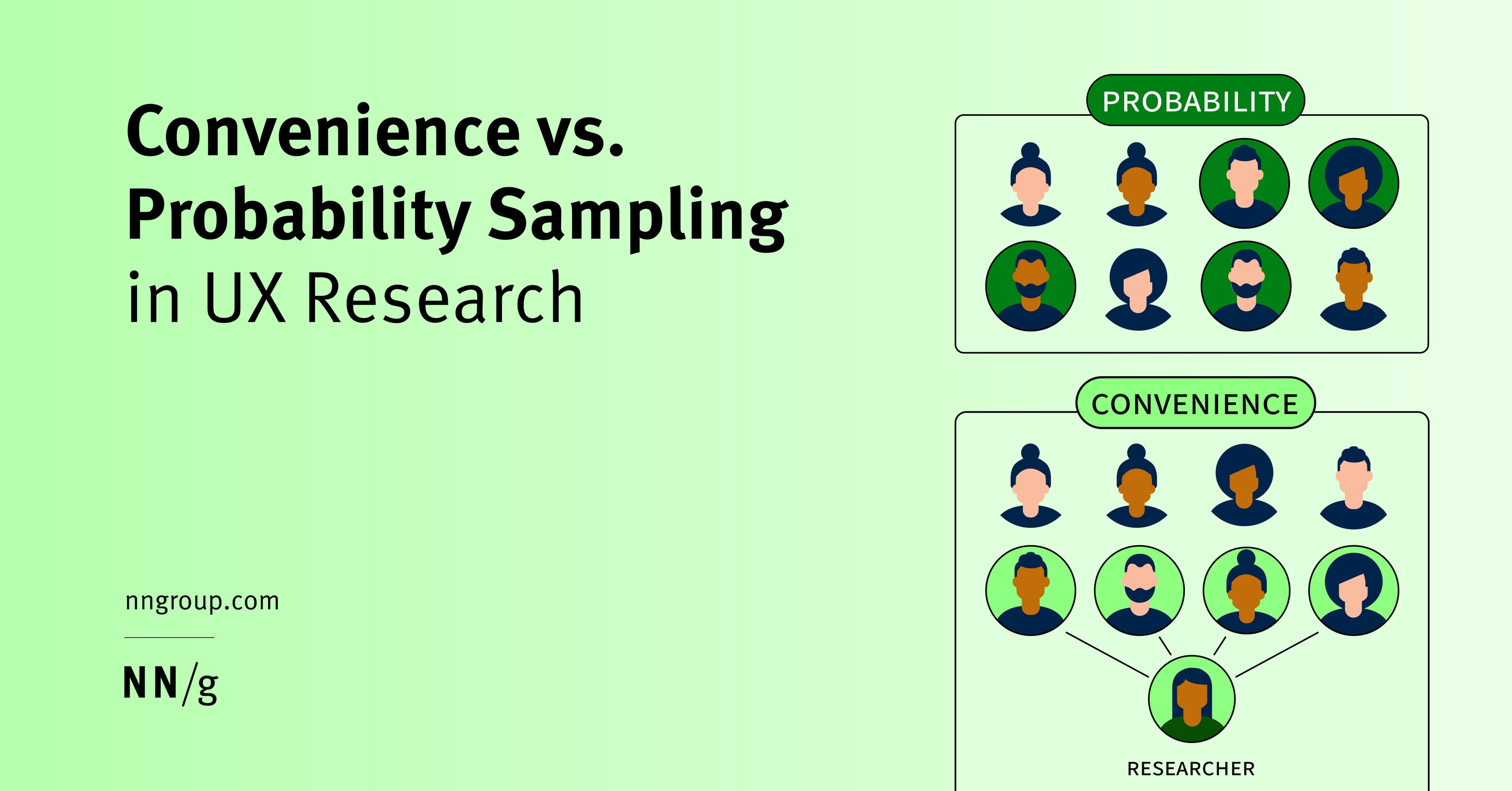
Convenience sampling is fast and cheap—ask whoever is easy to reach. Probability sampling is rigorous—ask a random slice of your population. Use convenience for quick usability tests, but probability for high-stakes decisions.

Why it exists

To ensure research findings are useful and reliable by selecting the right participants. The choice between a fast, cheap sample and a rigorous, representative one determines the confidence you can have in your results and whether they apply to your entire user base.

The mental model

Convenience sampling is like asking friends for feedback on a new recipe—it's fast and easy, but their tastes might not represent the general public. Probability sampling is like conducting a formal taste test with randomly selected people from the phone book—it's slower and more expensive, but the results are more likely to predict how the general public will react.

How it works

Convenience sampling involves nonrandom selection of participants who are readily available, such as from a company email list, a user panel, or a website intercept. Not everyone in the target population has an equal chance of being selected. Probability sampling uses random selection, where every person in the target population has a known, non-zero chance of being included. This randomness is powerful because it helps balance unmeasured differences across participants, like personality, cultural background, or emotional state, reducing hidden biases.

When to use it

Use convenience sampling for most day-to-day UX research. It's fast, cost-effective, and sufficient for identifying major usability issues and patterns in user behavior. It's ideal for formative studies where you need quick feedback to iterate on a design.

When not to use it

Avoid convenience sampling when you need high confidence that your findings accurately represent a broader user population. For strategic decisions, major product changes, or when results must be generalizable, use probability sampling. A common mistake is using quotas (e.g., 5 users per age group) and thinking it makes a convenience sample random; it doesn't, as hidden biases still exist in how those 5 users were selected.

One canonical example

A team wants to know if a new checkout flow is confusing. Using convenience sampling, they recruit participants from an existing user-research panel. This is fast and effectively identifies the most glaring usability problems. However, if the company were deciding whether to enter a new market, they would need probability sampling to survey a random, representative sample of that market to get a generalizable answer about potential demand.

Interview question

For which scenario would a UX researcher most appropriately choose probability sampling over convenience sampling?

  • a.To recruit participants from an existing user panel to save time and resources.
  • b.To gather rapid feedback for iterating on a design during a formative study.
  • c.To make a high-stakes strategic decision requiring findings generalizable to an entire user base.Correct
  • d.To quickly identify glaring usability problems in a new checkout flow.
Why?

Probability sampling is essential for high-stakes strategic decisions where findings must be generalizable to a broader population. Options A, B, and D describe situations where convenience sampling is recommended due to its speed and cost-effectiveness for identifying usability issues or getting quick feedback.

Just read this? Test yourself on what you have been reading.

Read the original → nngroup.com

You just looked this up. Could you explain it out loud?

That is the part interviews actually test. Tezvyn takes questions like this one and gives you what the interviewer is really checking, the answer that lands, and the mistake that ends the conversation, in the four minutes before your next meeting.

The iPhone app is on the way

We are building it. Until it lands, nothing here is held back from you: every interview card, your saved cards, streaks and the job board all work in Safari, plus hundreds of free practice quizzes of thirty questions each. Sign in and it all carries over to the app the day it arrives.

Want it as an icon? Tap Share at the bottom of Safari, then Add to Home Screen. It opens full screen and the cards you have read stay available offline.

Get it on Google PlayiPhone app coming soon

We are hiring for this. Open roles that interview on ux research — each one lists the topics its interview covers.

See open roles