What is CI, and what is its single most important goal?
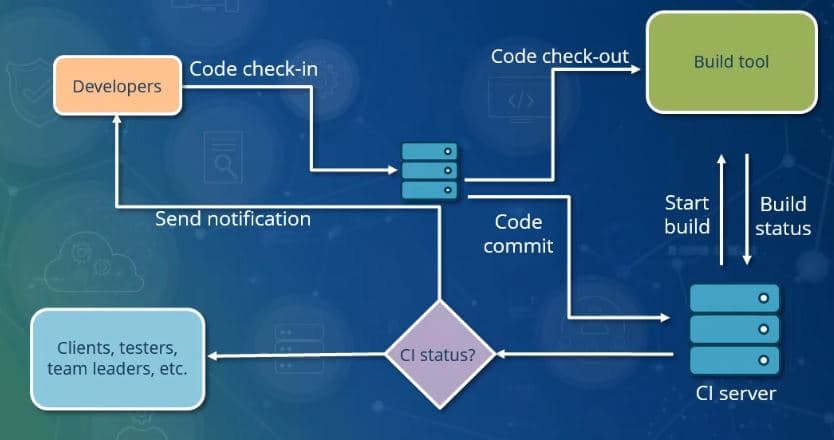
Distinguishing CI as keeping code workable, not just builds.
Frequent merges to a shared branch with automated build and test; top goal is a workable integrated codebase.
What's really being asked
This question tests whether you understand Continuous Integration as a software engineering practice rather than a specific tool or pipeline stage. Interviewers want to see that you separate the mechanism, automated builds and tests, from the intent, keeping the integrated codebase healthy. It also checks if you can state the single most important goal without drifting into Continuous Delivery or Deployment.
The full answer
A strong answer hits four things in order. First, define CI as the practice of integrating source code changes frequently, usually by merging into a shared integration branch. Second, note that an automated system builds and tests the software, running on each commit or on a schedule such as daily. Third, explicitly state that the single most important goal is ensuring the integrated codebase remains in a workable state at all times. Fourth, optionally mention that Grady Booch first proposed the term in 1991 and that the practice later evolved to include integrating multiple times per day.
The mistakes people make
The biggest red flag is conflating CI with CD by saying the goal is deploying to production or releasing software. Another mistake is listing tools like Jenkins, GitHub Actions, or CircleCI without defining the practice itself. Some candidates describe CI as merely running unit tests or linting, which misses the integration aspect. Saying the goal is finding bugs fast is partially true but secondary; the core objective is codebase workability.
What usually comes next
An interviewer might ask how often a team should integrate, what makes a build green versus red, or how CI relates to trunk-based development. They may probe on what workable state means in practice, such as whether it requires all tests to pass or merely successful compilation. Be ready to explain the difference between CI, Continuous Delivery, and Continuous Deployment in one sentence each.
A concrete example
Imagine a team of eight developers working on a monorepo. Without CI, each developer works on a feature branch for a week and merges on Friday, causing a day of merge conflicts and broken builds. With CI, every developer merges to the main branch at least once daily. The automated pipeline compiles the application, runs the test suite, and reports status within ten minutes. If the build fails, the team stops and fixes it immediately because the integrated codebase is no longer workable. The goal is not to deploy that day; it is to know that the code on the integration branch is always in a valid, buildable, testable state.
Interview question
A team merges into a shared branch daily with automated builds and tests. What is the single most important goal of this Continuous Integration practice?
- a.Automatically deploying every passing build to production
- b.Catching bugs immediately after they are introduced
- c.Keeping the integrated codebase in a workable state at all timesCorrect
- d.Automating builds and tests to reduce manual integration work
Why? this is the answer
The defining goal of CI is maintaining a workable integrated codebase, not deployment, which is the realm of CD. While automation and bug detection are part of the practice, they are mechanisms and secondary benefits rather than the core objective.
Just read this? Test yourself on what you have been reading.
Read the original → en.wikipedia.org
- #ci/cd
- #continuous integration
- #devops
- #software engineering
- #automation
You just looked this up. Could you explain it out loud?
That is the part interviews actually test. Tezvyn takes questions like this one and gives you what the interviewer is really checking, the answer that lands, and the mistake that ends the conversation, in the four minutes before your next meeting.
The iPhone app is on the way
We are building it. Until it lands, nothing here is held back from you: every interview card, your saved cards, streaks and the job board all work in Safari, plus hundreds of free practice quizzes of thirty questions each. Sign in and it all carries over to the app the day it arrives.
Want it as an icon? Tap Share at the bottom of Safari, then Add to Home Screen. It opens full screen and the cards you have read stay available offline.
We are hiring for this. Open roles that interview on ci/cd — each one lists the topics its interview covers.
See open roles