Why Svelte Skips the Virtual DOM
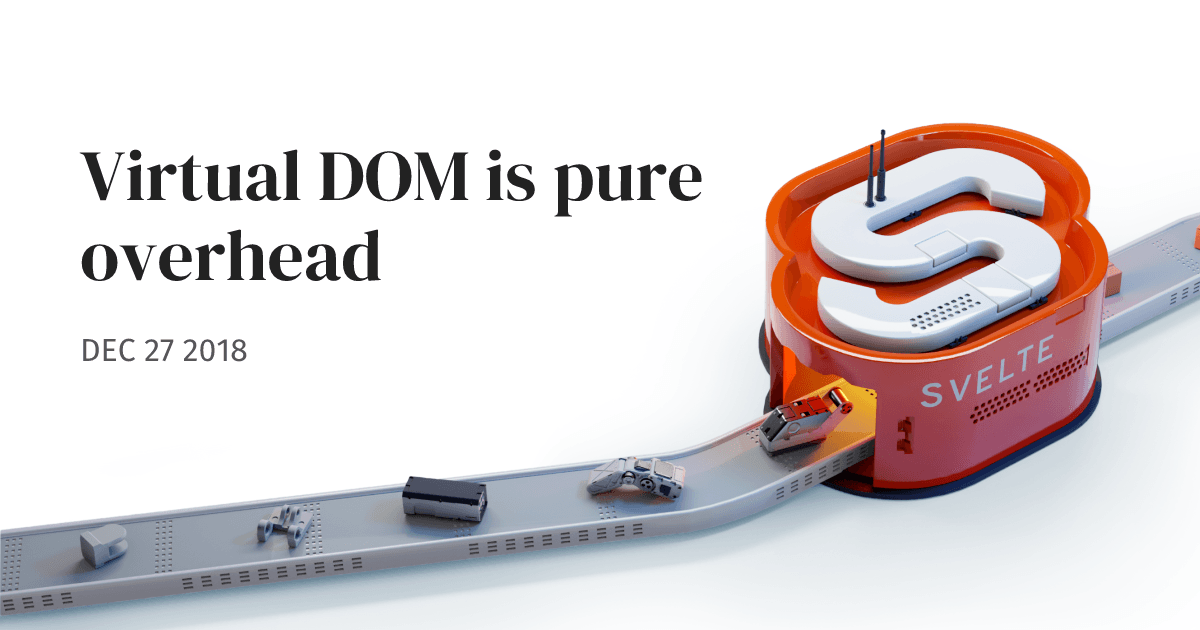
Svelte skips the Virtual DOM, treating it as runtime overhead. It acts as a compiler, generating precise JavaScript to update the DOM directly. This avoids the 'diffing' step of frameworks like React, leading to smaller bundles and faster updates.
Why it exists
The Virtual DOM (VDOM) was introduced to simplify UI development by letting developers re-render an entire app on any state change without worrying about performance. However, this abstraction isn't free. Comparing a new VDOM tree to an old one, an operation called "diffing", is computational work that happens at runtime, before the real DOM is even touched. Svelte was created to eliminate this runtime overhead.
The mental model
Think of the VDOM as a manager who, on every change, reads two full blueprints (old and new) and compares them line-by-line to create a short list of instructions for the construction worker (the real DOM). Svelte is like a brilliant architect who gives the worker a pre-written, reactive playbook. When a specific change happens, like the door color changing, the worker just flips to the correct page and instruction ('paint door blue') and does it directly. Svelte is the architect, not the manager.
How it works
Svelte is a compiler, not a runtime library. During your build process, the Svelte compiler parses your component files. It sees which variables are reactive and how they are used in your template. It then generates highly optimized, vanilla JavaScript code. This output code includes functions that directly manipulate the DOM when a specific piece of state changes. For example, if a variable name changes, Svelte generates code like element.textContent = name;, not code that triggers a full VDOM diff. It skips the intermediate representation entirely.
When to use it
Use Svelte when bundle size and startup performance are critical. It excels in resource-constrained environments like mobile devices or for building standalone components to be dropped into other applications, as it has minimal runtime dependencies. Its surgical updates make it very efficient for highly interactive visualizations or animations where VDOM overhead could cause frame drops.
When not to use it
The primary tradeoff is the mandatory build step. If you need to quickly add interactivity to a static HTML page without a build process, a library like Alpine.js or even vanilla JS might be a better fit. While its ecosystem is mature, it is smaller than React's, which might be a factor for large enterprise teams needing vast libraries of pre-built components or specific tooling.
One canonical example
In a VDOM framework like React, changing a name prop from 'world' to 'everybody' in Hello {name} triggers a diff. The runtime compares the old and new VDOM objects, checks the element type (p), checks its props, and finally discovers the text content changed before updating the real DOM. In Svelte, the compiler sees name is reactive and generates code that, upon name changing, directly executes a command like p_element.childNodes[0].nodeValue = 'Hello ' + name;. There is no diffing, only the direct, necessary update.
Interview question
How does Svelte fundamentally differ from Virtual DOM-based frameworks in its approach to updating the user interface?
- a.Svelte tracks component state changes at runtime and then uses a custom diffing algorithm to update the real DOM.
- b.Svelte uses a highly optimized, lightweight Virtual DOM that performs diffing only on critical changes.
- c.Svelte relies on browser-native Shadow DOM features to manage updates, avoiding manual DOM manipulation.
- d.Svelte compiles components into vanilla JavaScript that directly modifies the DOM based on state changes, eliminating runtime diffing.Correct
Why? this is the answer
Svelte is a compiler that generates highly optimized JavaScript to directly update the DOM when state changes, completely bypassing the Virtual DOM and its runtime diffing process. Option B is incorrect because Svelte eliminates the VDOM entirely, it doesn't optimize it.
Just read this? Test yourself on what you have been reading.
Read the original → svelte.dev
You just looked this up. Could you explain it out loud?
That is the part interviews actually test. Tezvyn takes questions like this one and gives you what the interviewer is really checking, the answer that lands, and the mistake that ends the conversation, in the four minutes before your next meeting.
The iPhone app is on the way
We are building it. Until it lands, nothing here is held back from you: every interview card, your saved cards, streaks and the job board all work in Safari, plus hundreds of free practice quizzes of thirty questions each. Sign in and it all carries over to the app the day it arrives.
Want it as an icon? Tap Share at the bottom of Safari, then Add to Home Screen. It opens full screen and the cards you have read stay available offline.
We are hiring for this. Open roles that interview on svelte — each one lists the topics its interview covers.
See open roles