Your build times increased significantly. How do you investigate and optimize?
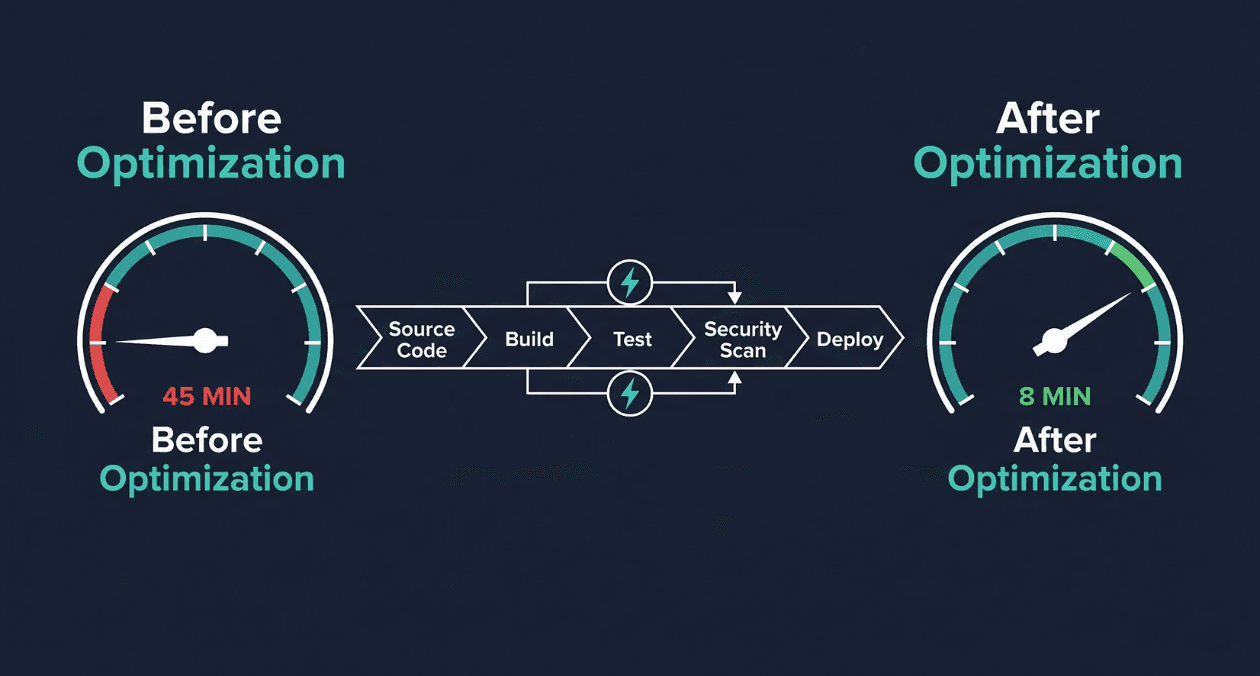
Tests methodical CI/CD bottleneck analysis and build optimization tactics. Strong answers baseline the timeline, isolate the slowest stage with metrics, then apply parallelism, caching, or dependency pruning.
What's really being asked
Your ability to treat a build pipeline like a distributed system and debug it with metrics rather than intuition. Interviewers want to see that you isolate variables, understand the difference between infrastructure limits and algorithmic inefficiency, and can prioritize fixes by impact.
The full answer
First, establish a baseline by checking historical build durations in your CI dashboard to pinpoint when the regression started. Second, decompose the pipeline into discrete stages such as dependency installation, compilation, static analysis, unit tests, integration tests, artifact packaging, and deployment, then measure each stage's wall-clock time. Third, apply targeted optimizations in order of impact: one, parallelize independent jobs across runners or shards so tests and builds run concurrently rather than sequentially; two, implement aggressive caching for dependencies, Docker layers, and compiled objects so repeated work is skipped; three, prune unnecessary work by running only affected tests via change detection, removing redundant linters, and shrinking artifact sizes. Fourth, verify the fix by comparing the new timeline against the baseline and monitoring for regressions.
The mistakes people make
Jumping straight to throwing money at bigger instances or more CPUs without identifying the actual bottleneck. Proposing a complete CI platform migration as the first step. Suggesting micro-optimizations like compiler flags before ruling out structural problems such as sequential integration tests or un-cached package downloads. Ignoring test suite bloat or artifact sprawl entirely.
What usually comes next
How would you handle a monorepo where a single commit triggers dozens of pipelines? What do you do if test parallelization causes flaky failures due to shared state? How do you balance build speed with security scanning requirements? When does it make sense to move from one-stage builds to multi-stage Docker builds?
A concrete example
A team sees builds jump from twelve minutes to thirty-eight minutes. Investigation shows checkout and compilation stayed flat, but integration test duration tripled because a new module added a heavy database migration that runs before every test. The fix shards the integration tests across four runners using test splitting, caches the seeded database image between runs, and moves the migration to a one-time setup job. Build time drops back to eleven minutes without changing hardware.
Interview question
After establishing a baseline for a build time regression, what is the most effective next step before applying optimizations?
- a.Parallelize independent jobs across additional runners immediately
- b.Decompose the pipeline into discrete stages and measure each stage's wall-clock timeCorrect
- c.Migrate to a faster CI platform with more powerful default runners
- d.Audit compiler flags and build configurations for micro-optimizations
Why? this is the answer
The card stresses measuring each stage to find the actual bottleneck before applying optimizations. A applies parallelism prematurely, B suggests a wasteful platform migration without diagnosis, and D targets micro-optimizations instead of structural issues.
Just read this? Test yourself on what you have been reading.
Read the original → askantech.com
- #ci/cd
- #build-optimization
- #debugging
- #pipeline-performance
- #senior
You just looked this up. Could you explain it out loud?
That is the part interviews actually test. Tezvyn takes questions like this one and gives you what the interviewer is really checking, the answer that lands, and the mistake that ends the conversation, in the four minutes before your next meeting.
The iPhone app is on the way
We are building it. Until it lands, nothing here is held back from you: every interview card, your saved cards, streaks and the job board all work in Safari, plus hundreds of free practice quizzes of thirty questions each. Sign in and it all carries over to the app the day it arrives.
Want it as an icon? Tap Share at the bottom of Safari, then Add to Home Screen. It opens full screen and the cards you have read stay available offline.
We are hiring for this. Open roles that interview on ci/cd — each one lists the topics its interview covers.
See open roles