Intermediate interview questions in AI & ML, page 10

How would GDPR requirements influence experiment tracking and model management design?
Immutable data lineage, user exclusion lists, audit logs, versioned explainability.
Handling outlier activations in INT8 quantization
Profile activation magnitudes to find a few large-magnitude outlier channels, then keep those in higher precision while quantizing the rest, a mixed-precision decomposition.
ML CI/CD versus traditional software CI/CD
Validates code plus data plus the model, auto-trains and evaluates, adds continuous training and monitoring.

How would you version control a 50GB dataset in a CI/CD pipeline?
Contrast Git LFS (simple, but 50GB chokes CI clones) with DVC (git metadata plus S3; enables selective pulls and CI cache).
Mitigating demographic bias in a fine-tuned chatbot
Curate or counterfactually augment training data to balance demographics, plus apply post-hoc guardrails or fairness-constrained fine-tuning.
CPU versus GPU serving: cost, latency, throughput
GPUs win on throughput for batched parallel work but cost more; CPUs suit low-volume or small models.
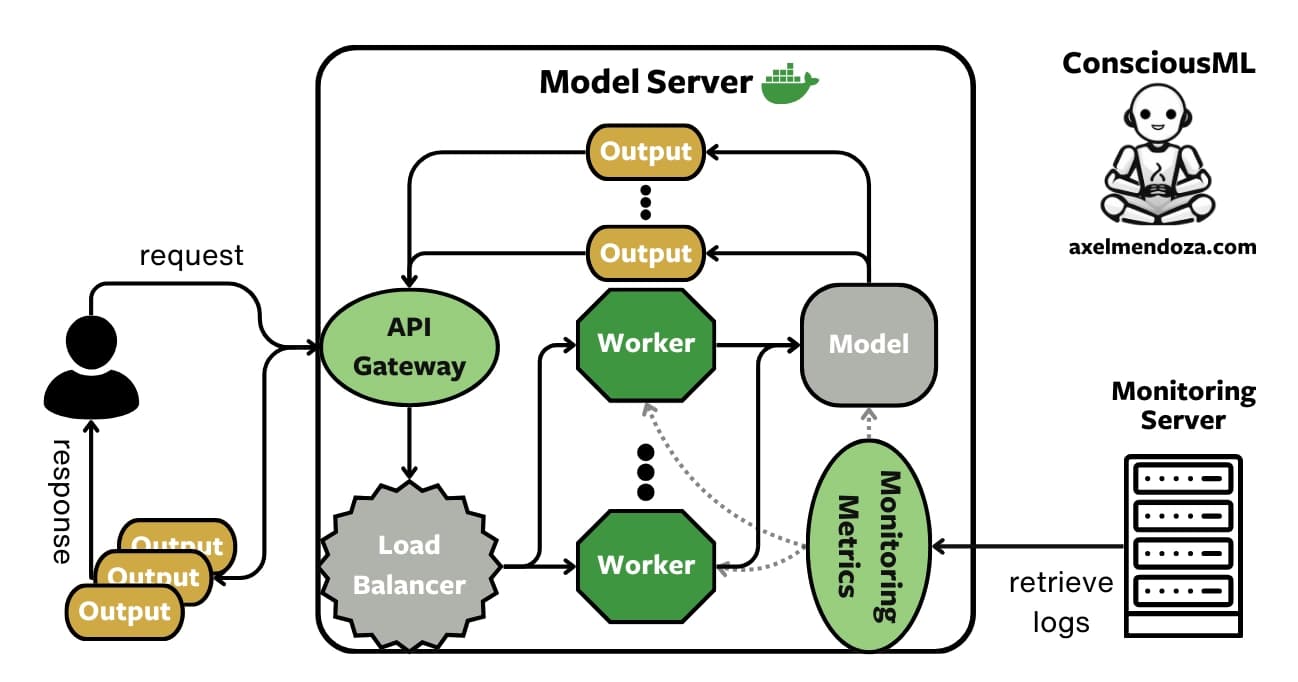
Expose a trained model as a simple web service
Practical MLOps knowledge from model serialization to serving. Package the model into a standard format, containerize it, expose a REST endpoint behind a load balancer, and add monitoring. A bare Flask server without containers or health checks is a red flag.
What is shadow deployment for ML models?
New model receives mirrored live traffic but its predictions are logged, not served; validates real-world behavior and latency without user risk.
Preprocessing conversations to protect privacy before fine-tuning
Detect and redact PII with NER plus regex, choose redaction versus pseudonymization, and validate recall.
Why version data and model artifacts, not just code
Code alone cannot reproduce a model; data and artifact versioning enable rollback, debugging, audit.
How is an HDR radiance map constructed from exposures?
Recover the inverse camera response function from corresponding pixels, linearize each exposure to radiance, then merge with confidence weights into a floating-point radiance map.
Measuring fairness in an embedding-based text classifier
Define group definitions, apply demographic parity and equalized odds, and address noisy labels and implicit group membership.
Feature detector vs feature descriptor.
A detector finds where interesting points are, a descriptor encodes the local appearance around each so points can be matched.

Compare Canary and Blue/Green ML deployments and model-specific metrics
Contrast Canary gradual shift vs Blue/Green instant swap; highlight silent failures, data drift, prediction distribution; cite accuracy and calibration.
Practical explainability for an LLM loan summary
Use attribution-by-design with grounded citations, structured rationales, and a deterministic rules layer instead of slow per-token SHAP.
Why learn detection and description jointly like SuperPoint?
A shared backbone jointly optimizes detection and description for matching, sharing computation and learning data-driven robustness instead of hand-crafted heuristics.

Design a multi-tenant GPU serving system for hundreds of fine-tuned models
Tests GPU memory tradeoffs versus cold-start latency in multi-tenant serving. Strong answers propose tiered CPU staging, predictive pre-warming, and disaggregated prefill and decode. Red flag: keeping all models GPU-resident or ignoring transfer overhead.
What is a model registry and how does it enable CD?
A registry versions models with metadata, lineage, and stage tags; CD watches stage transitions to trigger deploys.
Data lineage and machine unlearning for a fine-tuned LLM
Version and fingerprint datasets, record transforms and which checkpoint saw what, and enable unlearning via retraining, data sharding, or approximate gradient methods.
What is Bundle Adjustment and why is it tractable?
Jointly refine 3D points and camera poses by minimizing reprojection error, expensive due to many coupled parameters; sparsity of the Jacobian and the Schur complement make it tractable.
We are hiring for this. Every open role lists the topics its interview covers, so you can prepare for the real thing rather than guessing.
See open roles