Advanced everything in Databases & Architecture, page 3
Database Proxies: A Manager for Your Database Traffic
A database proxy is a manager between your app and database, handling requests to improve performance and security. It pools connections, caches queries, and balances load, preventing any single server from being overwhelmed.
Data Mapper Pattern: Decoupling Your Domain from Your DB
A Data Mapper is a dedicated layer that moves data between in-memory objects and a database. This decouples your business logic from persistence, keeping domain objects clean and unaware of the database schema. It's the opposite of the Active Record pattern.
Active Record: Your Object is the Database Row
The Active Record pattern treats an object as a self-managing database row, bundling data with persistence logic. It's great for simple CRUD apps, but tightly couples your business logic to your database schema, making complex refactors difficult.

Database Parameter Tuning: Beyond the Defaults
Database defaults are a compromise. Parameter tuning tailors the database to your specific workload, hardware, and reliability needs. It's used to optimize memory, WAL settings, or query planning.
Database Disaster Recovery: Planning for Total Failure
Database Disaster Recovery (DR) assumes your primary site is gone for good, focusing on restoring service at a secondary location. It's for critical systems where regional outages are unacceptable. The footgun is confusing DR with High Availability (HA).
Database High Availability: Surviving Server Failure
High Availability (HA) means having a hot standby database ready to take over instantly upon failure. It's essential for critical systems like payment gateways where downtime is unacceptable.
Causal Consistency: A Memory Model for Concurrency
Causal consistency is a rulebook for concurrent systems, defining legal data access patterns. It's used to ensure correctness in distributed shared memory and transactions, preventing data corruption from simultaneous operations.
Split-Brain: When a Cluster Disagrees With Itself
A split-brain is when a cluster partitions and nodes on each side think they're the leader, accepting writes independently. This is a classic failure in high-availability systems.
Paxos: Achieving Consensus in Unreliable Networks
Paxos is like a legislature agreeing on a law with unreliable messengers. It lets servers agree on a value (like a transaction) despite failures. It’s used in distributed databases for consistency, but its complexity is its biggest footgun; never implement it…

Raft: Understandable Distributed Consensus
Raft gets a cluster of servers to agree on a shared state by electing a leader to manage a replicated log. It's used to build fault-tolerant systems that must maintain a consistent state machine. The footgun: assuming 'easier than Paxos' means 'easy'.

Vector Clocks: Tracking Causality in Distributed Systems
A vector clock is an array of counters, one for each node, that tracks causality across a distributed system. It's how databases resolve conflicting writes.
MOLAP: A Pre-Computed Cube for Fast Analytics
MOLAP pre-calculates business data into a multi-dimensional "cube" for near-instant analytics. Use it for BI dashboards requiring fast responses to complex queries. The footgun: the cube is a static snapshot, and building it can be slow and rigid.
CRDTs: Syncing Data Without Locks or Conflicts
CRDTs are data structures where updates can be applied in any order and reach the same state, avoiding locks. They enable offline editing in collaborative apps and distributed databases.
Vector Databases: Searching by Meaning, Not Keywords
A vector database finds "what's most like this?" instead of "find me exactly this." It organizes data by semantic meaning, not just exact values, making it ideal for recommendation engines, semantic search, or finding similar images.
Polyglot Persistence: Use the Right Database for the Job
Polyglot persistence means using multiple, specialized data stores in one system. Instead of one database handling everything, you might use a relational DB for transactions, a document DB for profiles, and a graph DB for connections.

BASE: Trading Consistency for Availability
BASE is a database design philosophy that prioritizes availability over strict consistency, the opposite of ACID. It's used in large-scale systems like social media where uptime is key and slightly stale data is okay.
PostgreSQL's Free Space Map: Finding Room to Write
A Free Space Map is a table of contents for empty space in a Postgres table. It lets Postgres quickly find a page with enough room for a new row or index entry, avoiding a slow scan. It's used on every INSERT/UPDATE.
ARIES Recovery Algorithm
ARIES is a widely-used database recovery algorithm, found in systems like IBM Db2 and SQL Server. It enables high performance by supporting a 'no-force, steal' policy, ensuring data integrity after a crash. The main footgun is not understanding this policy.
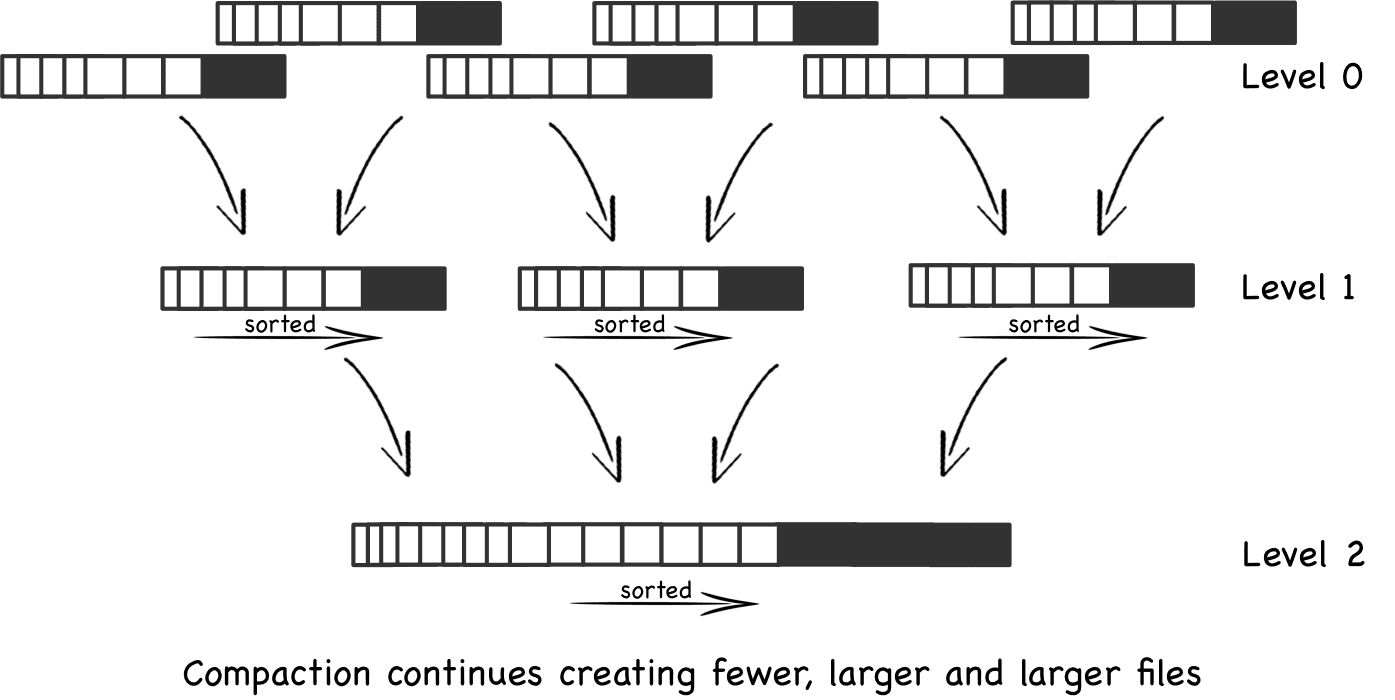
LSM-Tree: Fast Writes, Later Merges
An LSM-tree optimizes for high-volume writes by batching them in memory before flushing to disk, like a notepad for a busy filing cabinet. It's used in databases like Cassandra for write-heavy tasks. The footgun is unpredictable read latency.
Predicate Pushdown: Filter Data at the Source
Predicate pushdown tells the database to filter data at the source, not after fetching it. This speeds up queries in data warehouses and lakehouses by reducing network traffic. The main footgun: not all data sources can execute all types of filters.
We are hiring for this. Every open role lists the topics its interview covers, so you can prepare for the real thing rather than guessing.
See open roles