Intermediate interview questions in iOS & Swift
Explain the primary differences between a struct and a class in Swift
Tests value versus reference semantics and their impact on memory and mutation. Strong answers note structs copy on assignment and lack inheritance, while classes share heap instances via ARC. Red flag: claiming structs are always stack-allocated.
What is a retain cycle in ARC with closures?
It tests reference counting and closure capture semantics. A retain cycle forms when a closure captures self strongly while self holds the closure; break it with weak if self can deallocate, or unowned if it will outlive the closure.
What are Swift generics, why useful, and write a swap function?
This tests parametric polymorphism and type-safe reuse. A strong answer defines generics as placeholder types for reusable code, then writes a swap<T> function using inout parameters. Red flag: confusing generics with Any or omitting inout.
What is a closure capture list? Explain [weak self] versus [unowned self].
Define capture lists, contrast [weak self] safe optionality against [unowned self] crash risk, and match each to lifetime guarantees.
What is an Xcode Scheme? How do you configure a custom one?
This tests Xcode build orchestration. A scheme is a blueprint for build, test, run, profile, analyze actions; a strong answer covers duplicating it, setting launch arguments, and staging configs. A red flag is confusing schemes with build configurations.
Explain symbolic breakpoints and debug Auto Layout with one
Tests debugging closed-source frameworks without source lines. A strong answer says a symbolic breakpoint stops on UIViewAlertForUnsatisfiableConstraints, then checks the backtrace or log to find the bad view.
Which Instrument diagnoses scroll stuttering and dropped frames?
Tests whether you connect UI jank to Instruments data. A strong answer names the Core Animation or Time Profiler instrument, cites frame duration and hitch ratio, and correlates spikes with main-thread work.
How do UITableView and UICollectionView reuse cells?
This tests your understanding of UIKit's flyweight pattern and scroll performance. A strong answer covers the reuse pool, dequeueReusableCell mapping identifiers to new index paths, and registration.
Compare UIKit Auto Layout and SwiftUI layout systems
Tests imperative versus declarative layout paradigms. Contrast UIKit's constraint solver with SwiftUI's two-pass sizing and composition via stacks and modifiers instead of anchors. Red flag: claiming SwiftUI uses Auto Layout under the hood.
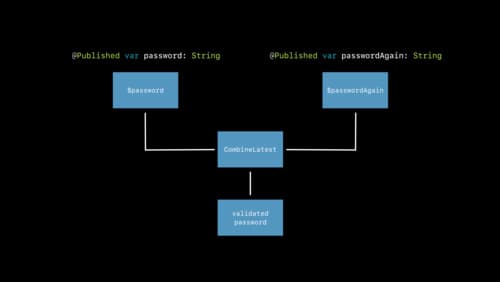
Differences between @State, @Binding, @ObservedObject, and @EnvironmentObject
Tests SwiftUI state ownership and propagation. @State owns local value types; @Binding borrows for two-way edits; @ObservedObject accepts an external ObservableObject; @EnvironmentObject reads one from the environment.
Integrate SwiftUI into UIKit and wrap UIKit for SwiftUI
Tests bridging architecture between UIKit and SwiftUI using UIHostingController and UIViewRepresentable. A strong answer names hosting controllers for SwiftUI in UIKit, representable protocols for UIKit in SwiftUI, and lifecycle hooks.
How do AppDelegate and SceneDelegate responsibilities differ?
AppDelegate owns process events (launch, push); SceneDelegate owns per-window lifecycle and UI.
Explain MVVM, its improvements over MVC, and Swift data binding techniques.
Tests architectural separation of concerns and pattern comparison skills. Define ViewModel as state transformer, cite MVC's massive view controller, and list Combine or closures for binding. Red flag: calling MVVM as MVC with no testability.
How do you complete a file download after the app backgrounds?
This tests iOS background execution and URLSession background transfers. Configure a background URLSession, handle AppDelegate events, and respect the 30-second completion handler limit. Never claim NSTimer or beginBackgroundTask sustains background downloads.

How does the Coordinator pattern decouple navigation, and what are its components?
This tests iOS separation of concerns. Explain that Coordinators extract navigation logic from view controllers for reuse, and describe AppCoordinator tree with child coordinators. A red flag is treating it as a router or ignoring parent-child retention.
Explain the Coordinator pattern and the navigation problem it solves in MVC
This tests if you see view controllers bloat from absorbing navigation flow. A good answer names 3 problems (delegate bloat, massive view controllers, embedded routing) and says coordinators own creation and routing.

Pass data back from a modally presented view controller delegate versus closure
This tests decoupled UIKit communication and memory safety. A strong answer outlines a weak delegate protocol and a closure with weak self, contrasting coupling and retain cycles. Red flag: singletons or direct parent references.
Handle a deep link URL in SceneDelegate and navigate to order detail.
Handles willConnectTo and openURLContexts; parses path with URLComponents; validates ID; pushes detail onto nav stack.
How do you pop to root in SwiftUI NavigationStack?
This tests declarative state-driven navigation. A strong answer binds NavigationStack to a NavigationPath, passes the binding down, and clears the path to pop to root. A red flag is suggesting UIKit popToRootViewController or legacy isActive hacks.
Why store auth tokens in Keychain, not UserDefaults?
UserDefaults is an unencrypted plist readable from backups and on jailbroken devices; use Keychain Services, which stores encrypted items with access control; save with SecItemAdd and read with…
We are hiring for this. Every open role lists the topics its interview covers, so you can prepare for the real thing rather than guessing.
See open roles