Intermediate everything in iOS & Swift, page 3
Difference between frame, bounds, and center
Frame and center are in the superview's space; bounds is the view's own space, usually origin zero. A non-identity transform makes frame undefined to read.
Add a default header to every URLSession request
Set httpAdditionalHeaders on a URLSessionConfiguration, build the session from it, mention per-request overrides win.
What is @MainActor and why does it matter?
@MainActor is a global actor guaranteeing code runs on the main thread; annotate UI-updating types or methods so post-network state changes are main-thread safe.
Run two API calls concurrently with async let
Use async let to start two independent fetches that run concurrently, then await both, so total time approaches the slower call rather than the sum.
URLSession data vs download vs upload tasks
Data tasks buffer responses in memory for small API calls; download tasks stream to a file and support background transfers for large files; upload tasks send bodies from data or files and report…
Why store auth tokens in Keychain, not UserDefaults?
UserDefaults is an unencrypted plist readable from backups and on jailbroken devices; use Keychain Services, which stores encrypted items with access control; save with SecItemAdd and read with…
Test Plans (XCTestPlan)
A Test Plan is an Xcode configuration file decoupling which tests run from how they run, letting one scheme execute many configurations: localizations, sanitizers, randomized order, and repetition, all without editing the scheme.

Describe lightweight vs heavyweight Core Data migration and a heavyweight example
This tests inferred versus manual Core Data migrations. Contrast lightweight additive changes with heavyweight transforms like entity splits, citing promoting a string to a new entity. A red flag is claiming renames always need custom mapping.
Describe a pattern for background Core Data fetches and UI updates
This tests NSManagedObjectContext concurrency and queue confinement. Strong answer: create a background context, fetch, pass objectIDs or structs to main, then main context fetches by ID to update UI. Red flag: passing NSManagedObjects across threads.
How do you pop to root in SwiftUI NavigationStack?
This tests declarative state-driven navigation. A strong answer binds NavigationStack to a NavigationPath, passes the binding down, and clears the path to pop to root. A red flag is suggesting UIKit popToRootViewController or legacy isActive hacks.
Handle a deep link URL in SceneDelegate and navigate to order detail.
Handles willConnectTo and openURLContexts; parses path with URLComponents; validates ID; pushes detail onto nav stack.

Pass data back from a modally presented view controller delegate versus closure
This tests decoupled UIKit communication and memory safety. A strong answer outlines a weak delegate protocol and a closure with weak self, contrasting coupling and retain cycles. Red flag: singletons or direct parent references.

Explain the Coordinator pattern and the navigation problem it solves in MVC
This tests if you see view controllers bloat from absorbing navigation flow. A good answer names 3 problems (delegate bloat, massive view controllers, embedded routing) and says coordinators own creation and routing.
How does the Coordinator pattern decouple navigation, and what are its components?
This tests iOS separation of concerns. Explain that Coordinators extract navigation logic from view controllers for reuse, and describe AppCoordinator tree with child coordinators. A red flag is treating it as a router or ignoring parent-child retention.
How do you complete a file download after the app backgrounds?
This tests iOS background execution and URLSession background transfers. Configure a background URLSession, handle AppDelegate events, and respect the 30-second completion handler limit. Never claim NSTimer or beginBackgroundTask sustains background downloads.
Explain MVVM, its improvements over MVC, and Swift data binding techniques.
Tests architectural separation of concerns and pattern comparison skills. Define ViewModel as state transformer, cite MVC's massive view controller, and list Combine or closures for binding. Red flag: calling MVVM as MVC with no testability.
How do AppDelegate and SceneDelegate responsibilities differ?
AppDelegate owns process events (launch, push); SceneDelegate owns per-window lifecycle and UI.
Integrate SwiftUI into UIKit and wrap UIKit for SwiftUI
Tests bridging architecture between UIKit and SwiftUI using UIHostingController and UIViewRepresentable. A strong answer names hosting controllers for SwiftUI in UIKit, representable protocols for UIKit in SwiftUI, and lifecycle hooks.
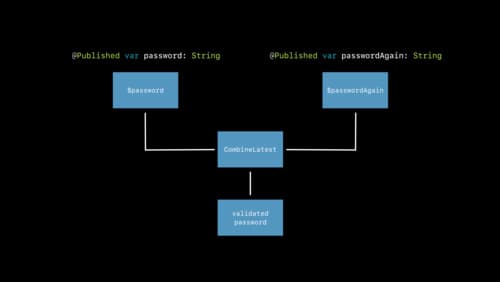
Differences between @State, @Binding, @ObservedObject, and @EnvironmentObject
Tests SwiftUI state ownership and propagation. @State owns local value types; @Binding borrows for two-way edits; @ObservedObject accepts an external ObservableObject; @EnvironmentObject reads one from the environment.
Compare UIKit Auto Layout and SwiftUI layout systems
Tests imperative versus declarative layout paradigms. Contrast UIKit's constraint solver with SwiftUI's two-pass sizing and composition via stacks and modifiers instead of anchors. Red flag: claiming SwiftUI uses Auto Layout under the hood.
We are hiring for this. Every open role lists the topics its interview covers, so you can prepare for the real thing rather than guessing.
See open roles