Everything in Vue, Angular & Svelte, page 7
Explain two-way data binding and provide input binding syntax
Tests whether you see two-way binding as sugar for value binding plus an input event. Strong answer: show one syntax, then explain the prop-out, event-in pattern. Red flag: syntax only with no mention of change detection or unidirectional flow.
How do you conditionally render Login/Logout with isLoggedIn in Vue or Angular?
This tests DOM lifecycle awareness versus CSS toggling. A strong answer uses v-if/*ngIf for infrequent changes that need cleanup, and v-show/[hidden] for frequent toggles that should stay mounted. A red flag is treating them as interchangeable.
How do Vue and Angular detect nested object mutations?
Tests deep reactivity vs reference-based detection. Vue 3 Proxies catch nested mutations; Angular Default checks on zone ticks and OnPush misses same-reference changes. Fix via immutability, deep watchers, or ngDoCheck.
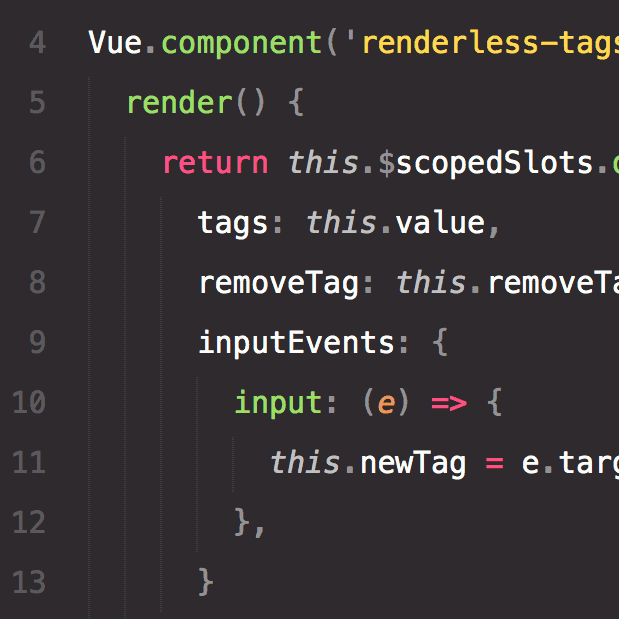
Architect a headless Toggle with scoped slots
This tests decoupling logic from markup via scoped slots. A strong answer exposes on and toggle through a single default scoped slot, renders no DOM, and cites UI flexibility. A red flag is using config props or CSS classes to control layout.
Implement a scoped slot pattern in a reusable DataList
It tests delegating rendering while keeping data ownership in the child. A strong answer covers a DataList that fetches internally and exposes rows via slot props, plus Angular TemplateRef via let-item. Red flag: parent loops or slots inheriting child scope.

Compare multiple boolean props versus a single status string prop
Booleans let callers pass conflicting flags like isLoading plus isError, leaking implementation priority; a single status enum makes invalid states unrepresentable.
What bindings do v-model and ngModel sugar, and why?
V-model sugars value and input; ngModel sugars [value] and (ngModelChange). This enforces one-way data flow for predictable state.
How do you emit events from a child to parent component?
This probes unidirectional data flow and child-to-parent event emission. In Vue, call $emit with a named event and payload; in Angular, use @Output with EventEmitter and emit the query. A red flag is suggesting two-way binding or direct parent mutation.
Primary mechanism for passing data from parent to child component
Tests unidirectional parent-to-child data flow and explicit component contracts. A strong answer names props or inputs, explains one-way binding, and warns against direct child mutation. Red flag: confusing props with global state or events.
Design the public API for a reusable Button component
Variant, size, disabled, type props; forward click; slots for content/icons; no router/form coupling.

How do you configure Vite Library Mode for ESM and UMD outputs?
Tests Vite Library Mode multi-format packaging. Strong answer: build.lib entry, formats es and umd, fileName function, and rollupOptions.output.globals for Vue. Red flag: multiple configs or omitting UMD global name.
How would you implement lazy loading for an Angular feature module?
This tests route-level code splitting and CLI workflows. A great answer hits: ng generate module, loadChildren in the route config, and excluding the feature from AppModule. A red flag is suggesting manual chunking instead of router-driven lazy loading.
What is a SvelteKit adapter and how do adapter-static and adapter-node differ?
Tests your grasp of SvelteKit's deployment abstraction. A strong answer outlines how adapters compile the app for a target platform, contrasting adapter-static's CDN-ready HTML with adapter-node's server-side request handler for Node environments.
Describe two key Angular CLI production build optimizations
Tests whether you know architect targets and concrete production optimizations. Strong answers name two of: dead code elimination and minification, hashed filenames for cache busting, or disabled source maps.
Explain Vite dependency pre-bundling, startup speed, and CommonJS handling
This tests whether you understand Vite's ESM-first dev server constraints. Pre-bundling converts CJS/UMD to ESM and collapses multi-file ESM deps into single modules to stop 600+ request waterfalls.
How do you configure Angular CLI dev server proxying?
Tests Angular CLI proxying to bypass CORS locally. Good answer: create proxy.conf.json with target and path, register it in angular.json serve options as proxyConfig, then restart ng serve.
How does src/routes determine routing in SvelteKit?
Src/routes mirrors URLs, folders become paths, [slug] creates dynamic params, and +page.svelte renders pages.
Why does create-vue ask about Pinia and Vitest during scaffolding?
Tests knowledge of Vue's lean core and modular tooling. Good answers note that create-vue conditionally installs deps, scaffolds folders like src/stores or tests/, and pre-configures Vite so you skip manual wiring.
ng serve purpose and fundamental difference from ng build
Ng serve compiles in memory and serves via a dev server with live reload, while ng build writes output to dist/.
Svelte compiler downsides vs Vue and Angular runtime
Tests compile-time versus runtime trade-offs in large apps. Strong answers address dynamic component limits, plugin friction, build scalability, and migration cost. Red flag: claiming Svelte has no runtime or that dynamic components are impossible.
We are hiring for this. Every open role lists the topics its interview covers, so you can prepare for the real thing rather than guessing.
See open roles