A/B Testing: Making Decisions with Data, Not Guesses
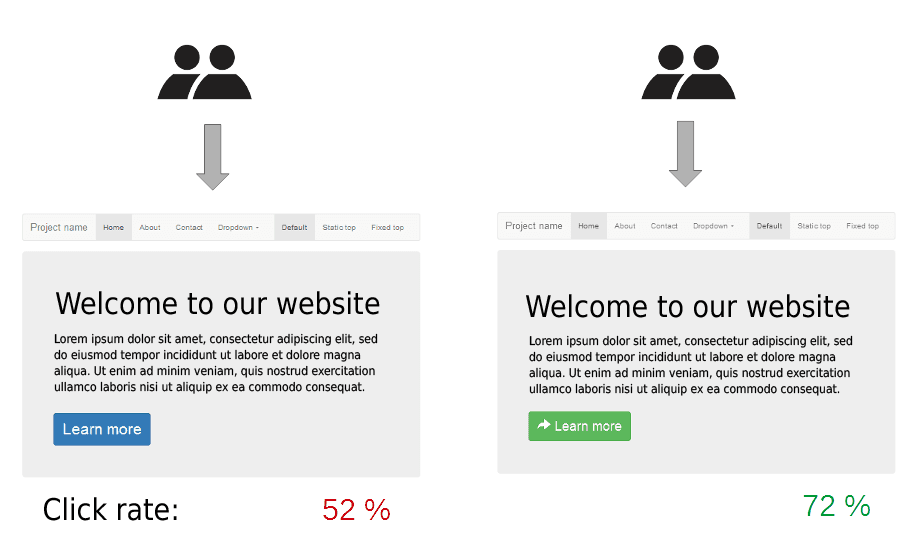
A/B testing is a controlled experiment pitting two versions of a product against each other with real users. It's used to see if a change, like a new button color, improves a metric like clicks.
THE MENTAL MODEL: A/B testing replaces guesswork with data by running a scientific experiment on your users. Instead of debating whether a red or blue button is better, you can show the red button to one group of users and the blue button to another, then measure which group clicks more. It is a direct application of two-sample hypothesis testing to product development.
HOW IT WORKS: The process involves a few key steps. First, you form a hypothesis, such as "Changing the 'Sign Up' button from green to orange will increase registrations." Next, you create two versions: Variant A (the control, green button) and Variant B (the challenger, orange button). Then, you randomly assign incoming users to either see Variant A or Variant B. You collect data on the key metric for both groups. Finally, you use statistical analysis to determine if the observed difference in performance is statistically significant, meaning it's unlikely to be due to random chance.
WHEN TO USE IT: Use A/B testing for optimizing existing features where you can isolate a single variable and measure a clear outcome. It is ideal for testing changes to user interfaces, such as button colors, headlines, or page layouts. It's also effective for testing different email subject lines to improve open rates or for comparing the performance of different recommendation algorithms.
WHEN NOT TO USE IT: A/B testing is not suitable for validating entirely new products or features where there is no existing 'control' version to compare against. It's also ineffective for changes whose impact is not immediately measurable or for testing multiple variables at once, which is the domain of multivariate testing. Drastic redesigns are also poor candidates, as you can't isolate which specific change caused the outcome.
ONE CANONICAL EXAMPLE: An e-commerce site wants to improve its conversion rate. Their hypothesis is that changing the "Buy Now" button text to "Add to Cart" will increase clicks. Variant A (control) shows "Buy Now" to 50% of traffic. Variant B (challenger) shows "Add to Cart" to the other 50%. After running the test on 20,000 users, the team finds that Variant B had a 15% click-through rate, while Variant A had 12%. Statistical analysis confirms this 3% lift is significant, so the company rolls out "Add to Cart" to all users.
Read the original → en.wikipedia.org
Get five bites like this every day.
Tezvyn delivers a daily feed of 60-second tech bites with quizzes to lock in what you learn.