AARRR 'Pirate' Metrics: A Funnel for What Really Matters
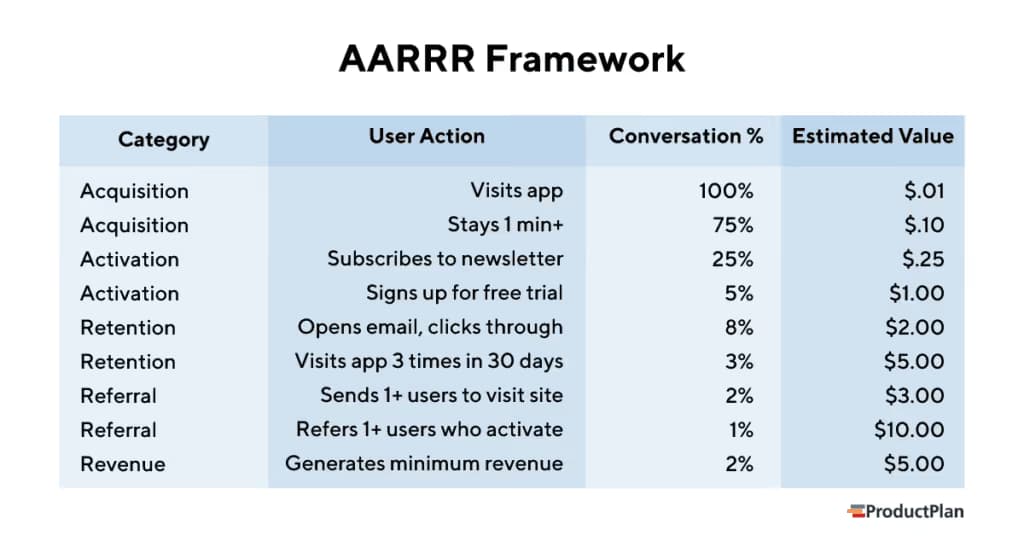
The AARRR framework is a five-stage funnel (Acquisition, Activation, Retention, Referral, Revenue) that tracks the user journey. It helps product teams focus on metrics that directly impact business health, not vanity metrics like social media likes.
Why it exists
The AARRR framework was created to solve a common startup problem: getting distracted by vanity metrics. Instead of focusing on superficial numbers like social media likes, which don't correlate to business health, this model provides a clear, actionable funnel that tracks the entire customer lifecycle from discovery to monetization.
The mental model
Think of AARRR as a five-stage funnel that maps your customer's journey. The acronym stands for Acquisition, Activation, Retention, Referral, and Revenue. It's nicknamed "Pirate Metrics" because of how "AARRR" sounds when said aloud. The goal is to measure how users move from one stage to the next, identifying where they drop off so you can fix the leak. It forces a focus on metrics that directly drive growth.
How it works
The framework breaks the user journey into five measurable stages. First, Acquisition tracks how people discover your product, through channels like SEO, marketing campaigns, or advertising. Second, Activation measures whether new users take a meaningful first action, like signing up for a trial or using a key feature. Third, Retention monitors if activated users continue to engage over time, for example, by returning to the app or opening emails. Fourth, Referral gauges if users like the product enough to tell others, tracked via referral promotions or contests. Finally, Revenue determines if users are willing to pay, measuring metrics like the cost to acquire a customer versus the revenue they generate. The process involves defining specific metrics for each stage and using tools like Google Analytics to track them.
When to use it
Use the AARRR framework when you need to bring a sharp focus to product-led growth initiatives. It is ideal for startups and businesses that need to systematically diagnose and improve their user conversion funnel. It helps product management and marketing teams measure the real-world impact of their efforts and pinpoint which part of the user experience, from awareness to payment, needs the most attention.
When not to use it
The framework is built to optimize a linear user conversion path. It is less effective for products where the primary goal isn't direct user acquisition and monetization. For example, it's not the best model for internal enterprise tools, where adoption might be mandated, or for open-source projects focused on community contribution rather than revenue.
One canonical example
A SaaS company sees user growth stall. Using AARRR, they analyze their funnel. Acquisition: 1,000 new sign-ups per week from their blog. Activation: only 10% of those sign-ups create their first document (the key activation event). Retention: 60% of activated users return the next week. Referral: 5% of users refer a friend. Revenue: 20% of activated users convert to a paid plan. The data clearly shows an Activation problem. Instead of spending more on ads to boost Acquisition, the team knows to focus all its energy on improving the onboarding experience to help more users create that first document.
Interview question
For which product scenario would the AARRR 'Pirate' Metrics framework be LEAST effective?
- a.An e-commerce site optimizing its customer conversion funnel.
- b.A new mobile game focused on user acquisition and monetization.
- c.An internal company tool for managing employee benefits.Correct
- d.A SaaS platform aiming to improve user retention and referrals.
Why? this is the answer
The AARRR framework is less effective for products where the primary goal isn't direct user acquisition and monetization, specifically mentioning 'internal enterprise tools.' The other options represent scenarios where direct user acquisition, engagement, and monetization are key, making AARRR highly applicable.
Just read this? Test yourself on what you have been reading.
Read the original → productplan.com
- #product management
- #metrics
- #growth
- #startups
You just looked this up. Could you explain it out loud?
That is the part interviews actually test. Tezvyn takes questions like this one and gives you what the interviewer is really checking, the answer that lands, and the mistake that ends the conversation, in the four minutes before your next meeting.
The iPhone app is on the way
We are building it. Until it lands, nothing here is held back from you: every interview card, your saved cards, streaks and the job board all work in Safari, plus hundreds of free practice quizzes of thirty questions each. Sign in and it all carries over to the app the day it arrives.
Want it as an icon? Tap Share at the bottom of Safari, then Add to Home Screen. It opens full screen and the cards you have read stay available offline.
We are hiring for this. Open roles that interview on product management — each one lists the topics its interview covers.
See open roles