Skip to content
tezvyn:

Atlassian Details its ML Studio Platform Design
Source: Atlassian BlogMediumHow cards are made

Atlassian Details its ML Studio Platform Design

Atlassian's ML Studio platform powers thousands of daily workflows for millions of Rovo users. It solves enterprise scaling issues with reusable modules, column-level data governance, and unified orchestration, offering a blueprint for building compliant…

Why it matters

As enterprise ML scales, engineering teams face a trade-off between development velocity and governance. Atlassian's ML Studio architecture provides a concrete blueprint for building a unified platform that delivers both, offering a reusable pattern for MLOps and platform engineers struggling with fragmented tooling and compliance bottlenecks.

What changed

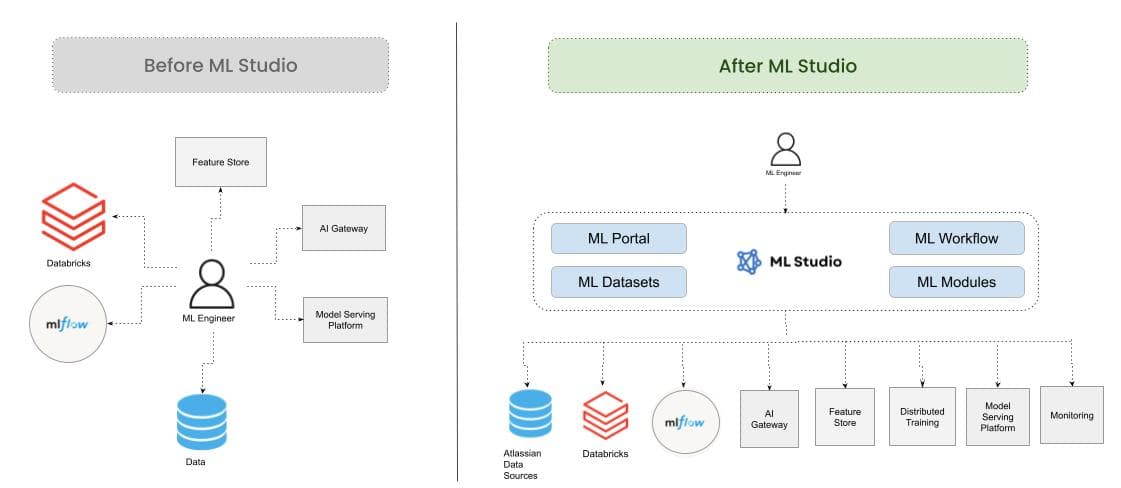
Atlassian revealed the architecture of ML Studio, its internal, enterprise-scale ML platform powering AI in Rovo, Confluence, and other products. It was designed to replace traditional, tightly coupled infrastructure. The platform standardizes the ML lifecycle through three core principles: modularity, centralized orchestration, and embedded governance. Key capabilities include reusable ML modules for data processing and training; automated, column-level data access controls for compliance; and a unified portal and CLI to orchestrate jobs across compute backends like Databricks. The system currently handles thousands of production workflow runs daily for millions of users.

What to watch

The design patterns from ML Studio, particularly the decoupling of components and the embedding of governance directly into the execution layer, are applicable to any large-scale internal developer platform. Engineers should evaluate how this model of centralized orchestration with modular, reusable components could simplify their own MLOps stacks. The success of this integrated approach at Atlassian signals a move away from piecemeal solutions toward holistic, governed platforms for enterprise AI development.

Interview question

What is the primary architectural approach Atlassian's ML Studio uses to balance development velocity with enterprise-level governance?

  • a.Enforcing a strict, manual review process for all data access requests and model changes.
  • b.Allowing individual teams to select their preferred ML tools and infrastructure for maximum flexibility.
  • c.Standardizing the ML lifecycle with reusable modules, centralized orchestration, and automated column-level data governance.Correct
  • d.Prioritizing rapid prototyping over compliance to accelerate new feature development.
Why?

The card states that the platform "standardizes the ML lifecycle through three core principles: modularity, centralized orchestration, and embedded governance," which includes "automated, column-level data access controls." Option B is incorrect because the platform aims to replace "fragmented tooling" with a "unified platform" and "centralized orchestration," not full team autonomy.

Just read this? Test yourself on what you have been reading.

Read the original → atlassian.com

You just looked this up. Could you explain it out loud?

That is the part interviews actually test. Tezvyn takes questions like this one and gives you what the interviewer is really checking, the answer that lands, and the mistake that ends the conversation, in the four minutes before your next meeting.

The iPhone app is on the way

We are building it. Until it lands, nothing here is held back from you: every interview card, your saved cards, streaks and the job board all work in Safari, plus hundreds of free practice quizzes of thirty questions each. Sign in and it all carries over to the app the day it arrives.

Want it as an icon? Tap Share at the bottom of Safari, then Add to Home Screen. It opens full screen and the cards you have read stay available offline.

Get it on Google PlayiPhone app coming soon

We are hiring for this. Open roles that interview on mlops — each one lists the topics its interview covers.

See open roles