CD4ML: Automating ML from Data to Deployment
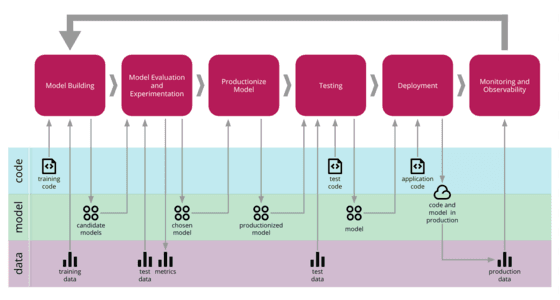
CD4ML extends CI/CD to manage ML's three axes of change: code, data, and models. It automates the entire lifecycle, enabling reliable updates for systems like sales forecasting.
Why it exists
Machine learning systems are more complex than traditional software because they are subject to change on three axes: the code, the model, and the data. As highlighted in the Google paper “Hidden Technical Debt in Machine Learning Systems,” the ML code is often a tiny fraction of the overall system. This complexity makes ML applications harder to test, deploy, and reliably improve, creating a need for a more disciplined approach.
The mental model
Think of CD4ML as extending a standard CI/CD pipeline to handle two extra, volatile artifacts: the data and the model. A traditional pipeline ships code. A CD4ML pipeline ships a trained model, which is a product of both code and data. It automates the entire assembly line from raw data to a monitored, live prediction endpoint, treating model releases with the same rigor as software releases.
How it works
CD4ML orchestrates a series of automated stages. It begins with versioning not just code, but also datasets and models. When new code or data is checked in, a pipeline is triggered that automatically trains a new model. This pipeline includes rigorous, automated tests for data validity, model quality, and software behavior. If all tests pass, the system automatically deploys the new model into production and begins monitoring its performance for degradation or drift.
When to use it
Use CD4ML for any ML application that is not a one-off experiment. It is critical for business-critical systems where models must evolve with new data, such as recommendation engines, fraud detection systems, or dynamic pricing tools. It enables you to release improvements safely, quickly, and sustainably.
When not to use it
CD4ML is overkill for early-stage research, one-off data analyses, or proofs-of-concept where the goal is exploration, not a production service. The overhead of building and maintaining fully automated pipelines is not justified if the model is not intended for continuous, reliable operation in a live environment.
One canonical example
A sales forecasting application needs to be updated weekly with new sales data. With CD4ML, a new data file landing in storage triggers the pipeline. The system automatically trains a new model, validates its accuracy against the old one, runs tests to ensure the prediction format is correct, and if all checks pass, deploys the new model into production without any human intervention.
Interview question
What is the primary distinguishing characteristic of CD4ML compared to traditional CI/CD pipelines?
- a.It explicitly manages and automates changes across code, data, and trained models.Correct
- b.It guarantees that machine learning models will always outperform previous versions in production.
- c.It focuses on automating the deployment of models to production without human intervention.
- d.It reduces the need for data scientists by fully automating model development and training.
Why? this is the answer
CD4ML's core innovation is extending CI/CD to manage the unique lifecycle of ML systems, which includes versioning and automating changes for code, data, and the trained model. While it does automate deployment (Option C), this is also a feature of traditional CI/CD; the distinction lies in the comprehensive management of data and models as first-class artifacts.
Just read this? Test yourself on what you have been reading.
Read the original → martinfowler.com
You just looked this up. Could you explain it out loud?
That is the part interviews actually test. Tezvyn takes questions like this one and gives you what the interviewer is really checking, the answer that lands, and the mistake that ends the conversation, in the four minutes before your next meeting.
The iPhone app is on the way
We are building it. Until it lands, nothing here is held back from you: every interview card, your saved cards, streaks and the job board all work in Safari, plus hundreds of free practice quizzes of thirty questions each. Sign in and it all carries over to the app the day it arrives.
Want it as an icon? Tap Share at the bottom of Safari, then Add to Home Screen. It opens full screen and the cards you have read stay available offline.
We are hiring for this. Open roles that interview on mlops — each one lists the topics its interview covers.
See open roles