Claude Mythos Cracks Firefox Bugs Fuzzing Missed
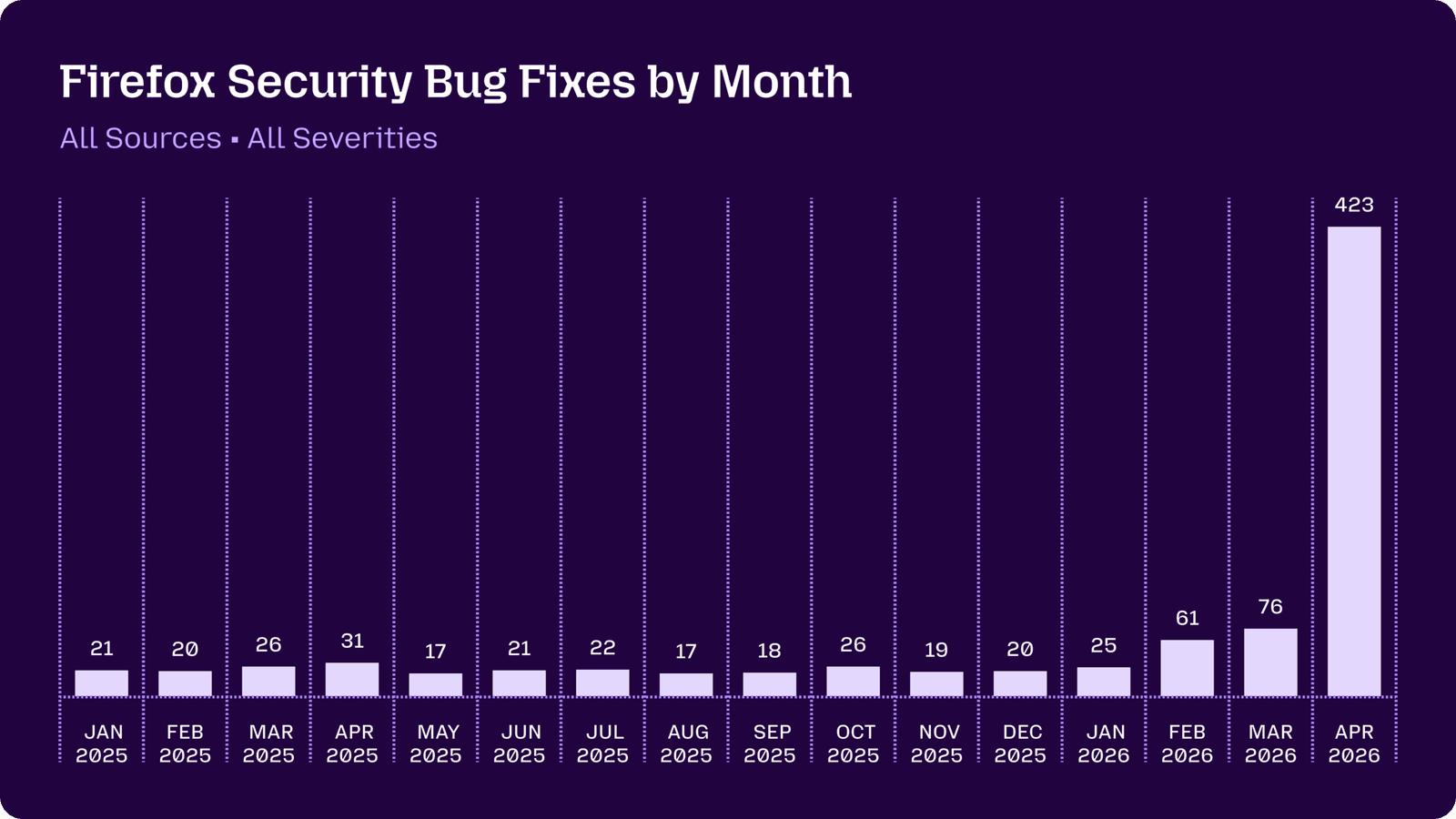
Claude Mythos Preview found 20-year-old XSLT and JIT bugs in Firefox that survived years of fuzzing. Mozilla shows AI now catches sandbox escapes and memory corruption. Add LLM security scanning to hardening workflows before attackers adopt them.
Why it matters
Firefox just proved that large language models can find security bugs that survived decades of expert scrutiny and aggressive fuzzing. Mozilla used Claude Mythos Preview to identify and fix an unprecedented volume of latent vulnerabilities, then published detailed reports typically withheld for months after shipping fixes. The findings include a 20-year-old XSLT bug, a JIT optimization flaw creating arbitrary read and write primitives, and multiple IPC race conditions enabling sandbox escapes. These are not shallow linting issues; they are deep architectural vulnerabilities in heavily audited C++ and Rust code. If AI can surface bugs in Firefox's hardened codebase after years of internal and external researcher attention, it can surface bugs in yours.
What changed
Mozilla's approach combined more capable models with rigorous techniques for steering, scaling, and stacking them to generate signal and filter out noise. The published sample spans browser subsystems: WebAssembly GC struct initialization bypassed via incorrect equality checks, raw NaN values crossing IPC boundaries masquerading as tagged JavaScript object pointers, and WebTransport certificate hash flooding stretching race conditions. One bug required simulating a malicious DNS server to trigger a UDP to TCP fallback edge case that leaked parent process stack memory. Another exploited HTML table rowspan semantics by appending over 65535 rows to overflow a 16 bit layout bitfield. Several findings evaded internal and external fuzzing programs that had already hammered the same code for years.
What to watch
Mozilla explicitly calls for defenders to adopt these techniques before attackers do. The asymmetric cost of AI generated reports has flipped: models are now good enough that the signal outweighs the noise. Watch for security teams building layered pipelines that use LLMs for initial discovery, then automated verification and human triage. Expect this to become standard for critical code paths handling IPC, memory management, and sandbox boundaries. Projects that delay integrating these capabilities will face a growing disadvantage as the tooling improves.
Interview question
Mozilla's use of Claude Mythos Preview on Firefox demonstrated that modern LLMs can accomplish what traditional fuzzing alone struggled to achieve?
- a.Automatically patch sandbox escapes in IPC boundaries without human review
- b.Simulate complex network edge cases to find memory leaks missed by fuzzers
- c.Replace human triage by filtering out all false positives before reporting
- d.Identify deep architectural vulnerabilities hidden in heavily audited code for decadesCorrect
Why? this is the answer
Mozilla showed LLMs can uncover deep architectural bugs in heavily audited code that survived years of fuzzing. Option B describes just one specific technique from a single finding, not the broader capability, and D overstates the workflow since human triage remains essential.
Just read this? Test yourself on what you have been reading.
Read the original → hacks.mozilla.org
You just looked this up. Could you explain it out loud?
That is the part interviews actually test. Tezvyn takes questions like this one and gives you what the interviewer is really checking, the answer that lands, and the mistake that ends the conversation, in the four minutes before your next meeting.
The iPhone app is on the way
We are building it. Until it lands, nothing here is held back from you: every interview card, your saved cards, streaks and the job board all work in Safari, plus hundreds of free practice quizzes of thirty questions each. Sign in and it all carries over to the app the day it arrives.
Want it as an icon? Tap Share at the bottom of Safari, then Add to Home Screen. It opens full screen and the cards you have read stay available offline.
We are hiring for this. Every open role lists the topics its interview covers, so you can prepare for the real thing rather than guessing.
See open roles