Cloud Direct Connect: A Private Lane to the Cloud
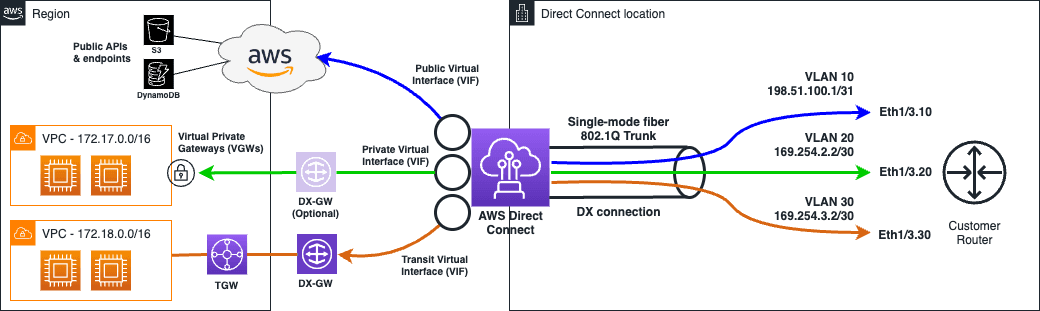
Think of Direct Connect as a private fiber-optic highway from your datacenter to the cloud, bypassing the public internet. It's for stable, high-bandwidth needs like large data transfers where public internet performance is too unpredictable or insecure.
Why it exists
The public internet is unpredictable, congested, and less secure. For mission-critical workloads that span on-premises datacenters and the cloud, businesses need a connection with guaranteed bandwidth, lower latency, and enhanced security that the public internet cannot provide.
The mental model
Imagine your office building and the AWS cloud are two separate cities. Using the public internet is like driving on public roads—you face traffic, detours, and potential security risks. A Direct Connect is like building a private, high-speed monorail directly from your building's lobby to the AWS city gates. It's exclusive, predictable, and secure, bypassing all public congestion.
How it works
You establish a physical, standard Ethernet fiber-optic connection from your router to a router at a designated Direct Connect location, which is a colocation facility with direct access to the cloud provider's network. This physical link is called a "Connection". Over this single connection, you create logical "Virtual Interfaces" (VIFs) using 802.1Q VLANs. A Private VIF connects to your VPCs using private IPs, while a Public VIF connects to public AWS services like S3. Routing between your network and the cloud is managed using Border Gateway Protocol (BGP).
When to use it
Use it when you have workloads that require more than what the public internet can offer. Three key scenarios are: first, large-scale data transfers for migration or disaster recovery; second, hybrid cloud applications that need consistent, low-latency communication between on-prem and cloud resources; and third, for security or compliance reasons that mandate traffic not traverse the public internet.
When not to use it
Avoid it for small-scale applications, development environments, or workloads that are not sensitive to network latency or jitter. The cost and complexity are significant. A standard site-to-site VPN over the public internet is a much simpler and more cost-effective solution for many use cases. It is overkill if your bandwidth needs are modest and unpredictable.
One canonical example
A financial services company needs to run a hybrid application where a trading algorithm on-premises must access real-time market data stored in an Amazon S3 bucket and execute trades via an application running in a VPC. Using a Direct Connect with a Public VIF for S3 and a Private VIF for the VPC ensures minimal, predictable latency and keeps sensitive financial traffic off the public internet, meeting both performance and regulatory requirements.
Interview question
For a financial firm moving petabytes of sensitive data to the cloud and running a hybrid analytics platform needing guaranteed low-latency access, which networking solution is best?
- a.Establishing a dedicated, unmanaged fiber optic link directly to the cloud provider's core network.
- b.Implementing Cloud Direct Connect with appropriate Virtual Interfaces.Correct
- c.Transferring data via the public internet with optimized transfer protocols.
- d.Utilizing a site-to-site VPN connection over the public internet.
Why? this is the answer
Cloud Direct Connect is designed for large-scale data transfers and hybrid applications requiring consistent, low-latency, and secure communication, precisely matching the firm's needs. A site-to-site VPN (D) is less suitable for petabytes of data and guaranteed low-latency, while the public internet (C) lacks the necessary predictability, security, and performance guarantees. Option A describes a non-standard or overly simplified approach, as Direct Connect involves specific colocation facilities and managed services, not a direct unmanaged link to the provider's core.
Just read this? Test yourself on what you have been reading.
Read the original → docs.aws.amazon.com
You just looked this up. Could you explain it out loud?
That is the part interviews actually test. Tezvyn takes questions like this one and gives you what the interviewer is really checking, the answer that lands, and the mistake that ends the conversation, in the four minutes before your next meeting.
The iPhone app is on the way
We are building it. Until it lands, nothing here is held back from you: every interview card, your saved cards, streaks and the job board all work in Safari, plus hundreds of free practice quizzes of thirty questions each. Sign in and it all carries over to the app the day it arrives.
Want it as an icon? Tap Share at the bottom of Safari, then Add to Home Screen. It opens full screen and the cards you have read stay available offline.
We are hiring for this. Open roles that interview on cloud — each one lists the topics its interview covers.
See open roles