FinOps Framework: Aligning Cloud Cost with Business Value
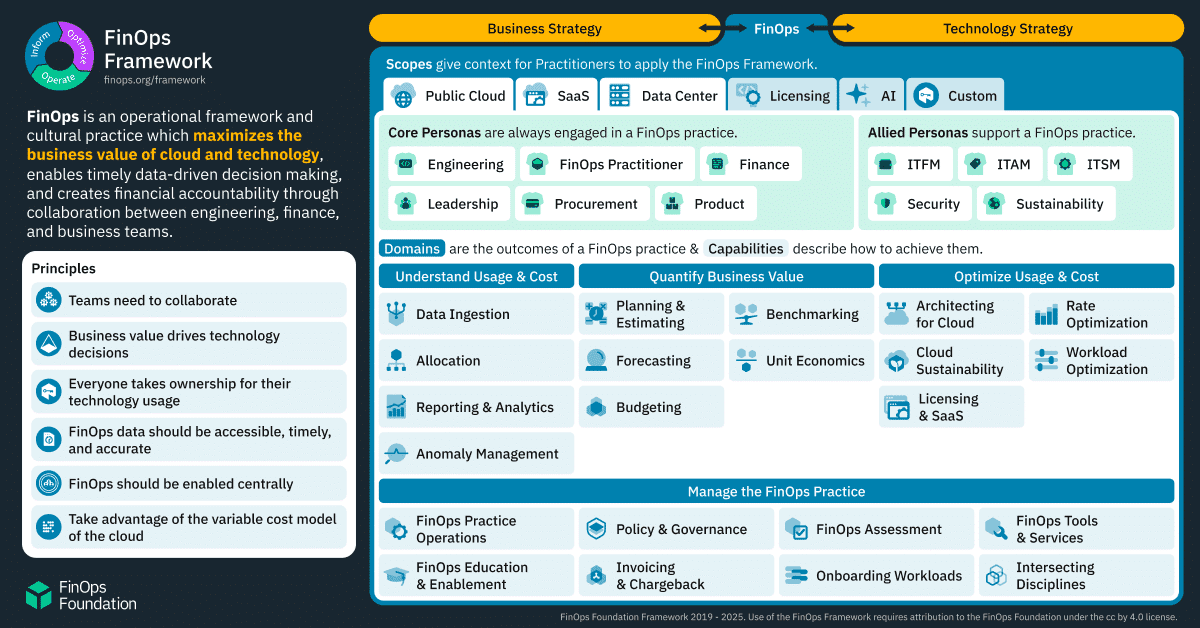
FinOps treats cloud spend as a business metric, not just an IT cost. It provides a shared framework for engineering, finance, and business to collaborate on data-driven spending decisions.
Why it exists
The variable, on-demand nature of the cloud broke traditional IT procurement models. Without a new approach, engineering teams could generate huge, unpredictable bills without understanding the business impact, leading to waste and budget surprises. FinOps was created to manage this variable spend collaboratively and tie it to business outcomes.
The mental model
Think of FinOps as applying the principles of DevOps to financial management. Instead of a central finance team policing costs, FinOps creates a culture of accountability where distributed teams own their cloud spend. It's about enabling teams with timely, accurate data so they can make smart trade-offs between cost, performance, and features to maximize business value.
How it works
The FinOps Framework is a flexible, non-prescriptive operating model. It is built on several key components. First, a set of Principles guides the practice, such as "Everyone takes ownership for their technology usage" and "Business value drives technology decisions." Second, it defines Personas (like Engineering, Finance, Product) and their roles. Third, it outlines a lifecycle of Inform, Optimize, and Operate. Finally, it organizes activities into Domains (e.g., "Understand Usage & Cost") and specific Capabilities within them (e.g., "Allocation," "Anomaly Management").
When to use it
Use the FinOps Framework when cloud costs are growing unpredictably or there's a disconnect between engineering activities and financial impact. It's essential for organizations scaling their cloud usage responsibly, enabling teams to forecast budgets, understand unit economics (e.g., cost per customer), and make data-driven architectural decisions. It provides a common language for engineers, finance, and leadership to discuss cloud value.
When not to use it
The full framework is overkill for very small teams with minimal, stable cloud spend. If your monthly bill is predictable and a tiny fraction of your operating budget, a simple review may suffice. FinOps is a cultural investment; adopting it without buy-in from engineering, finance, and leadership will lead to it being treated as a bureaucratic checklist rather than a value-driving practice.
One canonical example
A company wants to understand its cost per new user signup. Using the FinOps Framework, the engineering team tags resources related to the signup flow. The FinOps team uses allocation and reporting capabilities to ingest this data, calculate the cost, and present it on a dashboard. The Product persona then analyzes this unit economic metric to decide if the customer acquisition cost is sustainable or if the architecture needs optimization to improve value.
Interview question
What fundamental shift does the FinOps Framework introduce to cloud cost management?
- a.Centralizing all cloud spending decisions within a dedicated FinOps team.
- b.Primarily focusing on negotiating better rates with cloud providers through volume discounts.
- c.Implementing strict, top-down budget controls to prevent any unexpected cloud expenditure.
- d.Empowering distributed teams to balance cost, performance, and features based on business value.Correct
Why? this is the answer
The FinOps Framework promotes a culture where distributed teams own their cloud spend and make data-driven trade-offs to maximize business value. Option A is incorrect because FinOps emphasizes distributed accountability and collaboration, not centralization of all spending decisions.
Just read this? Test yourself on what you have been reading.
Read the original → finops.org
You just looked this up. Could you explain it out loud?
That is the part interviews actually test. Tezvyn takes questions like this one and gives you what the interviewer is really checking, the answer that lands, and the mistake that ends the conversation, in the four minutes before your next meeting.
The iPhone app is on the way
We are building it. Until it lands, nothing here is held back from you: every interview card, your saved cards, streaks and the job board all work in Safari, plus hundreds of free practice quizzes of thirty questions each. Sign in and it all carries over to the app the day it arrives.
Want it as an icon? Tap Share at the bottom of Safari, then Add to Home Screen. It opens full screen and the cards you have read stay available offline.
We are hiring for this. Every open role lists the topics its interview covers, so you can prepare for the real thing rather than guessing.
See open roles