Coded Aperture: Imaging Without a Lens
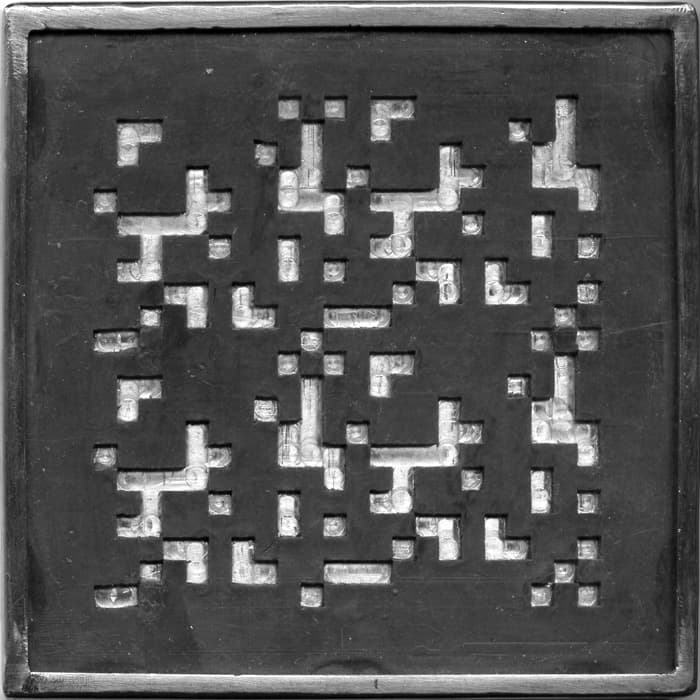
A coded aperture images radiation that can't be focused, like X-rays. Instead of a lens, it uses a patterned mask to cast a complex shadow, which is then mathematically decoded into an image. It's crucial for X-ray astronomy.
Why it exists
High-energy radiation like X-rays and gamma rays cannot be focused with conventional lenses or mirrors; they pass right through or are absorbed. Coded apertures were invented to solve this problem: how to form an image with radiation that defies traditional optics.
The mental model
A pinhole camera works but lets in very little light. Now, imagine punching thousands of pinholes in a specific, known pattern into a sheet of lead. This is a coded aperture. It lets in much more light, but creates a messy, overlapping shadow on the detector. Because you know the exact pattern of the holes (the 'code'), you can use a computer to mathematically unscramble the shadow and reconstruct a clear image of the source.
How it works
A mask, opaque to high-energy rays, is placed between the radiation source and a detector. The mask has a carefully designed pattern of transparent and opaque areas. Each transparent spot acts like a tiny pinhole, casting a simple shadow of the source onto the detector. The final pattern on the detector is the sum of thousands of these overlapping shadows. A mathematical process, typically cross-correlation with the known mask pattern, is then used to reconstruct the original source image from this jumbled shadowgram.
When to use it
Use this technique when you need to create an image from radiation that cannot be focused by lenses or mirrors. It's the standard for imaging systems in X-ray and gamma-ray astronomy, allowing us to 'see' black holes and neutron stars. It also has applications in specialized medical and industrial imaging where high-energy sources are used.
When not to use it
Avoid this for wavelengths that can be easily focused, like visible or infrared light. A conventional lens-based system is far more efficient and provides a direct image without needing heavy computation. The reconstruction process can also introduce artifacts not present in the original source, which may be unacceptable for some applications.
One canonical example
An X-ray telescope observing a distant galaxy cannot use a glass mirror. Instead, it uses a coded aperture mask made of a dense material like tungsten. Incoming X-rays from the galaxy cast a shadow through the mask onto a detector. On Earth, scientists process this shadow data, using the known mask pattern to reconstruct a detailed X-ray image of the galaxy, revealing structures invisible to optical telescopes.
Interview question
What is the main problem that coded apertures were invented to solve?
- a.The challenge of creating high-resolution images from visible light sources.
- b.The need to reduce the complexity of image processing for astronomical observations.
- c.The low light-gathering capability of simple pinhole cameras.
- d.The inability to focus high-energy radiation like X-rays using traditional lenses.Correct
Why? this is the answer
The card explicitly states that coded apertures were invented because "High-energy radiation like X-rays and gamma rays cannot be focused with conventional lenses or mirrors." While they do let in more light than a single pinhole camera (option C), this is a secondary benefit; the fundamental problem they address is the unfocusable nature of certain radiation types.
Just read this? Test yourself on what you have been reading.
Read the original → en.wikipedia.org
- #computer vision
- #imaging
- #optics
- #physics
You just looked this up. Could you explain it out loud?
That is the part interviews actually test. Tezvyn takes questions like this one and gives you what the interviewer is really checking, the answer that lands, and the mistake that ends the conversation, in the four minutes before your next meeting.
The iPhone app is on the way
We are building it. Until it lands, nothing here is held back from you: every interview card, your saved cards, streaks and the job board all work in Safari, plus hundreds of free practice quizzes of thirty questions each. Sign in and it all carries over to the app the day it arrives.
Want it as an icon? Tap Share at the bottom of Safari, then Add to Home Screen. It opens full screen and the cards you have read stay available offline.
We are hiring for this. Open roles that interview on computer vision — each one lists the topics its interview covers.
See open roles