Component library vs style guide vs design system
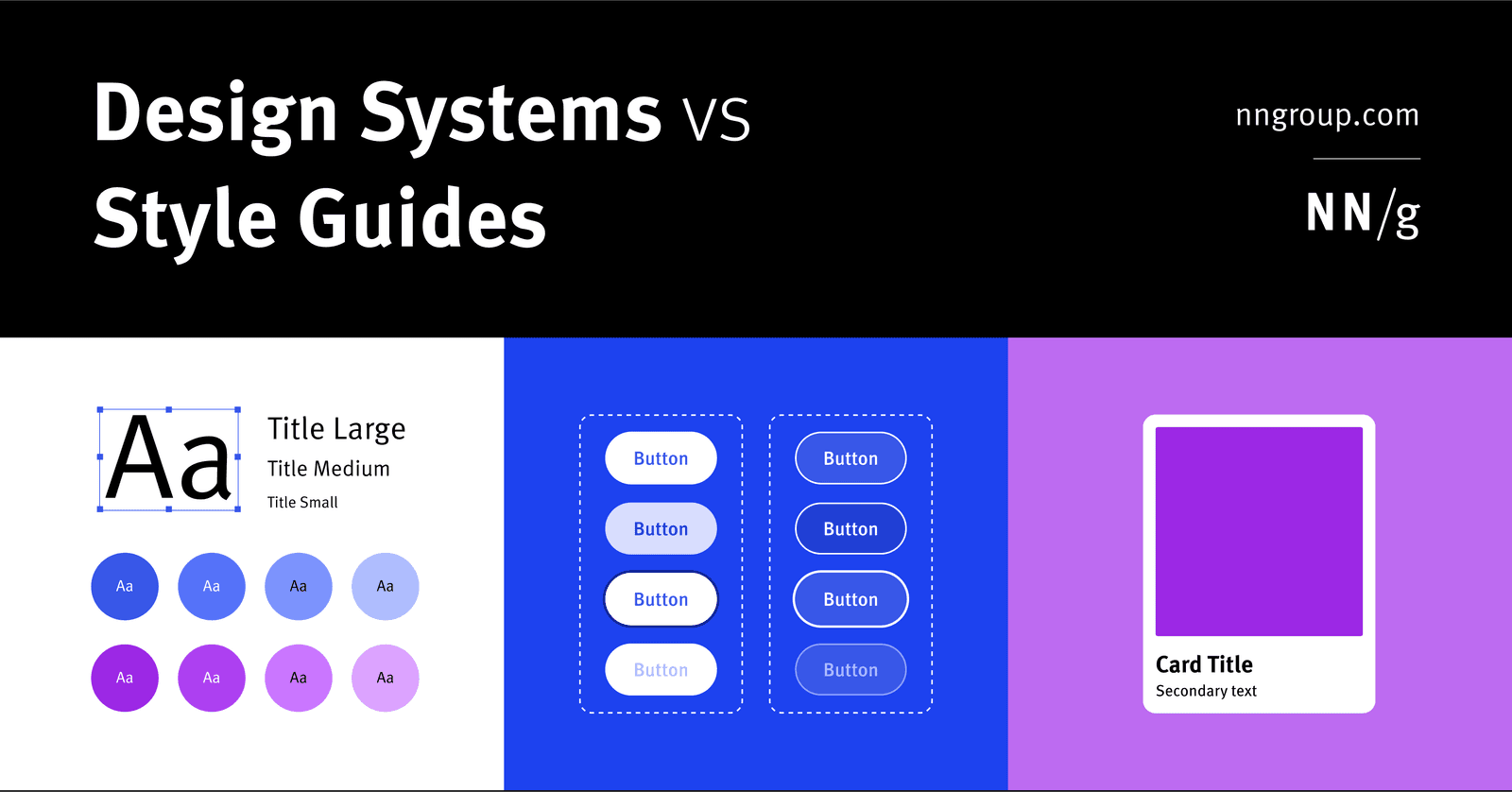
Knowledge of hierarchy in design artifacts.
A design system is holistic parent for scale; a style guide is a narrow visual/content child; a component library is a coded child of reusable UI elements.
Do not conflate them.
What's really being asked
This question tests whether you understand the scope and hierarchy of design infrastructure. Interviewers want to know if you can distinguish a broad ecosystem from its narrower parts, and whether you recognize that a design system is a living product that bridges design and engineering, not just a document or a folder of widgets.
The full answer
A strong answer establishes a clear parent-child relationship. First, define a design system as the holistic set of standards, reusable components, patterns, and documentation used to manage design at scale across teams and products. Second, describe a style guide as a narrow, focused child within that system that captures specific guidelines for visual design, content voice, or branding. Third, explain that a component library is another child that provides individually reusable UI elements such as buttons or inputs, complete with design specs, customizable attributes, states like hover and disabled, and production-ready code. Fourth, mention that design systems often live in a shared repository or website so both designers and developers can pull from a single source of truth.
The mistakes people make
A red flag is treating the three terms as interchangeable synonyms. Another is claiming a style guide alone constitutes a full design system, which ignores code, patterns, and cross-team workflow. Candidates also stumble by describing a component library as just a Figma file without mentioning coded implementations, or by failing to explain how the system reduces redundant work and enforces consistency at scale.
What usually comes next
Expect the interviewer to ask how you would evangelize a design system across product teams, how you version and govern contributions, or how you handle drift when teams bypass the system. They may also ask for the difference between a component library and a pattern library, or how you measure adoption.
A concrete example
Imagine a company where the marketing team builds a blue button and the product team builds a slightly different blue button. Without a design system, both teams waste time and create inconsistency. With a design system, the component library supplies one coded button with defined states and props, the style guide documents the exact color and typography rules, and the overall system repository houses both so any team can reuse the same element without redesigning or recoding it from scratch.
Interview question
A team documents brand colors and voice, yet engineers rebuild every button from scratch. What best describes their design infrastructure?
- a.They have interchangeable artifacts that each cover one part of the product, which is normal at scale.
- b.They have a style guide but lack the coded reusable components and cross-team workflow of a full design system.Correct
- c.They have a complete design system that is simply under-adopted by the engineering team.
- d.They have a component library that needs additional style guide documentation to become a design system.
Why? this is the answer
Documented colors and voice rules fit the narrow scope of a style guide, while the absence of production-ready, reusable code means they are missing the component library and holistic standards that define a design system. The most tempting distractor assumes a style guide alone constitutes a complete design system, but the card emphasizes that a design system must also include coded components and shared workflows.
Just read this? Test yourself on what you have been reading.
Read the original → nngroup.com
- #design systems
- #frontend architecture
- #ux
- #component libraries
- #style guides
You just looked this up. Could you explain it out loud?
That is the part interviews actually test. Tezvyn takes questions like this one and gives you what the interviewer is really checking, the answer that lands, and the mistake that ends the conversation, in the four minutes before your next meeting.
The iPhone app is on the way
We are building it. Until it lands, nothing here is held back from you: every interview card, your saved cards, streaks and the job board all work in Safari, plus hundreds of free practice quizzes of thirty questions each. Sign in and it all carries over to the app the day it arrives.
Want it as an icon? Tap Share at the bottom of Safari, then Add to Home Screen. It opens full screen and the cards you have read stay available offline.
We are hiring for this. Open roles that interview on design systems — each one lists the topics its interview covers.
See open roles