Design a GDPR 'Right to be Forgotten' System
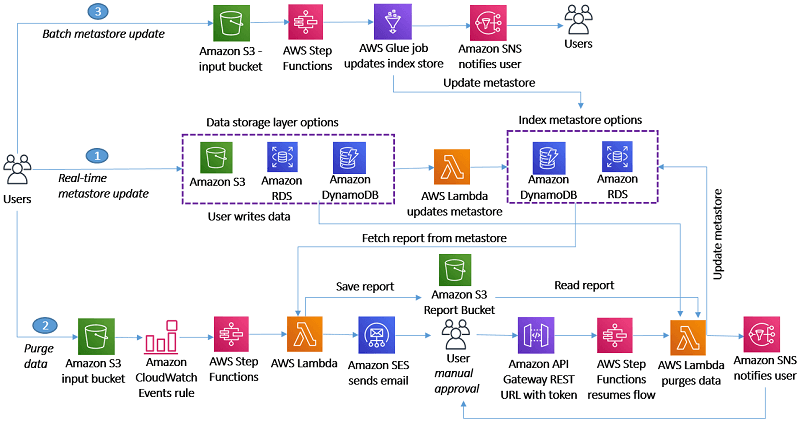
Tests your ability to design a verifiable data deletion system. A good answer outlines an index metastore, an orchestrated workflow, and auditing. A red flag is focusing only on the primary database, ignoring the data lake, warehouse, and caches.
What's really being asked
This question tests your ability to think beyond a simple DELETE statement. The interviewer is assessing if you understand the complexities of data lifecycle management in a modern, distributed architecture. They want to see you design a system that is not just functional but also auditable and verifiable, which is the cornerstone of regulations like GDPR. Can you handle immutable data (S3), transactional data (Snowflake), and ephemeral data (Redis) in a single, coherent process?
The full answer
An effective answer addresses four key areas in order. First, a Metastore Index: you cannot delete what you cannot find. Propose a centralized index (e.g., DynamoDB, RDS) that maps a user ID to every physical location their data resides, such as S3 object URIs and row numbers, database primary keys, etc. This index must be updated as data is ingested. Second, an Orchestration Workflow: describe a state machine (like AWS Step Functions) to manage the multi-step deletion process. This includes querying the index, handling approvals, dispatching deletion tasks, and reporting. Third, Storage-Specific Deletion Logic: explain how you'd handle each layer. For S3's immutable files, this means rewriting objects without the user's data, not deleting a 'row'. For Snowflake, it's running a DELETE but also considering time-travel. For Redis, it's a simple DEL command. Fourth, Verification and Auditing: the process must generate proof. This means logging all actions, storing approval records, and creating a final 'Certificate of Deletion' for compliance.
The mistakes people make
A candidate is failing if they focus only on the application database, saying "I'll just delete the user from the users table." This ignores 90% of the problem. Another major red flag is proposing a "search and destroy" approach without an index; scanning petabytes of data for every deletion request is operationally and financially infeasible. Suggesting you can simply delete a row from a Parquet file on S3 demonstrates a fundamental misunderstanding of data lake storage formats. Finally, forgetting the verification step is a critical omission; the goal is to prove deletion to a regulator, not just perform it.
What usually comes next
Be prepared for follow-ups like: "How do you handle backfills for existing data that was never indexed?" (Answer: a one-time batch job using Spark/EMR to scan and populate the metastore). Or, "How do you manage the cost of rewriting massive S3 objects for a single user deletion?" (Answer: batching deletion requests, using compaction strategies). And, "What about data in backups?" (Answer: policy dictates backups must expire on a schedule that aligns with regulations, or a process must exist to purge from them).
A concrete example
A user requests deletion via an API call. This triggers an AWS Step Function. The first Lambda queries a DynamoDB metastore to find all data locations for that user ID. The metastore returns a list of S3 URIs, Snowflake table rows, and Redis keys. The workflow pauses for an optional manual approval step. Upon approval, parallel tasks are dispatched: one Lambda rewrites the affected S3 Parquet files, another issues a DELETE to Snowflake, and a third issues a DEL to Redis. After all tasks succeed, the metastore entries are deleted and a final PDF report is generated and stored in an audit S3 bucket.
Interview question
Which component is most crucial for ensuring a GDPR 'Right to be Forgotten' system can effectively locate all user data across a distributed architecture?
- a.A robust verification and auditing mechanism
- b.A centralized metastore index mapping user IDs to data locationsCorrect
- c.Storage-specific deletion logic for each data layer
- d.An orchestration workflow to manage the multi-step deletion process
Why? this is the answer
The card emphasizes that 'you cannot delete what you cannot find' and describes the metastore index as mapping a user ID to every physical location their data resides. While other components are essential for the overall system, the metastore is foundational for identifying all data to be deleted, making it crucial for locating data.
Just read this? Test yourself on what you have been reading.
Read the original → aws.amazon.com
You just looked this up. Could you explain it out loud?
That is the part interviews actually test. Tezvyn takes questions like this one and gives you what the interviewer is really checking, the answer that lands, and the mistake that ends the conversation, in the four minutes before your next meeting.
The iPhone app is on the way
We are building it. Until it lands, nothing here is held back from you: every interview card, your saved cards, streaks and the job board all work in Safari, plus hundreds of free practice quizzes of thirty questions each. Sign in and it all carries over to the app the day it arrives.
Want it as an icon? Tap Share at the bottom of Safari, then Add to Home Screen. It opens full screen and the cards you have read stay available offline.
We are hiring for this. Open roles that interview on system design — each one lists the topics its interview covers.
See open roles