Design a Scalable Data Governance Framework
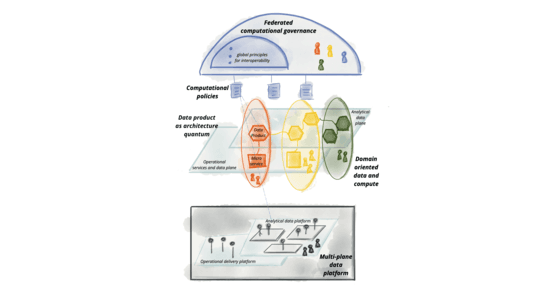
This tests your grasp of decentralized data governance (Data Mesh). A great answer outlines four principles: domain ownership, data as a product, a self-serve platform, and federated computational governance.
What's really being asked
Your ability to design a modern, scalable data governance strategy that avoids the bottlenecks of traditional, centralized models. It directly assesses your understanding of Data Mesh principles and how to balance developer autonomy with necessary controls for security, quality, and interoperability across hundreds of teams.
The full answer
Four key principles in order. First, establish Domain-Oriented Ownership, where teams that create the data are responsible for its quality, metadata, and lifecycle. Second, treat Data as a Product, meaning each dataset has clear owners, SLAs, documentation, and is discoverable via a central catalog. Third, build a Self-Serve Data Platform that provides the tooling for domains to easily publish, manage, and serve their data products. This platform includes shared solutions for the data catalog, schema registry, and access control. Fourth, implement Federated Computational Governance. This is the crucial balance: a central body of domain representatives sets global rules (e.g., PII tagging, schema compatibility), but these rules are automatically enforced by the platform (computationally), not by manual review.
The mistakes people make
Proposing a single, central "data governance team" to act as a gatekeeper for all schema changes, access requests, and catalog entries. This approach is unscalable and creates massive bottlenecks. Another red flag is simply listing tools (e.g., "Use Amundsen, a schema registry, and Ranger") without explaining the sociotechnical system: who is responsible for what, and how are policies enforced without killing developer velocity? Finally, failing to mention the organizational shift required from a central data team to an enabling platform team is a major miss.
What usually comes next
How do you handle a domain that consistently produces low-quality data? (Answer: Use data-as-a-product SLAs, observability dashboards, and potentially chargeback models). How would you migrate from a centralized model to this federated one? (Answer: Start with a pilot program with a few willing domains, demonstrate value, and build the self-serve platform iteratively). What is the role of the central data team now? (Answer: They shift from being gatekeepers to being platform builders and facilitators of the federated governance council).
A concrete example
For the schema registry, the federated governance body defines a global policy that all schemas must be backward compatible and must include PII annotations for specific field names (e.g., email, ssn). The self-serve platform provides a CI/CD pipeline for schema registration. A domain team can update their schema anytime via this pipeline. The pipeline automatically runs a linter that checks for backward compatibility and the required PII annotations. If the checks fail, the change is automatically rejected. This enforces the global policy without a human bottleneck.
Interview question
In a scalable data governance framework like Data Mesh, what is the primary mechanism for enforcing global policies without creating bottlenecks?
- a.Each data domain is fully autonomous, defining and enforcing its own data quality and security standards.
- b.A dedicated central data governance team acts as a gatekeeper, approving all schema changes and data access.
- c.Data governance is primarily achieved by implementing industry-standard data catalog and schema registry tools.
- d.Global policies are established by a cross-domain council and automatically enforced by the self-serve data platform.Correct
Why? this is the answer
The Data Mesh principle of Federated Computational Governance dictates that a central body (federated council) defines global rules, which are then automatically enforced by the self-serve data platform. This contrasts with a centralized gatekeeping team, which the card identifies as an unscalable bottleneck.
Just read this? Test yourself on what you have been reading.
Read the original → martinfowler.com
You just looked this up. Could you explain it out loud?
That is the part interviews actually test. Tezvyn takes questions like this one and gives you what the interviewer is really checking, the answer that lands, and the mistake that ends the conversation, in the four minutes before your next meeting.
The iPhone app is on the way
We are building it. Until it lands, nothing here is held back from you: every interview card, your saved cards, streaks and the job board all work in Safari, plus hundreds of free practice quizzes of thirty questions each. Sign in and it all carries over to the app the day it arrives.
Want it as an icon? Tap Share at the bottom of Safari, then Add to Home Screen. It opens full screen and the cards you have read stay available offline.
We are hiring for this. Open roles that interview on data governance — each one lists the topics its interview covers.
See open roles