Ensemble Forecasting: Predicting with a Crowd of Models
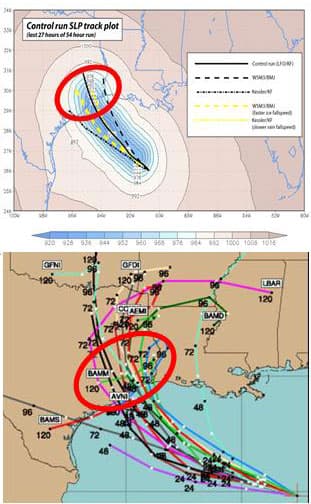
Instead of one 'best guess,' ensemble methods generate many forecasts to map the range of possibilities. This is crucial for complex systems like weather prediction, where a single model is misleadingly precise.
THE MENTAL MODEL: Instead of trusting a single, potentially flawed forecast, ensemble methods generate a committee of forecasts. This approach provides not just a single prediction but a measure of confidence in it. A tight cluster of forecasts suggests high certainty, while a wide spread signals significant uncertainty about the future state.
HOW IT WORKS: An ensemble is created by running the same forecasting model multiple times, each with slightly different initial conditions. For a weather forecast, this could mean running 50 simulations, each with a tiny, plausible variation in the starting temperature or wind speed. Each simulation evolves independently, and the collection of their final states forms the ensemble forecast. This set of outcomes gives a probabilistic view of what might happen.
WHEN TO USE IT: Use ensemble methods for complex, chaotic systems where small changes in initial inputs can lead to vastly different outcomes. This is standard practice in numerical weather prediction and climate modeling. It's also valuable in financial modeling to project market movements or in epidemiology to forecast the spread of a disease. Use it whenever understanding the range of possibilities is more important than a single, brittle number.
WHEN NOT TO USE IT: For simple, linear, and well-understood systems, a single deterministic model is more efficient. If you're forecasting inventory for a stable product with predictable demand, an ensemble is computational overkill. It's a heavy-duty tool for complex problems and may not be practical without significant computing resources to run many parallel simulations.
ONE CANONICAL EXAMPLE: A hurricane track forecast is the classic example. A single line on a map representing the 'most likely track' is notoriously unreliable. News outlets instead show a 'cone of uncertainty,' which is the graphical representation of an ensemble forecast. The cone is formed by the collection of many individual predicted storm tracks. Where the tracks are tightly bundled, confidence is high. Where the cone widens, it signifies that the storm's future path is highly uncertain.
Read the original → en.wikipedia.org
Get five bites like this every day.
Tezvyn delivers a daily feed of 60-second tech bites with quizzes to lock in what you learn.