Explain a star schema and its advantages for analytics
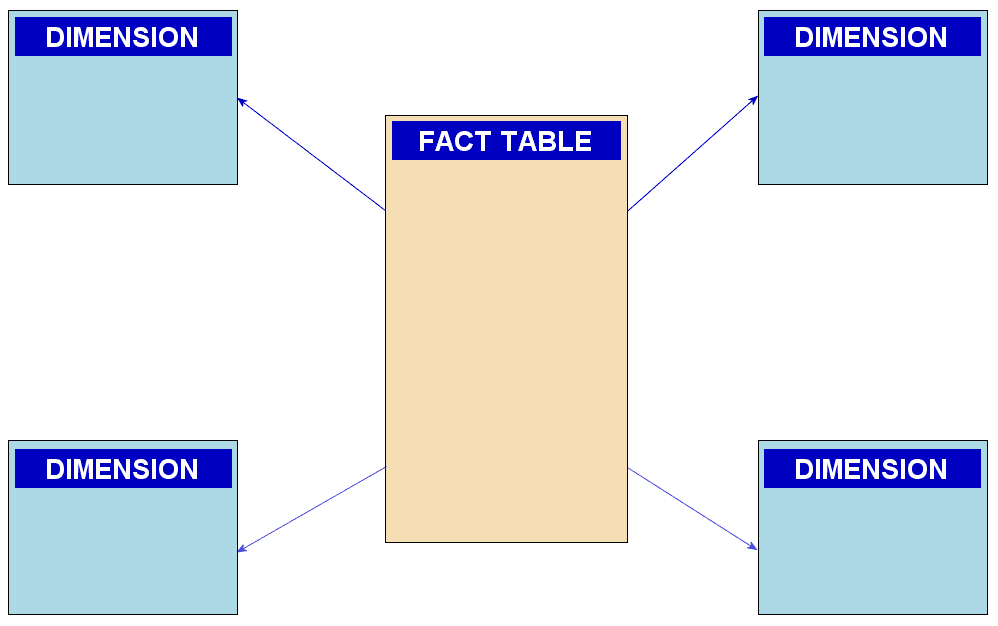
Tests your grasp of data modeling trade-offs for OLAP vs. OLTP. A good answer defines fact/dimension tables, then explains how denormalization and fewer joins improve query speed for analytics. A red flag is confusing it with a snowflake schema.
What's really being asked
This question probes your understanding of database design trade-offs. Interviewers want to see if you know why different workloads require different data models. It's not just about defining a star schema; it's about explaining why its denormalized structure is a deliberate, performance-oriented choice for analytics (OLAP) in contrast to the write-optimized, highly normalized schemas (like 3NF) used for transactional systems (OLTP).
The full answer
A good answer covers four key points. First, define the components: a central fact table containing quantitative measures (e.g., sales amount, units sold) and foreign keys. Second, describe the dimension tables that radiate from the fact table like points of a star, containing descriptive attributes (e.g., product name, customer city, date details). Third, explain the primary benefit: query performance. By denormalizing data into wide dimension tables, you drastically reduce the number of joins needed for a query. This is critical for analytical queries that scan and aggregate millions or billions of rows. Fourth, contrast this with a 3NF schema, explaining that 3NF is optimized for writes (avoiding data redundancy and anomalies) but requires many complex joins, which are slow for reporting.
The mistakes people make
A major red flag is simply describing the "star" shape without explaining the performance implications. Many candidates say "it has fewer joins" but can't articulate why that matters for analytics workloads (e.g., simpler query plans, less I/O). Another mistake is confusing it with a snowflake schema, which is more normalized (dimension tables are broken down into sub-dimensions). Also, saying it "saves space" is generally incorrect; denormalization often increases storage footprint in exchange for query speed.
What usually comes next
Expect questions like "When would you use a snowflake schema instead?" (Answer: When dimension tables are very large and you need to save space, or to better represent complex hierarchies). Another is "What is a factless fact table?" (Answer: A table that records an event, with no numeric measures, just foreign keys to dimensions). Or, "How would you handle slowly changing dimensions (SCDs)?"
A concrete example
Imagine an e-commerce business. The fact table, fact_sales, would contain columns like order_date_key, customer_key, product_key, units_sold, and sale_amount. The dimension tables would be dim_customer (with customer_name, city, state), dim_product (with product_name, category, brand), and dim_date (with full_date, month, year, is_weekend). To get total sales by brand for a specific state, you only need to join fact_sales to dim_product and dim_customer. In a 3NF schema, you might need to join 5-7 tables (orders, order_items, products, categories, brands, customers, addresses) making the query much slower.
Interview question
A data architect chooses a star schema for a new data warehouse. What is the most likely primary reason for this design decision?
- a.To support complex, multi-level hierarchical relationships within dimension tables through further normalization.
- b.To reduce the overall storage footprint by eliminating duplicate data across tables.
- c.To optimize query performance for analytical reporting by drastically reducing the number of table joins.Correct
- d.To ensure maximum data integrity and minimize data redundancy for transactional updates.
Why? this is the answer
A star schema is specifically designed for analytical workloads (OLAP) to improve query performance. Its denormalized structure reduces the need for multiple joins, which is crucial for fast aggregation and scanning of large datasets. Option D describes the benefits of highly normalized schemas (like 3NF) used for transactional systems (OLTP), which prioritize data integrity and write efficiency over read performance.
Just read this? Test yourself on what you have been reading.
Read the original → en.wikipedia.org
- #data modeling
- #sql
- #analytics
- #olap
- #database design
You just looked this up. Could you explain it out loud?
That is the part interviews actually test. Tezvyn takes questions like this one and gives you what the interviewer is really checking, the answer that lands, and the mistake that ends the conversation, in the four minutes before your next meeting.
The iPhone app is on the way
We are building it. Until it lands, nothing here is held back from you: every interview card, your saved cards, streaks and the job board all work in Safari, plus hundreds of free practice quizzes of thirty questions each. Sign in and it all carries over to the app the day it arrives.
Want it as an icon? Tap Share at the bottom of Safari, then Add to Home Screen. It opens full screen and the cards you have read stay available offline.
We are hiring for this. Open roles that interview on data modeling — each one lists the topics its interview covers.
See open roles