Explain the star schema and its advantages for analytics
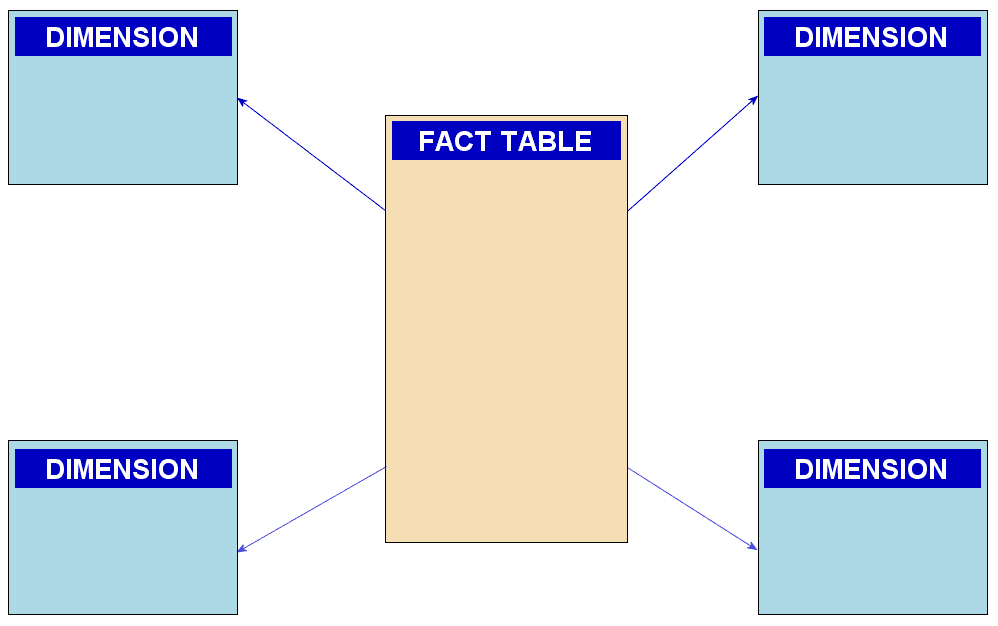
This tests your grasp of OLAP vs. OLTP data modeling. A great answer defines fact/dimension tables, explains how denormalization leads to fewer joins and faster queries, and contrasts this with 3NF's focus on write integrity.
What's really being asked
This question probes your understanding of fundamental data warehousing concepts and the trade-offs between different data models. The interviewer isn't just looking for a definition; they want to see if you can connect a schema's structure (star vs. 3NF) to its intended workload (analytics vs. transactions) and articulate the specific performance and usability implications of that choice.
The full answer
First, define the star schema's components: a central fact table containing quantitative business metrics (e.g., sales_amount, units_sold) and foreign keys, surrounded by dimension tables containing descriptive attributes (e.g., product_name, store_city, calendar_date). Second, highlight that dimension tables are intentionally denormalized. For instance, a product dimension might include product, category, and brand information in a single table. Third, explain the primary advantage is query performance. Fewer joins are needed because of denormalization, making aggregations much faster. A query for sales by brand might be a 2-table join, versus 4+ in 3NF. Fourth, mention the secondary advantage: simplicity. The model is intuitive for analysts and BI tools, as it mirrors how business users think about metrics and their attributes. Finally, contrast this with a highly normalized (3NF) schema, which is optimized for OLTP systems to minimize data redundancy and avoid update anomalies, prioritizing write-path integrity over read-path performance.
The mistakes people make
A frequent mistake is confusing a star schema with a snowflake schema. A snowflake schema normalizes the dimensions, creating more tables and joins, which negates some of the star schema's simplicity. Another red flag is vaguely stating "it's faster for reporting" without explaining that the speed comes directly from requiring fewer, less complex joins on large datasets. A less experienced candidate might also describe 3NF as simply "bad," failing to recognize it's the optimal choice for its specific use case (transactional systems).
What usually comes next
Expect questions like: "When would you choose a snowflake schema over a star schema?" (Answer: For very large, shared dimensions where storage savings from normalization are significant, e.g., a massive customer dimension). Or, "How would you handle a slowly changing dimension (SCD), like a customer moving to a new address?" (Answer: Describe Type 1 overwrite, Type 2 new row with versioning, or Type 3 previous value column).
A concrete example
Consider a retail data warehouse. The fact table, fact_sales, would have columns like product_key, date_key, store_key, units_sold, and revenue. It would be surrounded by dimensions like dim_product (product_key, product_name, brand, category) and dim_store (store_key, store_name, city, region). To get total revenue by brand for a specific region, you only need to join fact_sales, dim_product, and dim_store. In a 3NF schema, you might need additional joins to separate tables for brands, categories, cities, and regions, making the query significantly slower and more complex.
Interview question
What is the primary advantage of using a star schema over a highly normalized (3NF) model for analytical queries?
- a.It minimizes data redundancy to prevent update anomalies and ensure write-path integrity.
- b.It saves storage space by normalizing the dimension tables themselves into smaller, linked tables.
- c.It is structurally simpler for business users and BI tools to navigate and understand.
- d.It reduces the number of joins required by denormalizing dimensions, leading to faster aggregations.Correct
Why? this is the answer
The correct answer is C because the star schema's main performance benefit comes from denormalized dimensions, which require fewer joins for complex queries. Option A describes the primary benefit of a 3NF model, which is optimized for transactional writes, not analytical reads.
Just read this? Test yourself on what you have been reading.
Read the original → en.wikipedia.org
- #data modeling
- #analytics
- #sql
- #data warehousing
You just looked this up. Could you explain it out loud?
That is the part interviews actually test. Tezvyn takes questions like this one and gives you what the interviewer is really checking, the answer that lands, and the mistake that ends the conversation, in the four minutes before your next meeting.
The iPhone app is on the way
We are building it. Until it lands, nothing here is held back from you: every interview card, your saved cards, streaks and the job board all work in Safari, plus hundreds of free practice quizzes of thirty questions each. Sign in and it all carries over to the app the day it arrives.
Want it as an icon? Tap Share at the bottom of Safari, then Add to Home Screen. It opens full screen and the cards you have read stay available offline.
We are hiring for this. Open roles that interview on data modeling — each one lists the topics its interview covers.
See open roles