Explain the Test Pyramid and how it guides your strategy.
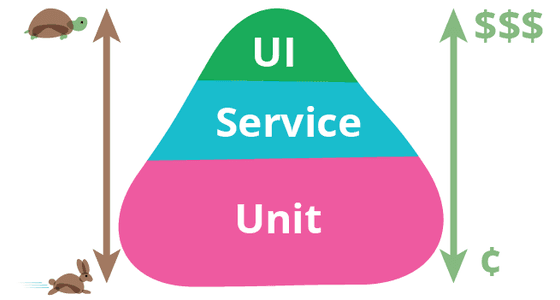
Tests your grasp of balanced automated testing. Define the pyramid's layers (Unit, Service, UI), explain trade-offs like speed and cost, then apply it to a new service. A red flag is describing the layers without explaining the 'why' behind the shape.
What's really being asked
This question tests your understanding of building a cost-effective and reliable automated testing portfolio. The interviewer wants to see if you can move beyond a simple definition and explain the trade-offs (speed, cost, brittleness) that justify the pyramid's shape. It's a test of practical strategy, not just theoretical knowledge.
The full answer
First, define the three layers. The base is a large number of Unit Tests, which are fast, isolated, and test a single component. The middle layer has fewer Service or Integration tests (also called Subcutaneous Tests), which verify interactions between components without a UI. The top has very few End-to-End or UI tests, which are slow and test the entire application stack.
Second, explain the economics. As you move up the pyramid, tests become exponentially slower to run, more expensive to write and maintain, and more brittle (i.e., likely to break due to unrelated UI changes). The pyramid shape is a direct consequence of optimizing for fast feedback and low maintenance cost.
Third, describe the feedback loop. A key senior insight is that a failure in a high-level test signals two problems: a bug in the application, and a missing unit test. The correct process is to first write a new, failing unit test that reproduces the bug, then fix the code, ensuring the bug cannot regress.
Fourth, apply the model. For a new feature, you would write many unit tests covering business logic, a few service tests for API contracts, and perhaps only one or two critical-path UI tests to ensure everything is wired together correctly.
The mistakes people make
Describing the "Ice Cream Cone" anti-pattern as a valid strategy. This is an inverted pyramid with lots of slow, brittle UI tests and few unit tests, which leads to slow builds and high maintenance.
Conflating test types. A candidate might incorrectly treat UI tests, end-to-end tests, and customer-facing tests as the same thing. They are orthogonal concepts; for example, a complex JavaScript UI should have its own unit tests.
Stopping at the definition. Simply listing the layers without explaining the underlying reasons of speed, cost, and brittleness shows a superficial understanding.
Forgetting the middle layer. Only discussing unit and UI tests misses the crucial service layer, which often provides the best balance of coverage and speed for testing component interactions.
What usually comes next
"When might you deviate from the pyramid shape?" (Answer: Very rarely, but perhaps if high-level tests are unusually fast and reliable, or for a simple CRUD app with little business logic.)
"How do you handle a flaky end-to-end test that keeps failing non-deterministically?" (Answer: Quarantine it from the main build, add detailed logging, and prioritize writing more reliable, lower-level tests to cover the same functionality.)
A concrete example
For a new "Add to Cart" feature on an e-commerce site, the strategy would be:
Unit Tests (~80% of tests): Dozens of tests for the Cart model's internal logic, such as addItem(), calculateTotal(), and applyDiscount(). These run in milliseconds.
Service Tests (~15%): A few tests that hit the /cart API endpoint directly, verifying that sending a POST request with an item ID correctly updates the database and returns the right JSON response. These run in under a second.
UI Tests (~5%): One or two tests using a tool like Selenium to simulate a full user journey: logging in, finding a product, clicking the 'Add to Cart' button, and verifying the cart icon updates. This single test might take 30-60 seconds to run.
Interview question
What is the primary strategic reason for the Test Pyramid's shape, which advocates for many unit tests and very few UI tests?
- a.As you move up from unit to UI tests, tests become exponentially slower, more expensive, and more brittle, impacting feedback speed and maintenance costs.Correct
- b.Unit tests are the best method for achieving 100% code coverage, which is the main objective of the pyramid model.
- c.UI tests provide less business value than unit tests because they only test the 'happy path' and not edge cases.
- d.This structure allows development teams to write all the tests, removing the need for a separate QA team.
Why? this is the answer
The correct answer explains the core trade-offs: higher-level tests are slower, costlier, and more fragile, so the pyramid strategy minimizes them to optimize for fast, reliable feedback. The 'code coverage' option is a tempting distractor because while unit tests drive coverage, it is not the sole goal of the pyramid model.
Just read this? Test yourself on what you have been reading.
Read the original → martinfowler.com
- #testing
- #agile
- #architecture
- #quality
You just looked this up. Could you explain it out loud?
That is the part interviews actually test. Tezvyn takes questions like this one and gives you what the interviewer is really checking, the answer that lands, and the mistake that ends the conversation, in the four minutes before your next meeting.
The iPhone app is on the way
We are building it. Until it lands, nothing here is held back from you: every interview card, your saved cards, streaks and the job board all work in Safari, plus hundreds of free practice quizzes of thirty questions each. Sign in and it all carries over to the app the day it arrives.
Want it as an icon? Tap Share at the bottom of Safari, then Add to Home Screen. It opens full screen and the cards you have read stay available offline.
We are hiring for this. Open roles that interview on testing — each one lists the topics its interview covers.
See open roles