Explain the Test Pyramid and its strategic use
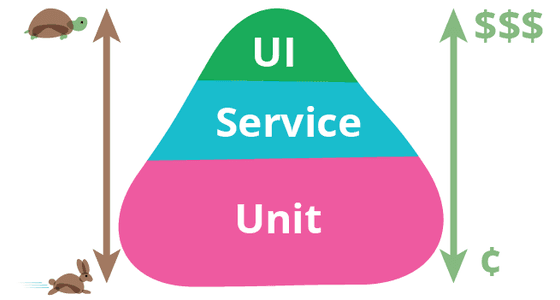
Tests your grasp of balanced testing trade-offs. A good answer defines the Unit, Service, and UI layers, explains the cost/speed rationale, and applies it to a feature strategy. A red flag is describing the pyramid but not its strategic 'why'.
What's really being asked
This question tests your understanding of automated testing strategy, specifically the trade-offs between different test types regarding speed, cost, and brittleness. The interviewer wants to see if you can move beyond definitions to make practical decisions that result in a fast, reliable, and maintainable build pipeline. It's a test of strategic thinking, not just rote memorization.
The full answer
An effective answer covers three key points in order. First, define the pyramid's structure: a large base of Unit Tests, a smaller middle layer of Service or Integration tests, and a very small top layer of UI or End-to-End (E2E) tests. Second, explain the rationale: Unit tests are fast, cheap, and precisely isolate failures, so you want many. UI tests are slow, expensive, and brittle (breaking easily with minor changes), so you should have very few. Third, apply this to a new feature: this means writing comprehensive unit tests for business logic, using service-level tests for API contracts, and adding only a few E2E tests for the most critical user paths as a final safety net.
The mistakes people make
A major red flag is describing the "Ice-Cream Cone" anti-pattern, where a team relies heavily on slow, brittle UI tests. This demonstrates inexperience with the resulting high maintenance costs and slow feedback cycles. Other mistakes include conflating test types (e.g., UI vs. E2E vs. customer-facing) or simply describing the pyramid's shape without explaining the underlying principles of cost, speed, and reliability that justify its structure. Advocating for record-playback tools without acknowledging their extreme brittleness is also a sign of a junior mindset.
What usually comes next
Expect questions like: "How does this model change for a complex single-page application?" (Hint: JavaScript unit tests). "Where do contract tests or performance tests fit in?". "What if your high-level tests are actually fast and reliable? Do you still need the lower layers?" (This probes if you understand the model's assumptions).
A concrete example
For a new e-commerce "Add to Cart" feature, a pyramid-guided strategy would be: 80% of tests are Unit Tests for the pricing logic, inventory calculation, and validation rules, running in milliseconds. 15% are Service tests that call the /cart/add API endpoint directly, verifying the database state and response, running in seconds. Only 5% are UI/E2E tests, with maybe one script that uses Selenium to load the page, click the button, and verify the cart icon updates, which could take 30+ seconds to run.
Interview question
What is the fundamental strategic reason the Test Pyramid advocates for a large number of unit tests and a small number of UI tests?
- a.Unit tests offer rapid feedback, precise fault isolation, and lower cost, whereas UI tests are slow, expensive, and prone to brittleness.Correct
- b.UI tests are primarily for validating the visual presentation and user experience, not the underlying business logic.
- c.Unit tests are simpler to automate and integrate into CI/CD pipelines compared to complex UI test setups.
- d.The volume of unit tests ensures complete code coverage, making extensive UI testing largely redundant.
Why? this is the answer
The Test Pyramid prioritizes unit tests because they are fast, cheap, and effectively isolate failures, providing quick feedback. Conversely, UI tests are minimized due to their slowness, high cost, and brittleness, making them inefficient for broad coverage.
Just read this? Test yourself on what you have been reading.
Read the original → martinfowler.com
You just looked this up. Could you explain it out loud?
That is the part interviews actually test. Tezvyn takes questions like this one and gives you what the interviewer is really checking, the answer that lands, and the mistake that ends the conversation, in the four minutes before your next meeting.
The iPhone app is on the way
We are building it. Until it lands, nothing here is held back from you: every interview card, your saved cards, streaks and the job board all work in Safari, plus hundreds of free practice quizzes of thirty questions each. Sign in and it all carries over to the app the day it arrives.
Want it as an icon? Tap Share at the bottom of Safari, then Add to Home Screen. It opens full screen and the cards you have read stay available offline.
We are hiring for this. Open roles that interview on testing — each one lists the topics its interview covers.
See open roles