FastAPI: Automatic Interactive API Docs
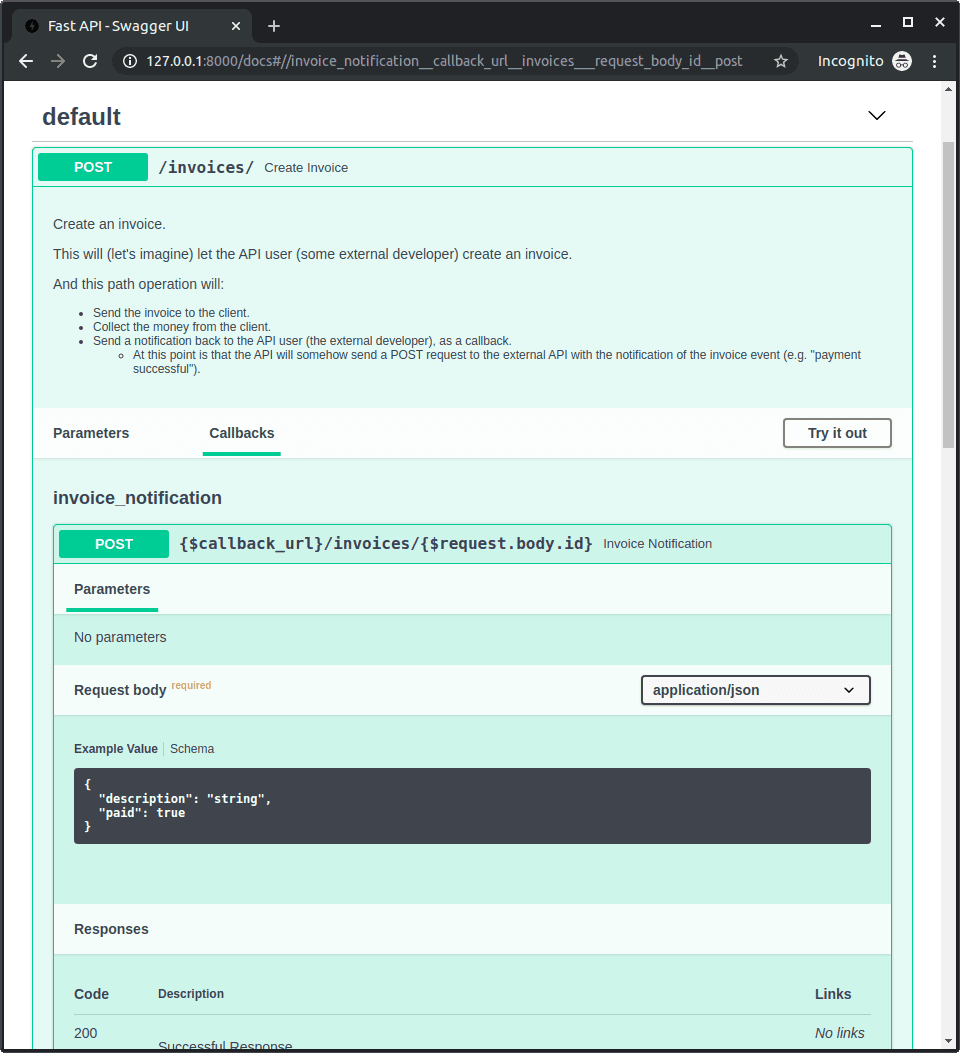
FastAPI turns your Python type hints into live, interactive API documentation. It generates an OpenAPI schema to power a UI where you can test endpoints directly from your browser, no extra work needed.
Why it exists
Manually writing and maintaining API documentation is tedious and error-prone. Docs quickly become outdated as code changes, creating a disconnect between the specification and the implementation, which leads to integration problems for API consumers.
The mental model
Think of your code as the single source of truth for your documentation. FastAPI reads your Python functions, their parameters, their type hints, and Pydantic models. It uses this information to build a detailed, machine-readable contract of your API, which it then uses to render a human-friendly, interactive website.
How it works
FastAPI leverages the OpenAPI standard to define the API structure in a standard JSON format, and JSON Schema to define the data models. When you run your application, FastAPI introspects your code, generates an openapi.json file on the fly, and serves it at /openapi.json. It also includes two pre-configured web UIs that consume this file: Swagger UI (at /docs) and ReDoc (at /redoc). Swagger provides a "Try it out" feature for every endpoint, while ReDoc offers a cleaner, multi-column documentation view.
When to use it
This is a default, core feature of every FastAPI project. It is invaluable for team collaboration, allowing frontend developers or other API consumers to understand and test endpoints without needing to run the backend code locally. It also serves as an excellent debugging tool for backend developers to quickly interact with their own endpoints.
When not to use it
You might disable the public-facing documentation in production environments for security reasons, to avoid exposing your API's internal structure. You can achieve this by initializing the FastAPI app with docs_url=None and redoc_url=None.
One canonical example
If you write a function async def get_user(user_id: int):, FastAPI automatically understands that user_id is a required integer path parameter. When you visit /docs, you will see an entry for the endpoint /users/{user_id}. The UI will provide a field to input an integer for user_id and a button to execute the request against your running server, showing you the exact response.
Interview question
What is the fundamental principle behind FastAPI's ability to provide accurate and up-to-date API documentation?
- a.It integrates with a continuous integration pipeline to validate documentation against API tests.
- b.It uses a proprietary markup language embedded in docstrings to define API endpoints and parameters.
- c.It relies on developers to meticulously maintain separate OpenAPI specification files.
- d.It automatically generates documentation by introspecting the application's Python code and type hints.Correct
Why? this is the answer
The card states, "Think of your code as the single source of truth for your documentation. FastAPI reads your Python functions, their parameters, their type hints..." This means the documentation is generated directly from the code, ensuring it's always current. Other options describe alternative or supplementary methods, but not FastAPI's core mechanism for documentation generation.
Just read this? Test yourself on what you have been reading.
Read the original → fastapi.tiangolo.com
You just looked this up. Could you explain it out loud?
That is the part interviews actually test. Tezvyn takes questions like this one and gives you what the interviewer is really checking, the answer that lands, and the mistake that ends the conversation, in the four minutes before your next meeting.
The iPhone app is on the way
We are building it. Until it lands, nothing here is held back from you: every interview card, your saved cards, streaks and the job board all work in Safari, plus hundreds of free practice quizzes of thirty questions each. Sign in and it all carries over to the app the day it arrives.
Want it as an icon? Tap Share at the bottom of Safari, then Add to Home Screen. It opens full screen and the cards you have read stay available offline.
We are hiring for this. Open roles that interview on fastapi — each one lists the topics its interview covers.
See open roles