FinOps: Making Cloud Costs Everyone's Job
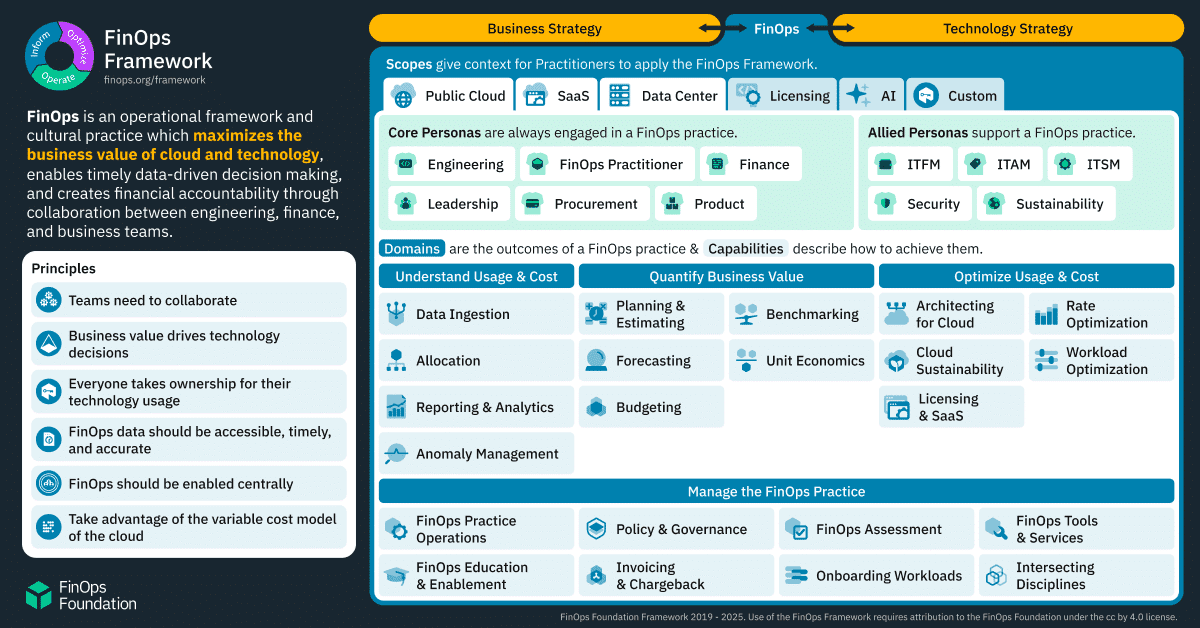
FinOps makes cloud cost a shared responsibility between engineering, finance, and business teams. It applies the variable, on-demand nature of the cloud to financial accountability.
Why it exists
The shift to the cloud replaced fixed data center costs with a variable, on-demand spending model. Engineers could provision resources instantly, but traditional finance processes couldn't track the spending in real-time. This created a gap where costs could spiral without accountability, leading to budget overruns and waste.
The mental model
FinOps treats cloud spend as a business metric to be optimized, not just an expense to be cut. The goal is to maximize the business value derived from every dollar spent. It's a cultural practice that creates shared ownership of cloud costs between engineering, finance, and product teams, shifting from a centralized cost center to decentralized, real-time financial accountability.
How it works
FinOps is a continuous practice built on collaboration. It starts with providing teams with timely, accessible, and accurate data about their cloud usage. This visibility allows different personas—engineers, finance, leadership, and product owners—to make data-driven decisions. The practice is organized into domains: understanding cost, quantifying business value, optimizing usage, and managing the overall FinOps practice through governance and education.
When to use it
Adopt FinOps when your cloud bill is significant and you lack a clear understanding of what drives costs. It is essential when engineering teams are decentralized and can provision their own infrastructure. It helps align technology decisions with business goals, for instance, by calculating unit economics like 'cost per customer' or 'cost per API call'.
When not to use it
A formal FinOps framework is likely overkill for a small organization with a simple, static cloud footprint and a predictably low bill. If one person manages all infrastructure and costs are negligible, the overhead of the practice may not be justified, though the core principles of cost awareness remain valuable.
One canonical example
An e-commerce company sees its cloud bill spike during the holidays. Instead of just accepting it, a cross-functional team collaborates. Engineering analyzes usage data and finds over-provisioned databases. Finance models the savings from purchasing reserved capacity for baseline workloads. The product team weighs the cost of a new feature against its projected revenue. Together, they optimize spend without hurting performance, maximizing profit during their busiest season.
Interview question
What is a fundamental principle of the FinOps framework regarding cloud cost management?
- a.Cloud costs are treated as a shared responsibility across engineering, finance, and business teams.Correct
- b.The main goal is to cut cloud spending as much as possible, even if it impacts performance.
- c.Engineering teams are solely accountable for optimizing the cloud resources they provision.
- d.Cloud cost management is primarily the responsibility of a centralized finance department.
Why? this is the answer
FinOps emphasizes that cloud cost management is a shared responsibility, fostering collaboration among engineering, finance, and business teams. Option D is incorrect because FinOps moves away from a purely centralized finance-driven model to a collaborative one.
Just read this? Test yourself on what you have been reading.
Read the original → finops.org
- #finops
- #cloud
- #mlops & infrastructure
- #cost optimization
You just looked this up. Could you explain it out loud?
That is the part interviews actually test. Tezvyn takes questions like this one and gives you what the interviewer is really checking, the answer that lands, and the mistake that ends the conversation, in the four minutes before your next meeting.
The iPhone app is on the way
We are building it. Until it lands, nothing here is held back from you: every interview card, your saved cards, streaks and the job board all work in Safari, plus hundreds of free practice quizzes of thirty questions each. Sign in and it all carries over to the app the day it arrives.
Want it as an icon? Tap Share at the bottom of Safari, then Add to Home Screen. It opens full screen and the cards you have read stay available offline.
We are hiring for this. Every open role lists the topics its interview covers, so you can prepare for the real thing rather than guessing.
See open roles