How does management's role evolve in scaled agile frameworks like LeSS?
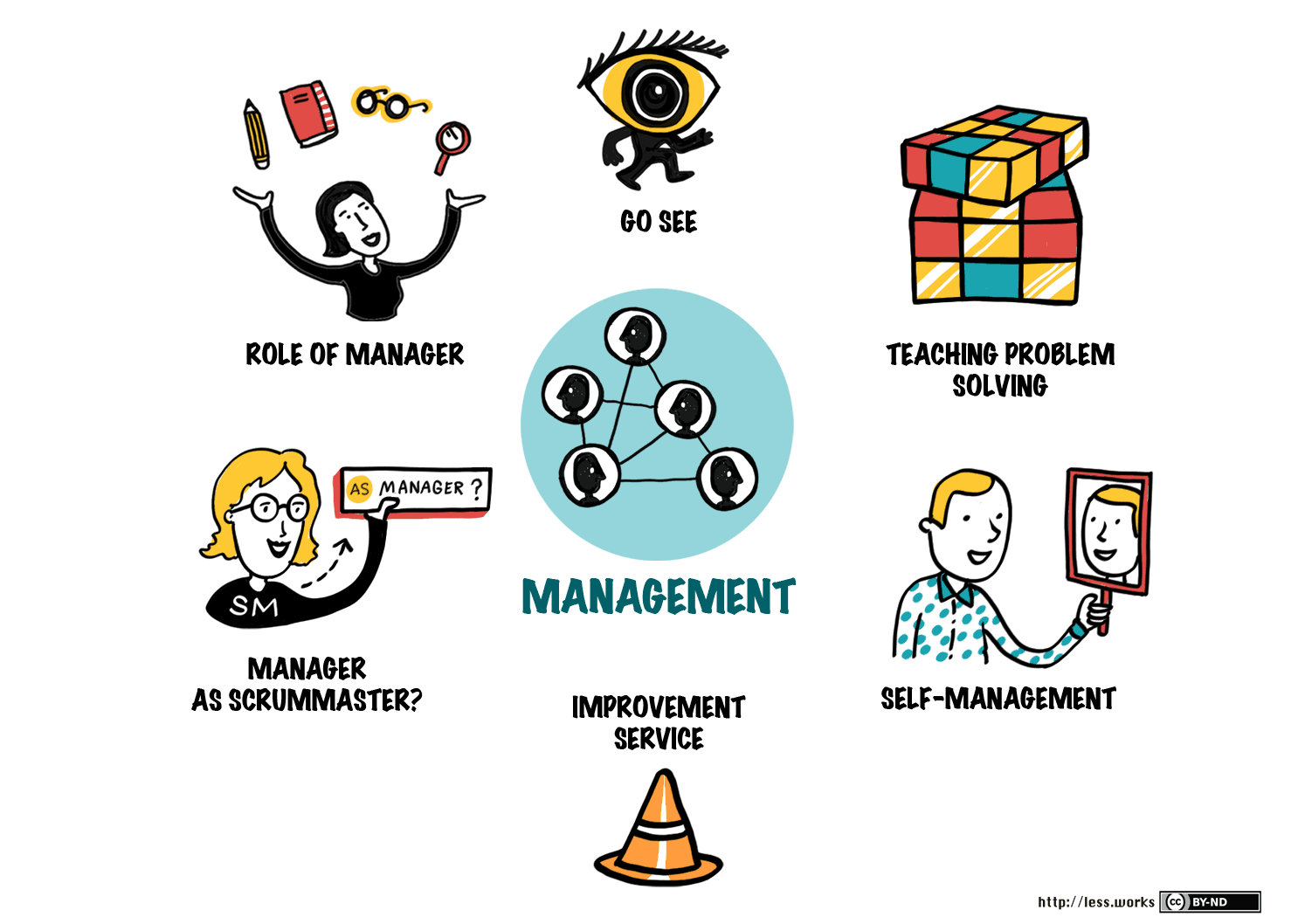
This tests your grasp of modern agile management, moving from command-and-control to enabling teams. Contrast Theory X (directing) with Theory Y (coaching). In LeSS, managers improve the system and teach, not assign tasks.
What's really being asked
This question probes your understanding of servant leadership in a scaled environment. It's not about knowing the LeSS rules, but about grasping the fundamental philosophical shift in management's purpose. Interviewers are testing if you see management as a function that improves the system, not one that directs the people within it. They want to see you articulate the difference between managing tasks (traditional) and cultivating an environment where high-performing teams can solve their own problems, including dependencies.
The full answer
First, contrast the two underlying philosophies using the Theory X vs. Theory Y model. Theory X (traditional) assumes people need to be controlled and directed. Theory Y (LeSS/modern agile) assumes people are self-motivated and seek responsibility. Second, explain how responsibilities are re-delegated in LeSS: Product Owners decide WHAT work to do, and self-managing teams decide HOW to do it. This makes the traditional manager's role of assigning and tracking work redundant. Third, define the new role of the manager as an organizational systems thinker. Their job is to improve the overall system by teaching problem-solving, removing systemic impediments, and creating an environment for continuous improvement. Fourth, explicitly state that in this model, managers 'Go See'—they observe teams to understand reality, rather than relying on status reports.
The mistakes people make
A major red flag is describing the manager as a chief dependency-resolver or a 'super Scrum Master.' This indicates a failure to grasp the principle of team self-management. Another wrong answer is to focus on process policing, suggesting the manager's job is just to 'make sure teams are doing agile correctly.' This is a superficial understanding. A candidate who suggests managers should still approve technical designs, mediate all cross-team conflicts directly, or use metrics like individual velocity for performance reviews is demonstrating a traditional, command-and-control mindset that is incompatible with LeSS.
What usually comes next
Expect questions like: 'What happens when two teams are deadlocked on a dependency and can't resolve it?' (A good answer involves coaching the teams to find a solution, not dictating one). Or, 'What metrics would this type of manager track?' (Answer: System-level metrics like customer lead time, cycle time, and customer satisfaction, not team-level output metrics like story points). Or, 'How would you transition a traditional manager to this new role?'
A concrete example
Imagine two teams have recurring integration failures. A traditional 'command' manager might impose a new sign-off process, making themselves a bottleneck and adding bureaucracy. An 'enabling' LeSS manager would facilitate a joint retrospective with the teams. They would teach them root cause analysis techniques. The teams, not the manager, might decide to implement automated contract testing or create a temporary cross-team task force. The manager improves the organization's problem-solving capability rather than just fixing the single problem.
Interview question
In a LeSS framework, when two teams have a recurring, unresolved dependency, what is the manager's most effective response?
- a.Audit the teams' adherence to the LeSS framework rules to find and correct their process deviations.
- b.Define and impose a new mandatory process that both teams must follow to prevent future conflicts.
- c.Coach the teams on problem-solving techniques so they can analyze the root cause and develop their own solution.Correct
- d.Act as the primary liaison, coordinating between the teams to resolve the dependency for them.
Why? this is the answer
The correct answer reflects the manager's role as a teacher who enables self-managing teams to solve their own problems. Acting as a liaison (D) is a common misconception that undermines team ownership and creates a dependency on the manager.
Just read this? Test yourself on what you have been reading.
Read the original → less.works
You just looked this up. Could you explain it out loud?
That is the part interviews actually test. Tezvyn takes questions like this one and gives you what the interviewer is really checking, the answer that lands, and the mistake that ends the conversation, in the four minutes before your next meeting.
The iPhone app is on the way
We are building it. Until it lands, nothing here is held back from you: every interview card, your saved cards, streaks and the job board all work in Safari, plus hundreds of free practice quizzes of thirty questions each. Sign in and it all carries over to the app the day it arrives.
Want it as an icon? Tap Share at the bottom of Safari, then Add to Home Screen. It opens full screen and the cards you have read stay available offline.
We are hiring for this. Open roles that interview on agile — each one lists the topics its interview covers.
See open roles