How to apply Conway's Law to design team structures?
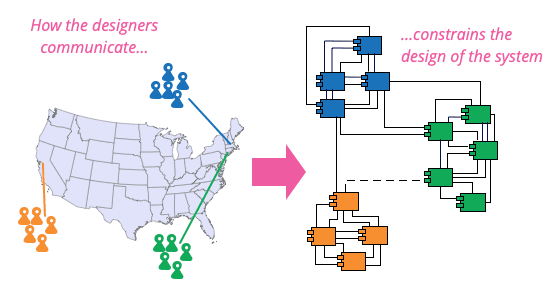
Tests if you can use Conway's Law proactively (the 'Inverse Conway Maneuver'). Outline: define the target architecture, then align small, autonomous teams to its components. A red flag is seeing the law only as a constraint, not a tool for intentional design.
What's really being asked
This question tests your understanding of the 'Inverse Conway Maneuver'. It assesses if you can think strategically about the relationship between organizational structure and software architecture. Interviewers are looking for senior candidates who see software development as a socio-technical system, where team design is a powerful lever to achieve technical goals. It separates candidates who simply observe Conway's Law from those who know how to use it as a tool.
The full answer
A strong answer addresses four key points in order. First, start with the desired architecture. For microservices, this means identifying the bounded contexts that will become services. Second, explicitly name the 'Inverse Conway Maneuver' and state the goal: to structure the organization to produce that desired architecture. Third, propose creating small, autonomous, cross-functional teams (e.g., 5-9 people) and assign each team full ownership of one or more services. Fourth, emphasize that inter-team communication must mirror the desired inter-service communication. That is, it should be formal, asynchronous, and via well-defined interfaces, just like API calls.
The mistakes people make
A major red flag is suggesting you can 'fight' or 'ignore' Conway's Law. This shows a lack of experience with how human systems behave. Another common mistake is proposing activity-oriented teams (e.g., a 'frontend team', a 'database team'). This structure directly encourages the creation of a layered monolith, which is the opposite of the desired microservices architecture. Finally, a weak answer might suggest creating many small teams without considering the new communication overhead, which simply trades one problem for another.
What usually comes next
Expect questions like: 'How would you transition a large team on a monolith to this model?' (Hint: Apply the Strangler Fig pattern to the organization, peeling off one small team at a time to own a new service). Or, 'What are the costs of this approach?' (Hint: Coordination overhead, potential for duplicated effort, tooling complexity). Or, 'Does this apply to a 10-person startup?' (Hint: No, a single team with high-bandwidth communication will naturally build a monolith, which is often appropriate at that scale).
A concrete example
An architect leading a project with six teams in six different cities made their first decision: 'There will be six major subsystems.' They did this before knowing what the subsystems were. They recognized that the high communication friction between cities would make tight coupling impossible. By pre-deciding on six subsystems, they forced an architecture that respected the communication boundaries of the organization, leveraging Conway's Law from day one.
Interview question
When applying the Inverse Conway Maneuver to design teams for a microservices architecture, what is the recommended first step?
- a.Restructure existing large teams into smaller, cross-functional units of 5-9 people
- b.Create specialized teams for distinct architectural layers like frontend, backend, and database
- c.Implement strict, asynchronous communication protocols between all development teams
- d.Identify the bounded contexts that will form the desired microservices architectureCorrect
Why? this is the answer
The card explicitly states that the first step is to "start with the desired architecture," which for microservices means "identifying the bounded contexts." Option B describes an activity-oriented team structure, which is a common wrong answer and leads to a layered monolith, not a microservices architecture.
Just read this? Test yourself on what you have been reading.
Read the original → martinfowler.com
- #architecture
- #team-structure
- #conways-law
- #leadership
- #agile
You just looked this up. Could you explain it out loud?
That is the part interviews actually test. Tezvyn takes questions like this one and gives you what the interviewer is really checking, the answer that lands, and the mistake that ends the conversation, in the four minutes before your next meeting.
The iPhone app is on the way
We are building it. Until it lands, nothing here is held back from you: every interview card, your saved cards, streaks and the job board all work in Safari, plus hundreds of free practice quizzes of thirty questions each. Sign in and it all carries over to the app the day it arrives.
Want it as an icon? Tap Share at the bottom of Safari, then Add to Home Screen. It opens full screen and the cards you have read stay available offline.
We are hiring for this. Open roles that interview on architecture — each one lists the topics its interview covers.
See open roles