How would you apply Conway's Law to design team structures for microservices?
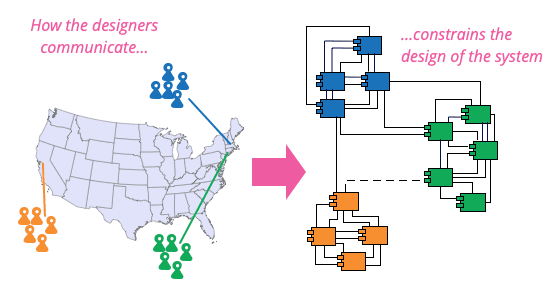
Using org structure as an intentional architecture lever.
Map bounded contexts to cross-functional teams; use APIs as contracts; split by decoupling boundary.
What's really being asked
This question tests whether you understand Conway's Law as an active design constraint rather than a passive observation. The interviewer wants to see if you recognize that human communication patterns directly determine software coupling, and whether you can intentionally shape team topology to produce a target architecture. Senior candidates should demonstrate that org design is an architectural activity, not just an HR function.
The full answer
A strong answer hits four things in order. First, acknowledge that you cannot fight Conway's Law; if the organization is structured a certain way, the system will mirror it, so the org must be designed first. Second, map bounded contexts or business capabilities to autonomous cross-functional teams that own the full lifecycle of their services, which naturally produces microservices with loose coupling and high cohesion. Third, design inter-team APIs and contracts to match actual communication patterns, accounting for time zones and location; teams that cannot talk easily need stable, well-defined interfaces. Fourth, explicitly reject layer-based team structures like separate front-end, back-end, and database teams because they force a PresentationDomainDataLayering architecture and create tight coupling across the system.
The mistakes people make
The biggest red flag is suggesting that architecture can be mandated from an ivory tower without changing team structures. Another mistake is proposing layer-oriented teams while claiming to want microservices; this directly contradicts Conway's Law and leads to distributed monoliths. Candidates also stumble by ignoring communication friction, such as assuming six teams in six time zones can maintain the same informal coordination as a single co-located team.
What usually comes next
The interviewer may ask how you would restructure an existing monolith when the current teams are organized by technology layer. They might also probe how remote-first work changes the law, or how you would handle a platform team that provides shared infrastructure without becoming a bottleneck. Another common follow-up is what to do when business capabilities do not cleanly map to team boundaries.
A concrete example
Suppose you want to move from a monolith to microservices in an e-commerce company. Instead of keeping front-end, back-end, and database teams, you create small teams around capabilities like Search, Checkout, and Inventory. Each team contains its own developers, testers, and data specialists. Because Search and Checkout rarely need deep real-time collaboration, their API boundary becomes a stable service contract. If Checkout and Inventory must coordinate tightly, you either colocate them or merge them into one team until the boundary clarifies. The resulting system architecture mirrors these communication boundaries, producing genuinely decoupled services.
Interview question
When applying Conway's Law to design teams for microservices, which structure best produces loose coupling and high cohesion?
- a.Organize autonomous cross-functional teams around business capabilities or bounded contexts, giving each team full lifecycle ownershipCorrect
- b.Maintain separate front-end, back-end, and database teams, and enforce service boundaries through strict architectural governance
- c.Establish a central architecture team to design all service contracts while implementation teams focus on coding their assigned layers
- d.Assign developers to microservices based on immediate workload needs, rotating staff between teams each sprint
Why? this is the answer
Conway's Law dictates that software structure mirrors communication patterns, so aligning autonomous cross-functional teams with bounded contexts creates loosely coupled services. Option B is tempting but wrong because layer-based teams force tight coupling and contradict the law.
Just read this? Test yourself on what you have been reading.
Read the original → martinfowler.com
- #conways-law
- #team-topologies
- #microservices
- #organizational-design
- #software-architecture
You just looked this up. Could you explain it out loud?
That is the part interviews actually test. Tezvyn takes questions like this one and gives you what the interviewer is really checking, the answer that lands, and the mistake that ends the conversation, in the four minutes before your next meeting.
The iPhone app is on the way
We are building it. Until it lands, nothing here is held back from you: every interview card, your saved cards, streaks and the job board all work in Safari, plus hundreds of free practice quizzes of thirty questions each. Sign in and it all carries over to the app the day it arrives.
Want it as an icon? Tap Share at the bottom of Safari, then Add to Home Screen. It opens full screen and the cards you have read stay available offline.
We are hiring for this. Every open role lists the topics its interview covers, so you can prepare for the real thing rather than guessing.
See open roles