Image-to-Image Translation: One Model, Many Styles
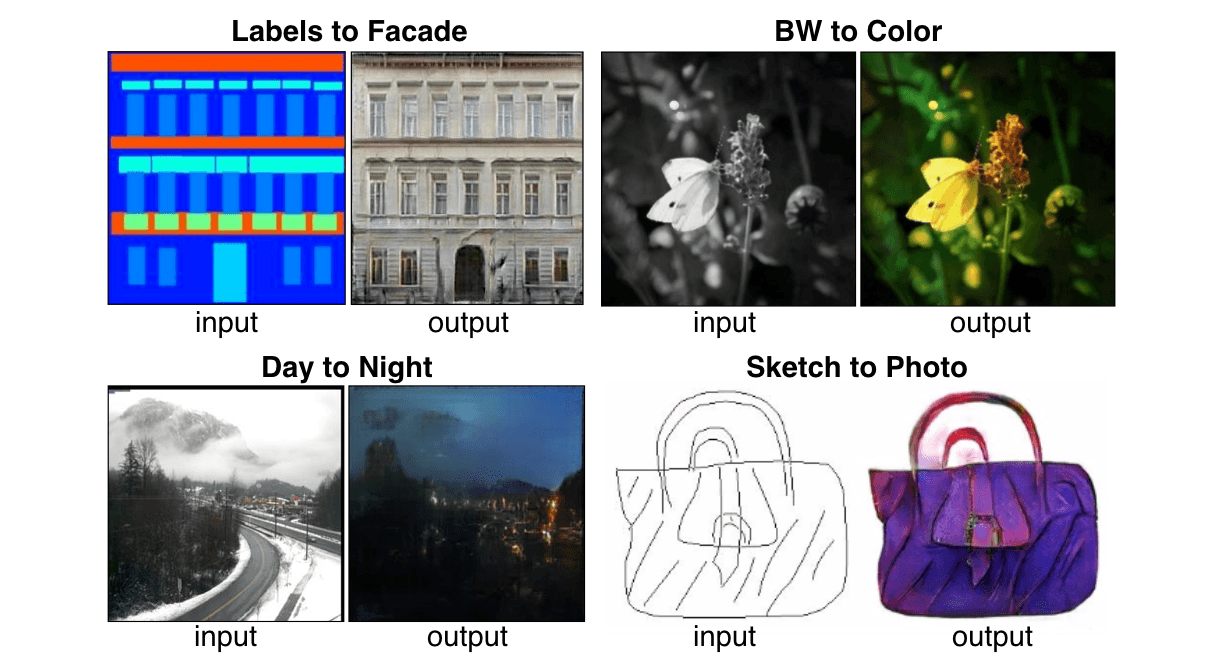
Think of it as a universal visual translator. Given paired examples, it learns to convert one image style to another, like turning a building sketch into a photorealistic rendering. The footgun: it needs a large, aligned 'before-and-after' dataset.
Why it exists
Before general-purpose models, translating one type of image to another—like colorizing a black-and-white photo—required a unique, hand-engineered loss function for each specific task. This was slow and specialized. Image-to-image translation provides a single, unified framework that can be trained on different paired datasets to solve many of these problems without custom code.
The mental model
Think of a student artist (the Generator) learning to mimic a master. The student is given a sketch (the input image) and tries to produce a finished painting (the output image) in the master's style. A critic (the Discriminator) looks at the original sketch and the finished painting, and must decide if it's a genuine work from the master or a forgery from the student. The student's goal is to fool the critic, getting progressively better at creating authentic-looking paintings from sketches.
How it works
This technique uses a Conditional Generative Adversarial Network (cGAN). It has two parts: a Generator and a Discriminator. The Generator takes an input image (e.g., a semantic map) and creates a new output image (e.g., a realistic photo). The Discriminator then looks at the input image alongside an output image—either the real one from the dataset or the fake one from the Generator—and tries to determine if the pair is authentic. The Generator is trained to produce images so realistic that they fool the Discriminator. The "conditional" aspect is key: the judgment is conditioned on the input image.
When to use it
Use this for any problem you can frame as translating between two visual domains, provided you have a large dataset of paired examples. Common applications include: synthesizing photos from label maps, converting satellite aerials to street maps, turning sketches or edge maps into realistic objects (like handbags or cats), and automatic colorization of grayscale images.
When not to use it
This method is not suitable when you lack a large dataset of corresponding input-output pairs. For example, if you have a folder of horse photos and a separate folder of zebra photos, but no 'before-and-after' shots of the same animal, this paired approach will not work. It is also risky for applications demanding absolute factual correctness, as the model can generate plausible but incorrect details.
One canonical example
The 'edges2cats' project became a viral demonstration. A model was trained on thousands of pairs of cat photos and their corresponding edge maps. Users could then draw a crude outline of a cat, and the model would translate that sketch into a photorealistic (and often surreal) image of a cat, vividly showing the model's ability to translate from the 'edge' domain to the 'photo' domain.
Interview question
What is the most critical data requirement for effectively training an Image-to-Image Translation model?
- a.A vast collection of diverse images belonging to the target output domain.
- b.A large dataset where each input image is precisely matched with its desired output image.Correct
- c.A separate, unpaired dataset for both the input and output domains to learn stylistic differences.
- d.A set of carefully designed, task-specific loss functions to guide the translation process.
Why? this is the answer
The card explicitly states that Image-to-Image Translation requires "a large dataset of corresponding input-output pairs" or "a large, aligned 'before-and-after' dataset." Option C describes a different approach (like CycleGAN) that handles unpaired data, which the card notes is a scenario where this method is not suitable.
Just read this? Test yourself on what you have been reading.
Read the original → phillipi.github.io
You just looked this up. Could you explain it out loud?
That is the part interviews actually test. Tezvyn takes questions like this one and gives you what the interviewer is really checking, the answer that lands, and the mistake that ends the conversation, in the four minutes before your next meeting.
The iPhone app is on the way
We are building it. Until it lands, nothing here is held back from you: every interview card, your saved cards, streaks and the job board all work in Safari, plus hundreds of free practice quizzes of thirty questions each. Sign in and it all carries over to the app the day it arrives.
Want it as an icon? Tap Share at the bottom of Safari, then Add to Home Screen. It opens full screen and the cards you have read stay available offline.
We are hiring for this. Open roles that interview on computer vision — each one lists the topics its interview covers.
See open roles