Key latent space difference between Autoencoder and VAE, and generative use
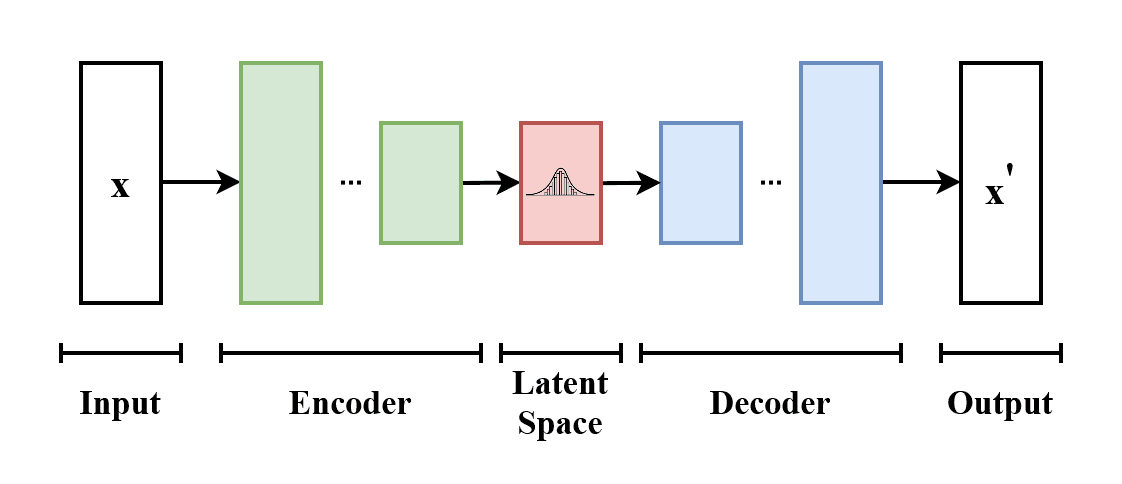
This tests deterministic versus probabilistic latent representations. Standard autoencoders encode fixed points; VAEs encode distributions. Sampling the regularized latent distribution generates new data. Red flag: calling VAEs mere noise adders.
What's really being asked
The interviewer wants to know if you understand why a standard autoencoder is a deterministic compression engine while a variational autoencoder is a generative model. The core concept is the shift from a deterministic latent point to a probabilistic latent distribution, and how that change plus proper regularization creates a smooth, interpolatable latent manifold.
The full answer
First, state that a standard autoencoder compresses input into a single fixed latent vector, which means each input maps to exactly one point. Second, explain that a VAE encoder outputs parameters of a probability distribution, typically a mean and a diagonal covariance, rather than a single vector. Third, mention the reparameterization trick, which samples from that distribution in a way that keeps gradients flowing back through the network. Fourth, describe the KL divergence term in the loss function, which penalizes the learned distribution for deviating from a prior, usually a standard normal, and forces the latent space to be continuous and structured. Fifth, connect this to generation: because every point in the regularized latent space decodes to a plausible output, you can sample new points from the prior and feed them through the decoder to synthesize novel data.
The mistakes people make
A major red flag is saying a VAE just adds noise to a standard autoencoder bottleneck without mentioning learned distribution parameters. Another mistake is conflating the encoder output with a sampled latent vector; candidates should distinguish between the distribution parameters and the actual sampled point. Some candidates also forget the KL divergence entirely and treat the model as a fancy denoiser, which misses the probabilistic graphical model foundation. Finally, claiming that standard autoencoders can generate data by sampling random latent points is incorrect because their latent spaces are typically discontinuous and sparse.
What usually comes next
The interviewer might ask why the reparameterization trick is necessary instead of sampling directly from the distribution. They could also ask what happens if the KL divergence weight is too high or too low, leading to posterior collapse or poor reconstruction. Another common follow-up is how VAEs compare to GANs or diffusion models in terms of latent space structure and training stability. You might also be asked to name the prior distribution and explain why a standard normal is the conventional choice.
A concrete example
Imagine training on handwritten digits. A standard autoencoder might place the latent point for a specific seven at coordinates negative two and three, but the space around that point could decode into meaningless smudges. A VAE instead places a Gaussian blob around that region. The KL loss pulls all those blobs toward the origin and shapes them to overlap smoothly. As a result, sampling a point near zero and decoding it produces a clear, coherent digit rather than static, and interpolating between two latent points morphs one digit into another in a natural way.
Interview question
What is the key difference that makes a VAE a generative model whereas a standard autoencoder is not?
- a.The VAE encoder outputs a single fixed latent vector like an autoencoder, but adds Gaussian noise to it before decoding.
- b.The VAE encoder outputs parameters of a probability distribution, and the loss function regularizes the latent space to be continuous and structured.Correct
- c.The VAE reconstructs input data with higher fidelity, which allows random latent points to produce meaningful outputs.
- d.The VAE uses a significantly deeper neural network architecture in both the encoder and decoder paths.
Why? this is the answer
A VAE learns parameters of a latent probability distribution and uses KL divergence to regularize the space into a smooth manifold, enabling generation by sampling. Option A reflects the common misconception that a VAE merely adds noise to a fixed latent vector, which ignores the learned distribution parameters and the crucial regularization that structures the latent space.
Just read this? Test yourself on what you have been reading.
Read the original → en.wikipedia.org
- #autoencoders
- #vae
- #generative models
- #latent space
- #interview
You just looked this up. Could you explain it out loud?
That is the part interviews actually test. Tezvyn takes questions like this one and gives you what the interviewer is really checking, the answer that lands, and the mistake that ends the conversation, in the four minutes before your next meeting.
The iPhone app is on the way
We are building it. Until it lands, nothing here is held back from you: every interview card, your saved cards, streaks and the job board all work in Safari, plus hundreds of free practice quizzes of thirty questions each. Sign in and it all carries over to the app the day it arrives.
Want it as an icon? Tap Share at the bottom of Safari, then Add to Home Screen. It opens full screen and the cards you have read stay available offline.
We are hiring for this. Every open role lists the topics its interview covers, so you can prepare for the real thing rather than guessing.
See open roles