LIME: Explaining Single Predictions from Any ML Model
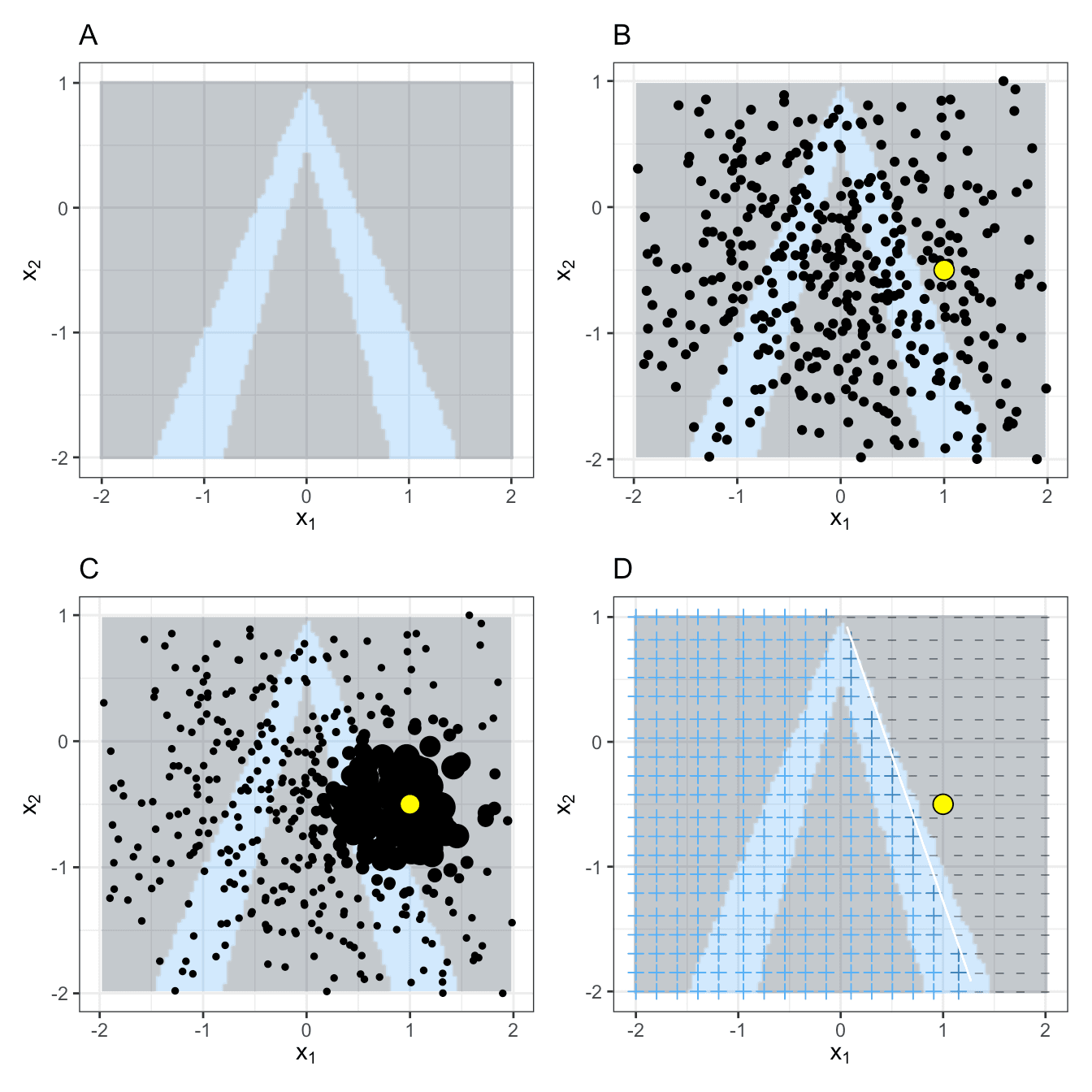
LIME explains a single prediction from any 'black box' model by approximating it with a simpler model that's only accurate locally. Use it to see why a specific user churned.
Why it exists
Complex models like neural networks or gradient boosted trees achieve high accuracy but are 'black boxes,' making it hard to understand why they make a specific prediction. This lack of transparency is a problem for debugging, building trust, and ensuring fairness. LIME was created to provide local, human-understandable explanations for any model's individual predictions without needing to know the model's internal structure.
The mental model
Think of explaining a complex model's decision like asking a foreign language expert for a translation. Instead of asking them to teach you the entire language (a global explanation), you point to one specific phrase and ask, 'What does this mean, and why?' LIME does this for a model prediction. It doesn't explain the whole model, just the behavior around one data point, by creating a simple, local approximation.
How it works
LIME follows a clear recipe. First, select the specific prediction you want to understand. Second, create a new dataset by generating many 'perturbed' variations of your original data point (e.g., slightly changing feature values or removing words from a sentence). Third, get the black box model's predictions for all these new, perturbed points. Fourth, train a simple, interpretable model, like a weighted linear regression, on this new dataset. The key is to give more weight to perturbed samples that are closer to your original data point. Finally, the interpretation of this simple local model (e.g., its feature coefficients) serves as the explanation for the original prediction.
When to use it
Use LIME when you need to explain an individual prediction from any model you can't or don't want to inspect internally. It's ideal for debugging ('Why was this loan application denied?'), providing transparency to users ('Your post was flagged because it contained these words...'), and auditing model behavior on specific, critical cases. It works on tabular data, text, and images.
When not to use it
Do not use LIME if you need a global understanding of the entire model's behavior; for that, use methods like SHAP or Partial Dependence Plots. LIME explanations can also be unstable; slightly different perturbations can sometimes lead to different explanations. It's not suitable for situations requiring a single, mathematically guaranteed 'true' explanation, as the result depends on user-defined settings like the neighborhood size and number of features.
One canonical example
A bank uses an XGBoost model for loan approvals. An applicant is denied. To understand why, they run LIME on the applicant's data. LIME creates thousands of slightly altered profiles (e.g., income $1k higher, credit score 5 points lower) and gets the model's score for each. It then fits a simple linear model to these results, weighted by similarity to the original application. The linear model shows the top factors for the denial were a high debt-to-income ratio and a low number of years at current employment, providing a concrete, local explanation.
Interview question
What is the fundamental approach LIME uses to explain an individual prediction from any black-box model?
- a.It provides a global understanding of the black-box model's behavior by simplifying its overall decision boundaries.
- b.It identifies the most similar training examples that led to the prediction and presents them as an explanation.
- c.It extracts the most influential features by analyzing the model's internal structure and parameters.
- d.It trains a simple, local, interpretable model on perturbed versions of the specific input, weighted by their similarity.Correct
Why? this is the answer
LIME works by creating a new dataset of perturbed versions of the input, getting predictions from the black-box model for these, and then training a simple, interpretable model (like linear regression) on this new dataset, weighted by proximity to the original input. Option C is incorrect because LIME is model-agnostic and does not inspect the internal structure of the black-box model.
Just read this? Test yourself on what you have been reading.
Read the original → christophm.github.io
- #mlops
- #explainability
- #machine learning
- #lime
You just looked this up. Could you explain it out loud?
That is the part interviews actually test. Tezvyn takes questions like this one and gives you what the interviewer is really checking, the answer that lands, and the mistake that ends the conversation, in the four minutes before your next meeting.
The iPhone app is on the way
We are building it. Until it lands, nothing here is held back from you: every interview card, your saved cards, streaks and the job board all work in Safari, plus hundreds of free practice quizzes of thirty questions each. Sign in and it all carries over to the app the day it arrives.
Want it as an icon? Tap Share at the bottom of Safari, then Add to Home Screen. It opens full screen and the cards you have read stay available offline.
We are hiring for this. Open roles that interview on mlops — each one lists the topics its interview covers.
See open roles