Mixture of Experts: Scaling Models by Activating Specialists
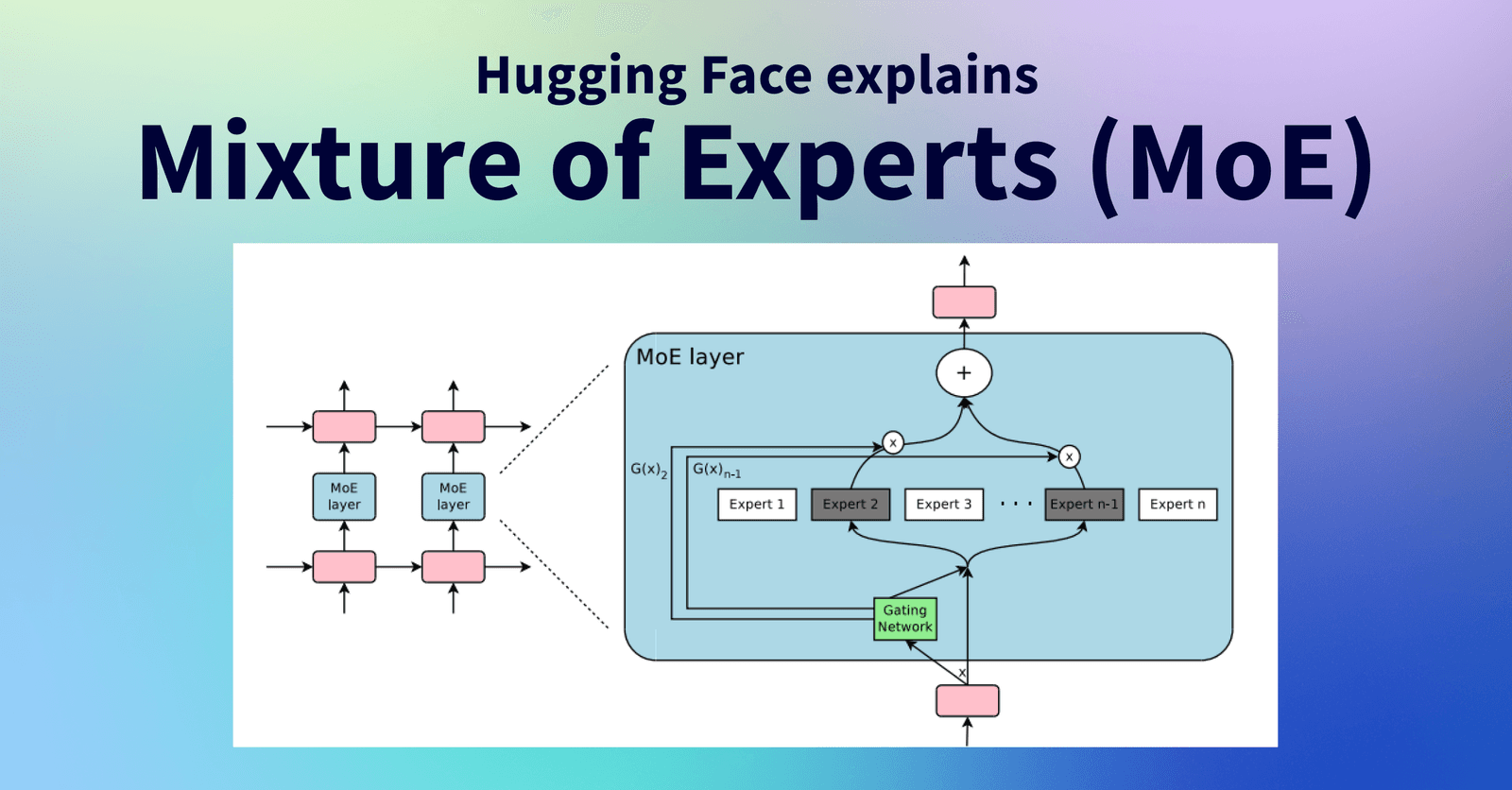
A Mixture of Experts (MoE) model acts like a team of specialists instead of one generalist. A router sends each token to a few expert sub-networks, enabling faster training and inference for massive models.
Why it exists
Training larger models generally leads to better performance, but the computational cost grows prohibitively. Mixture of Experts was developed to get the benefits of a massive parameter count—like deeper knowledge and nuance—without the crippling compute costs of training an equally large dense model. It's a strategy for more efficient scaling.
The mental model
Think of an MoE model not as a single giant brain, but as a committee of specialized consultants. For any given task (a token), a dispatcher (the router) doesn't ask the entire committee to weigh in. Instead, it intelligently selects the one or two most relevant experts to handle the job. The other experts remain silent, saving time and energy.
How it works
In a standard Transformer, every token is processed by the same dense feed-forward network (FFN) layers. In an MoE, these FFN layers are replaced with MoE layers. Each MoE layer consists of two parts: a gating network (or router) and a set of experts (e.g., 8 or 16), where each expert is its own FFN. When a token arrives, the router decides which one or two experts are best suited to process it. The token is sent only to those active experts. The outputs are then combined. This means that for any given token, most of the model's parameters in that layer are inactive, a concept called sparse activation.
When to use it
Use MoE when your goal is to pre-train the largest possible model on a fixed compute budget. MoEs achieve the same quality as a dense model much faster during pre-training. They also offer significantly faster inference speeds compared to a dense model with the same total number of parameters, because only a fraction of the model is used per token.
When not to use it
MoEs are not a good fit for memory-constrained environments. Although inference is computationally sparse, all expert parameters must be loaded into VRAM, leading to massive memory requirements. For example, Mixtral 8x7B requires enough VRAM to hold a 47B parameter model. Additionally, MoEs have historically been more difficult to fine-tune without overfitting, so a traditional dense model may be more reliable for tasks requiring heavy specialization on smaller datasets.
One canonical example
Mixtral 8x7B is a prominent open-source MoE model. The name "8x7B" signifies it has 8 distinct "expert" networks, each with roughly 7 billion parameters. For any input token, its router selects only 2 of these 8 experts to perform calculations. This results in the model using about 14B active parameters for inference, giving it the speed of a smaller model while benefiting from the knowledge stored across its full ~47B parameters.
Interview question
What is the primary reason a Mixture of Experts (MoE) model can achieve faster inference than a dense model with a comparable total number of parameters?
- a.Its gating network efficiently pre-processes tokens, reducing the workload for the expert networks.
- b.All expert networks operate in parallel, allowing simultaneous computation for each input token.
- c.It dynamically offloads inactive expert parameters to disk, freeing up VRAM for active computations.
- d.Only a small, selected fraction of the model's total parameters is actively engaged in computation for any given token.Correct
Why? this is the answer
The card states that MoE models achieve faster inference because "only a fraction of the model is used per token," a concept called sparse activation. This means that despite a large total parameter count, the actual computational load per token is much smaller. Distractor D is incorrect because the card explicitly mentions that "all expert parameters must be loaded into VRAM," indicating that dynamic offloading to disk is not how MoE models manage memory for efficiency.
Just read this? Test yourself on what you have been reading.
Read the original → huggingface.co
You just looked this up. Could you explain it out loud?
That is the part interviews actually test. Tezvyn takes questions like this one and gives you what the interviewer is really checking, the answer that lands, and the mistake that ends the conversation, in the four minutes before your next meeting.
The iPhone app is on the way
We are building it. Until it lands, nothing here is held back from you: every interview card, your saved cards, streaks and the job board all work in Safari, plus hundreds of free practice quizzes of thirty questions each. Sign in and it all carries over to the app the day it arrives.
Want it as an icon? Tap Share at the bottom of Safari, then Add to Home Screen. It opens full screen and the cards you have read stay available offline.
We are hiring for this. Open roles that interview on llms — each one lists the topics its interview covers.
See open roles