ML Monitoring Dashboards: Your Model's Health Chart
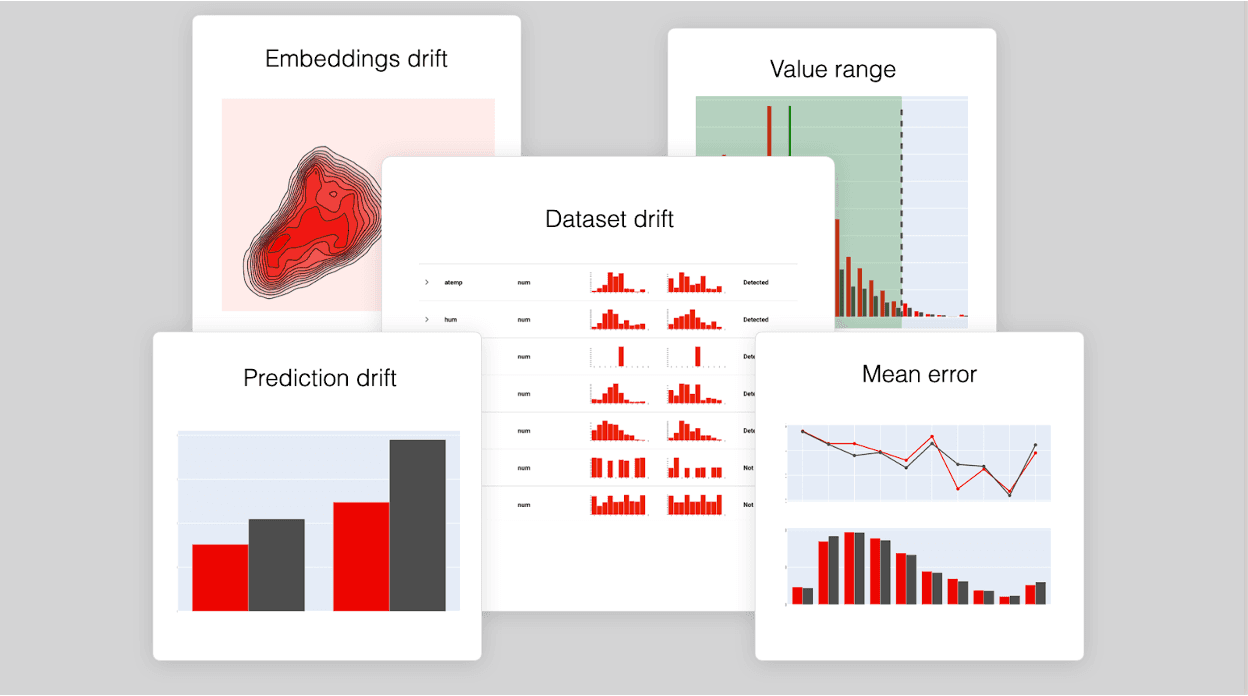
An ML monitoring dashboard is a health chart for your production model, showing how its performance decays. It tracks silent failures like data drift or concept drift, where user behavior changes and makes your model obsolete.
Why it exists
Machine learning models are trained on a snapshot of the world. But the real world changes, and a model's performance inevitably decays over time. This decay can lead to silent, costly failures if left unchecked, as the model makes increasingly inaccurate predictions on new data.
The mental model
Think of an ML monitoring dashboard as a car's dashboard for your model. While your application's server monitoring tells you if the engine is running (is the API up?), the ML dashboard tells you if you're actually driving well (is the model accurate?). It tracks vital signs specific to the model's predictive health, not just the software's operational status.
How it works
ML monitoring systems continuously track and analyze a model's behavior in production. They compare live data and predictions against a baseline, often the training data. Dashboards then visualize key metrics from this process. Common metrics include: first, model quality (accuracy, precision, recall); second, data drift (changes in the statistical properties of input features); third, concept drift (changes in the relationship between inputs and outputs); and fourth, data quality (missing values, schema errors).
When to use it
Use ML monitoring for any model deployed in a production environment that influences business decisions or user experience. It's critical for systems where the input data is expected to change, such as in fraud detection, product recommendation, or demand forecasting. Monitoring helps you decide when to retrain, debug performance issues, and document model behavior.
When not to use it
Monitoring is less critical for models where the input distribution is guaranteed to be stable, which is extremely rare in real-world applications. For one-off analytical models not serving live predictions, a final evaluation report might suffice. The main footgun is assuming your model is 'static' when it almost certainly is not; any model interacting with the real world will eventually decay.
One canonical example
A product recommendation system is trained on user behavior from last year. Over the next six months, new user preferences emerge. A monitoring dashboard would detect this as "concept drift." It would show a gradual decline in the model's click-through rate (a quality metric) and a shift in the distribution of product categories being purchased (data drift). This alerts the team that the model no longer reflects current reality and needs to be retrained on recent data.
Interview question
What primary problem does an ML monitoring dashboard address that traditional application monitoring does not?
- a.Identifying when the model's predictive accuracy is degrading due to environmental changesCorrect
- b.Ensuring the model's API endpoints are accessible and responsive
- c.Verifying the integrity and security of the model's deployed code
- d.Detecting memory leaks or CPU overloads within the model's serving infrastructure
Why? this is the answer
The card emphasizes that ML monitoring specifically tracks the model's predictive health and detects performance decay caused by issues like data or concept drift due to real-world changes. Traditional application monitoring, in contrast, focuses on the operational status of the software, such as API uptime.
Just read this? Test yourself on what you have been reading.
Read the original → evidentlyai.com
- #mlops
- #model monitoring
- #data drift
- #concept drift
You just looked this up. Could you explain it out loud?
That is the part interviews actually test. Tezvyn takes questions like this one and gives you what the interviewer is really checking, the answer that lands, and the mistake that ends the conversation, in the four minutes before your next meeting.
The iPhone app is on the way
We are building it. Until it lands, nothing here is held back from you: every interview card, your saved cards, streaks and the job board all work in Safari, plus hundreds of free practice quizzes of thirty questions each. Sign in and it all carries over to the app the day it arrives.
Want it as an icon? Tap Share at the bottom of Safari, then Add to Home Screen. It opens full screen and the cards you have read stay available offline.
We are hiring for this. Open roles that interview on mlops — each one lists the topics its interview covers.
See open roles