Naive Bayes: Fast Classification by Assuming Independence
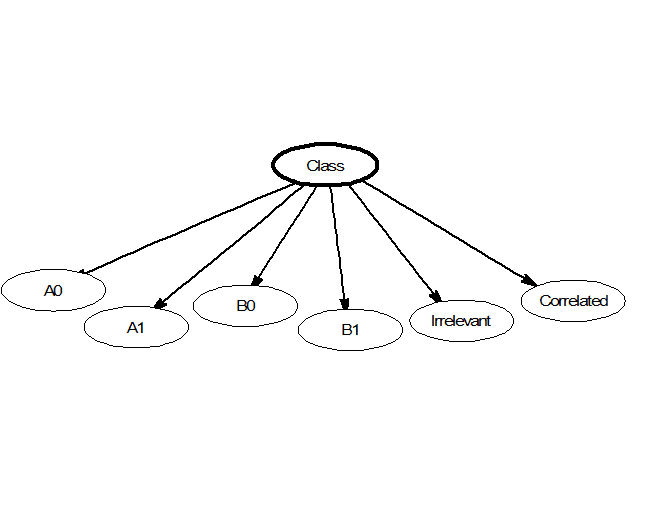
Naive Bayes classifies data by assuming its features are unrelated, like judging a fruit's type by color and shape independently. This makes it fast for tasks like spam filtering or real-time predictions. Its core 'naive' assumption is almost always wrong.
Why it exists
Complex classification problems can be computationally expensive. We needed a simple, fast algorithm that could provide a good-enough baseline prediction, even if it wasn't perfectly accurate. This is especially true for problems with many features, like text analysis, where most features might be irrelevant.
The mental model
Imagine you're a doctor diagnosing an illness. A Naive Bayes approach would be to look at each symptom (fever, cough, rash) and calculate its probability of occurring with a specific disease, assuming the presence of a fever tells you nothing about the likelihood of a cough. You're treating each piece of evidence as completely independent. While this is rarely true, it simplifies the math dramatically.
How it works
The classifier uses Bayes' theorem. For a given data point with several features, it calculates the probability of it belonging to each possible class. It does this by multiplying the probabilities of each individual feature occurring in that class, based on what it saw in the training data. The class with the highest resulting probability "wins." The "naive" part is this multiplication step, which is only mathematically sound if the features are truly independent.
When to use it
Use it as a quick and dirty baseline for classification problems to see if a more complex model is even necessary. It shines in text classification (spam detection, sentiment analysis) where the number of features (words) is huge. It's also good for real-time predictions where training and prediction speed are critical.
When not to use it
Avoid Naive Bayes when your features are known to be strongly correlated. For example, in a financial model, a person's income and their credit score are not independent. Using Naive Bayes here would ignore this crucial link and likely lead to poor predictions. It's also not ideal when you need highly accurate probability estimates, as its own estimates are skewed by the independence assumption.
One canonical example
A classic example is spam filtering. An email is a collection of words (features). The classifier is trained on emails labeled as "spam" or "not spam." It learns the probability of words like "Viagra," "free," and "money" appearing in spam versus legitimate emails. When a new email arrives, it calculates the probability it's spam by assuming the presence of "Viagra" is independent of the presence of "free." Despite this flawed assumption, it works surprisingly well in practice.
Interview question
What is the primary benefit derived from the "naive" assumption in Naive Bayes classification?
- a.It eliminates the need for extensive feature engineering or data preprocessing.
- b.It guarantees that the predicted probabilities are highly accurate and reliable.
- c.It allows the model to perfectly account for complex interactions between input features.
- d.It significantly reduces the computational complexity, making the algorithm fast and scalable.Correct
Why? this is the answer
The "naive" assumption of feature independence dramatically simplifies the mathematical calculations required by Bayes' theorem, which is the primary reason Naive Bayes is fast and computationally efficient. This simplification comes at the cost of ignoring true feature relationships, meaning it does not perfectly account for complex interactions or guarantee highly accurate probability estimates.
Just read this? Test yourself on what you have been reading.
Read the original → en.wikipedia.org
- #machine learning
- #classification
- #statistics
- #bayesian
You just looked this up. Could you explain it out loud?
That is the part interviews actually test. Tezvyn takes questions like this one and gives you what the interviewer is really checking, the answer that lands, and the mistake that ends the conversation, in the four minutes before your next meeting.
The iPhone app is on the way
We are building it. Until it lands, nothing here is held back from you: every interview card, your saved cards, streaks and the job board all work in Safari, plus hundreds of free practice quizzes of thirty questions each. Sign in and it all carries over to the app the day it arrives.
Want it as an icon? Tap Share at the bottom of Safari, then Add to Home Screen. It opens full screen and the cards you have read stay available offline.
We are hiring for this. Open roles that interview on machine learning — each one lists the topics its interview covers.
See open roles