ORPilot JSON IR Ends Solver Lock-In
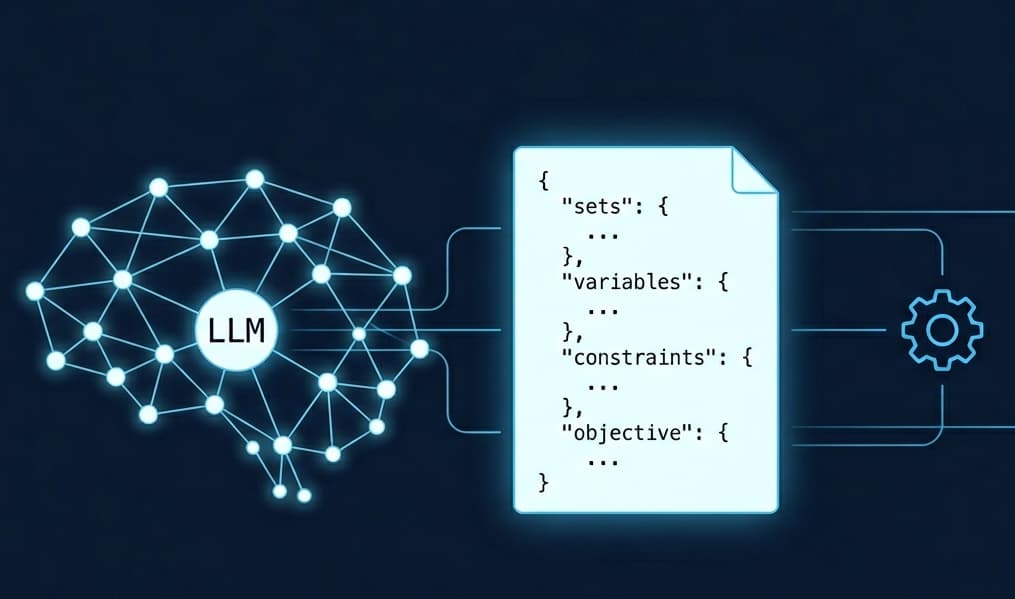
ORPilot's open-source IR captures optimization models as solver-agnostic JSON, letting teams swap solvers or update data without calling the LLM again. It separates model structure from solver syntax, making LLM-generated OR models reproducible in production.
Why it matters
Most LLM-for-OR tools generate solver-specific code that breaks the moment you update demand data, switch machines, or move from Gurobi to an open-source alternative because of licensing costs. That forces teams to pay for another LLM API call and hope the regenerated model structure matches the original. In production, that nondeterminism and API tax is unacceptable. ORPilot's Intermediate Representation solves this by treating the optimization model as structured data rather than throwaway code, making it portable and reproducible across environments and solvers.
What changed
ORPilot introduced a solver-agnostic, typed JSON schema called Intermediate Representation that captures the complete mathematical structure of a model in five top-level sections. Sets define named collections like Workers or Tasks and link directly to CSV files, scalar counts, or hardcoded lists. Parameters hold indexed numerical data with explicit domain mappings and column names for loading. Variables specify type such as continuous, binary, or integer along with bounds and domain. Objective stores a symbolic expression tree using sums, products, and indexed sums in solver-neutral form. Constraints are complete self-describing objects with expression trees, domains, and sense. Because the IR describes the mathematical model itself rather than Python or solver syntax, teams can reload it with new data, rerun it on different hardware, or retarget it to a completely different solver without ever calling the LLM again or worrying about model drift.
What to watch
Whether this JSON-based abstraction becomes a standard interchange format for LLM-generated optimization workflows. If ORPilot's IR gains broader adoption, it could end vendor lock-in for operations research pipelines and make model versioning as straightforward as checking in a JSON file and swapping a solver backend. Engineers should evaluate whether their current LLM optimization workflows require full code regeneration for every data update or solver change, and consider whether adopting a structured IR would cut API costs and eliminate nondeterministic model drift in production.
Interview question
Why does solver-specific code generated by LLMs create production risk that ORPilot's JSON IR avoids?
- a.The IR compiles into solver-neutral bytecode that executes on any optimization engine
- b.LLM temperature settings make it impossible to regenerate identical solver-specific syntax
- c.Data or solver changes force a new LLM API call, risking nondeterministic model driftCorrect
- d.Commercial solver APIs restrict batch updates to demand data without model recompilation
Why? this is the answer
The card explains that solver-specific code breaks when data or solvers change, forcing costly LLM regeneration and risking model drift, whereas the IR captures the mathematical structure as portable JSON that can be retargeted without another API call.
Just read this? Test yourself on what you have been reading.
Read the original → towardsdatascience.com
- #orpilot
- #optimization
- #mlops
- #operations-research
- #reproducibility
You just looked this up. Could you explain it out loud?
That is the part interviews actually test. Tezvyn takes questions like this one and gives you what the interviewer is really checking, the answer that lands, and the mistake that ends the conversation, in the four minutes before your next meeting.
The iPhone app is on the way
We are building it. Until it lands, nothing here is held back from you: every interview card, your saved cards, streaks and the job board all work in Safari, plus hundreds of free practice quizzes of thirty questions each. Sign in and it all carries over to the app the day it arrives.
Want it as an icon? Tap Share at the bottom of Safari, then Add to Home Screen. It opens full screen and the cards you have read stay available offline.
We are hiring for this. Every open role lists the topics its interview covers, so you can prepare for the real thing rather than guessing.
See open roles