Photometric Stereo: Reconstructing Shape from Light
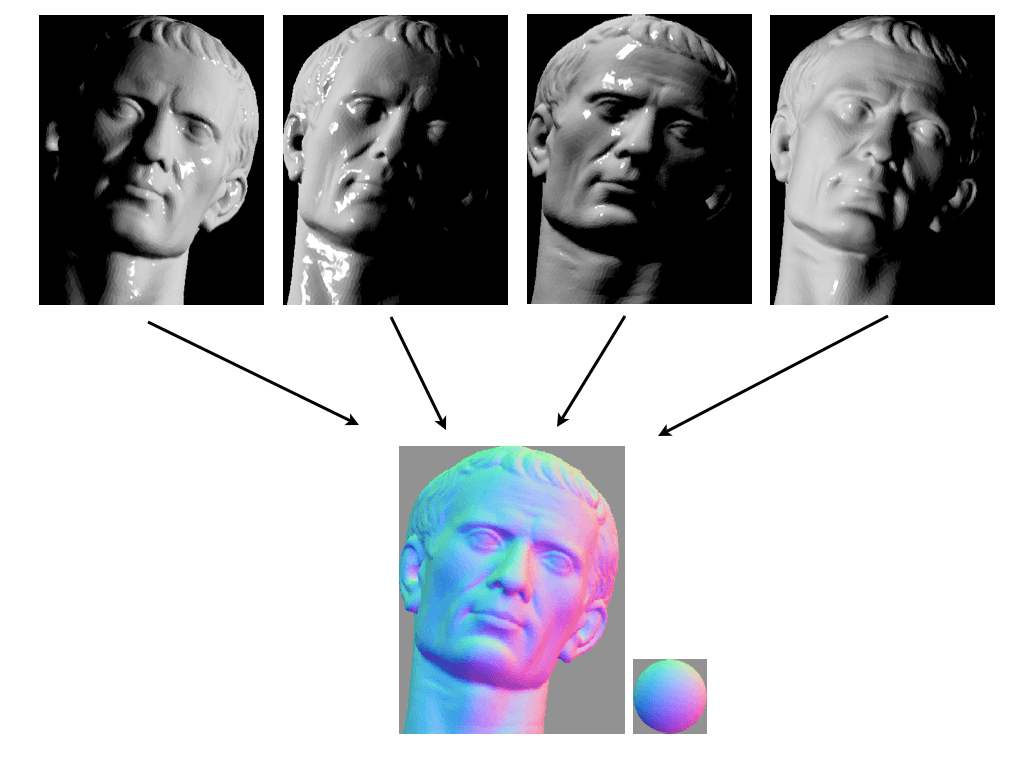
Photometric stereo deduces an object's 3D shape by watching how its surface reflects light from different directions. It’s used in industrial inspection and computer graphics to capture detailed surface geometry. The footgun is assuming it works on any object.
WHY IT EXISTS To recover the 3D shape and surface detail of an object without complex depth sensors or laser scanners. Traditional 3D capture might miss subtle surface variations, but analyzing how light reflects from a surface can reveal its fine-grained orientation at every point.
THE MENTAL MODEL Imagine you're in a dark room with a statue and a single flashlight. By shining the light from the left, then from above, then from the right, and taking a picture each time, you can see which parts of the surface light up. Photometric stereo is the algorithm that takes these images and calculates the 3D shape from the brightness changes.
HOW IT WORKS A camera is held in a fixed position, pointed at a static object. A series of images are captured, but for each image, the lighting is different—a light source is moved to a new, known position. For any given pixel on the object's surface, its brightness will change across the set of images. Based on the fact that a surface's brightness depends on its orientation relative to the light, the algorithm can solve for that orientation. With at least three images from different light source directions, you can uniquely determine the surface normal (the direction the surface is facing) for every pixel, effectively mapping out the object's shape.
WHEN TO USE IT Use it for high-quality surface capture in controlled environments. It's excellent for digitizing static objects for visual effects and video games, creating detailed material maps (normal maps), and for industrial quality control where subtle surface imperfections like dents or scratches need to be detected automatically.
WHEN NOT TO USE IT Avoid it for scenes with moving objects or a moving camera. The technique struggles with highly specular (mirror-like), transparent, or translucent surfaces because their light interaction is too complex. It is also impractical for uncontrolled environments where lighting is unknown or causes complex self-shadowing (where one part of an object casts a shadow on another).
ONE CANONICAL EXAMPLE Creating a 'normal map' for a video game character. An artist sculpts a hyper-detailed model. Then, a photometric stereo process (or a digital simulation of it) is used to capture all the fine surface detail as a normal map texture. This texture is then applied to a much simpler, low-polygon model in the game engine, making it appear incredibly detailed without the high computational cost of rendering the original sculpt.
Read the original → en.wikipedia.org
Get five bites like this every day.
Tezvyn delivers a daily feed of 60-second tech bites with quizzes to lock in what you learn.