Pipeline Parallelism: An Assembly Line for Your Model
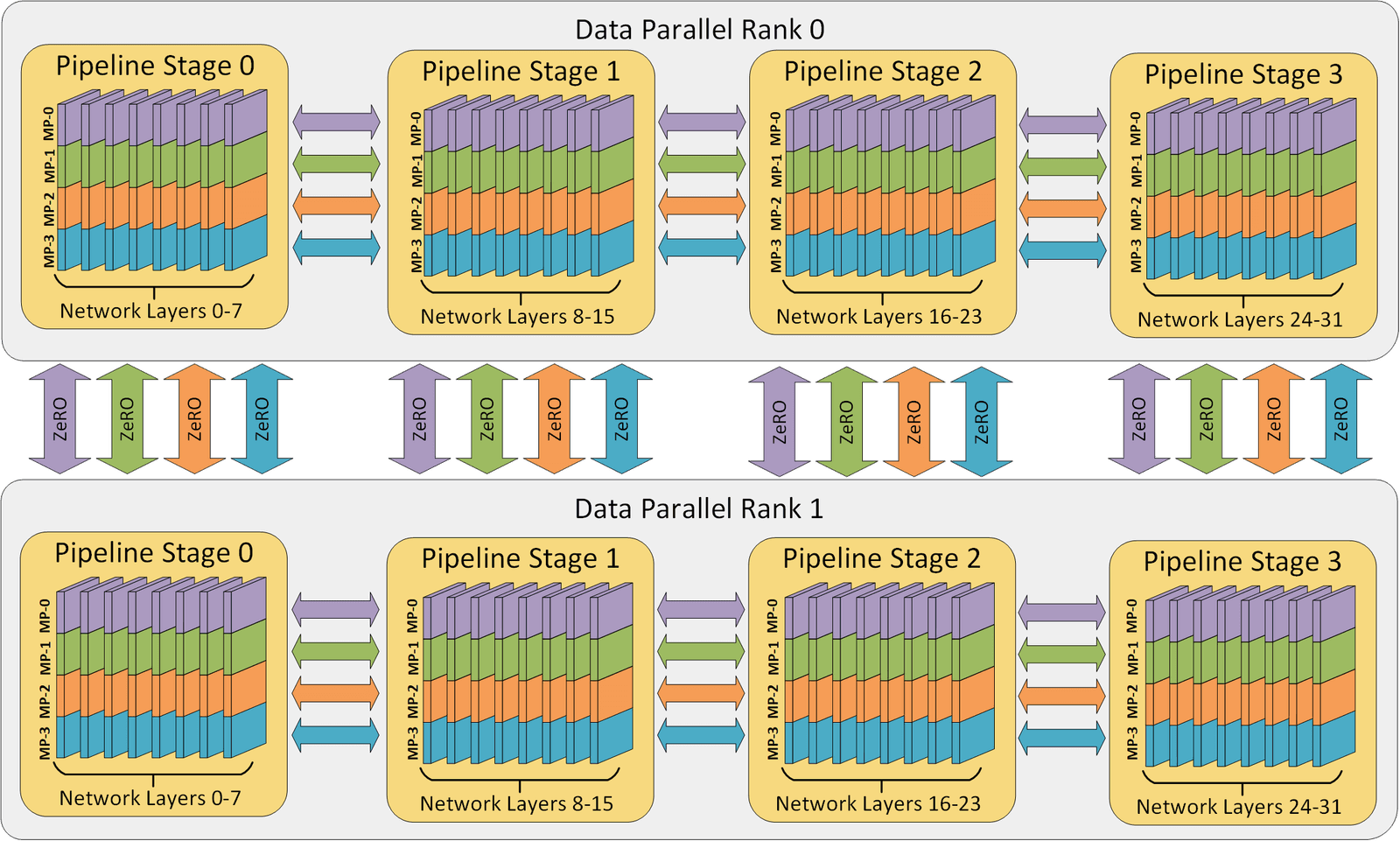
Think of training a huge model like an assembly line. Pipeline parallelism splits a model's layers into stages across multiple GPUs, allowing you to train models too large for one device.
Why it exists
Modern AI models can have billions or trillions of parameters, far exceeding the memory of a single GPU. While data parallelism replicates the model on each GPU and splits the data, pipeline parallelism splits the model itself, allowing it to span multiple devices.
The mental model
Think of it as a factory assembly line for your model's layers. Each GPU is a worker at a station responsible for a specific set of tasks, which is a 'stage' of layers. A data batch is broken into small parts, or micro-batches, that move down the line. As one worker finishes its task on a part and passes it on, it immediately starts on the next part, keeping the whole line busy.
How it works
The model's layers are partitioned into sequential stages, and each stage is assigned to a different GPU. A training batch is split into many smaller micro-batches. The first GPU stage performs a forward pass on a micro-batch and sends the resulting activations to the next stage. As the second stage begins its work, the first stage starts on the next micro-batch. This creates a staggered, parallel execution flow. The backward pass follows the same pattern in reverse, with gradients being passed back down the pipeline. Each stage accumulates its gradients locally across all micro-batches. The main drawback is the 'pipeline bubble,' an initial ramp-up and final ramp-down period where not all GPUs are active, which can hurt efficiency.
When to use it
Use pipeline parallelism when a model is too large to fit into the memory of a single accelerator, even after applying other memory-saving techniques. It is essential for training state-of-the-art foundation models with hundreds of billions of parameters. It is often used in a hybrid approach with data parallelism, where groups of GPUs form a pipeline, and these pipelines are replicated for data parallelism.
When not to use it
Avoid it for models that can fit on a single GPU. The communication overhead of passing activations between stages and the inefficiency from pipeline bubbles can make it slower than standard data parallelism for smaller models. It also requires a model architecture that can be cleanly split into sequential blocks.
One canonical example
The DeepSpeed library simplifies this. A torch.nn.Sequential model can be converted into a pipeline-parallel model with one line. By wrapping the sequential model in deepspeed.pipe.PipelineModule and specifying num_stages, DeepSpeed automatically partitions the model's layers and distributes them to the specified number of GPUs.
Interview question
What is the primary advantage of employing pipeline parallelism in deep learning model training?
- a.It significantly reduces the total training time for any model by parallelizing computations.
- b.It simplifies the model's architecture by automatically partitioning layers into independent modules.
- c.It minimizes communication overhead between different GPUs by processing data in large batches.
- d.It enables the training of models whose total parameter count exceeds the memory capacity of a single GPU.Correct
Why? this is the answer
B is correct as the card states pipeline parallelism is for models 'too large to fit into the memory of a single accelerator.' A is incorrect because, despite using parallelism, the card notes that communication overhead and pipeline bubbles can make it slower for models that fit on a single GPU, so its primary benefit isn't universal speedup.
Just read this? Test yourself on what you have been reading.
Read the original → deepspeed.ai
- #llm
- #distributed training
- #model parallelism
- #deepspeed
You just looked this up. Could you explain it out loud?
That is the part interviews actually test. Tezvyn takes questions like this one and gives you what the interviewer is really checking, the answer that lands, and the mistake that ends the conversation, in the four minutes before your next meeting.
The iPhone app is on the way
We are building it. Until it lands, nothing here is held back from you: every interview card, your saved cards, streaks and the job board all work in Safari, plus hundreds of free practice quizzes of thirty questions each. Sign in and it all carries over to the app the day it arrives.
Want it as an icon? Tap Share at the bottom of Safari, then Add to Home Screen. It opens full screen and the cards you have read stay available offline.
We are hiring for this. Open roles that interview on llm — each one lists the topics its interview covers.
See open roles