Point Cloud: A 3D Shape as a Dust Cloud of Data
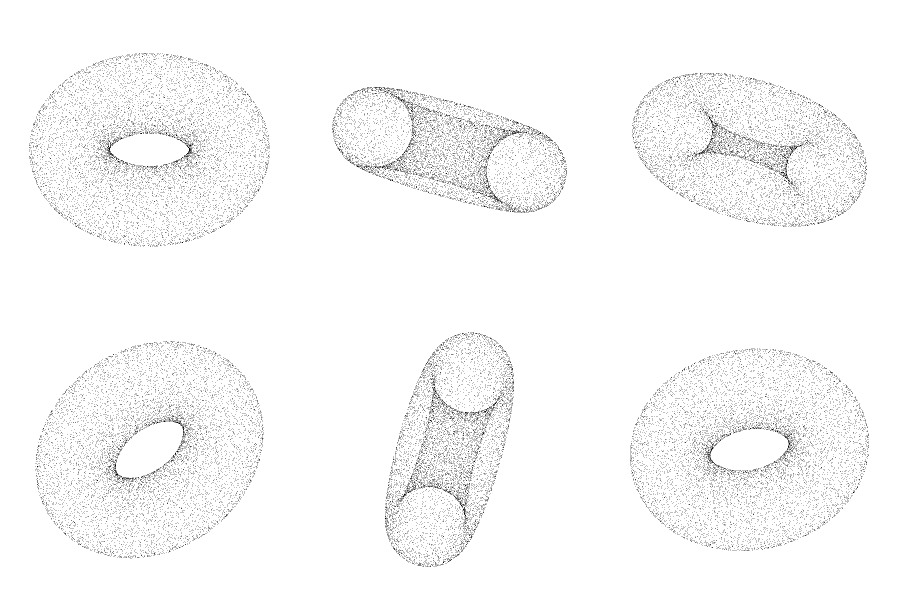
A point cloud represents a 3D object as a cloud of individual data points in space. It's the raw output from 3D scanners, used to create CAD models or GIS maps. The footgun is assuming it's a solid model; it has no surfaces, only disconnected.
Why it exists
To capture the precise geometry of real-world objects in a digital format. Before creating a smooth 3D model, you need a raw, direct measurement of an object's surface, and a point cloud provides exactly that.
The mental model
Imagine spraying a fine, glowing dust onto an object. The dust settles on every part of the surface you can see. A point cloud is the digital equivalent: a massive collection of individual points, each with its own (x, y, z) coordinate, representing the object's external shape. It's a "cloud" of data points, not a solid object.
How it works
3D scanners (like LiDAR) or photogrammetry software measure a vast number of points on an object's surface. Each measurement becomes a point in the cloud with Cartesian coordinates. This data can be enhanced with additional attributes per point, such as RGB color values, surface normals (the direction the point is "facing"), or timestamps.
When to use it
Use a point cloud as the initial, raw data for any process that needs to digitize a real-world object. It's the starting point for creating 3D CAD models, building geographic information system (GIS) maps, performing quality inspection on manufactured parts, and for applications in visualization and animation.
When not to use it
Don't use a raw point cloud when you need a "watertight" solid model with defined surfaces, volumes, or topology. A point cloud has no concept of "inside" vs. "outside" or how points connect to each other. It must be processed into a mesh (like a triangle mesh) for tasks like 3D printing or physics simulations.
One canonical example
A self-driving car's LiDAR system spins, sending out laser pulses. Each pulse that hits an object reflects back, and its travel time is used to calculate a precise 3D coordinate. The collection of all these coordinates in a single frame forms a point cloud of the car's immediate surroundings.
Interview question
Which statement best describes a key limitation of a raw point cloud when compared to a 3D model ready for manufacturing or simulation?
- a.It lacks the ability to store color or texture information for the object.
- b.It represents an object as a collection of disconnected points, lacking defined surfaces or volume.Correct
- c.It provides a less precise measurement of the object's external geometry.
- d.It cannot be used as the initial data to create CAD models or GIS maps.
Why? this is the answer
The card explicitly states that a raw point cloud 'has no surfaces, only disconnected' points and 'has no concept of "inside" vs. "outside" or how points connect to each other,' making it unsuitable for tasks requiring defined surfaces or volume. Other options contradict information in the card, such as its ability to store color or its use as a starting point for CAD models.
Just read this? Test yourself on what you have been reading.
Read the original → en.wikipedia.org
- #computer vision
- #3d
- #data structures
- #graphics
You just looked this up. Could you explain it out loud?
That is the part interviews actually test. Tezvyn takes questions like this one and gives you what the interviewer is really checking, the answer that lands, and the mistake that ends the conversation, in the four minutes before your next meeting.
The iPhone app is on the way
We are building it. Until it lands, nothing here is held back from you: every interview card, your saved cards, streaks and the job board all work in Safari, plus hundreds of free practice quizzes of thirty questions each. Sign in and it all carries over to the app the day it arrives.
Want it as an icon? Tap Share at the bottom of Safari, then Add to Home Screen. It opens full screen and the cards you have read stay available offline.
We are hiring for this. Open roles that interview on computer vision — each one lists the topics its interview covers.
See open roles