Research Competency Matrix: Mapping Team Growth
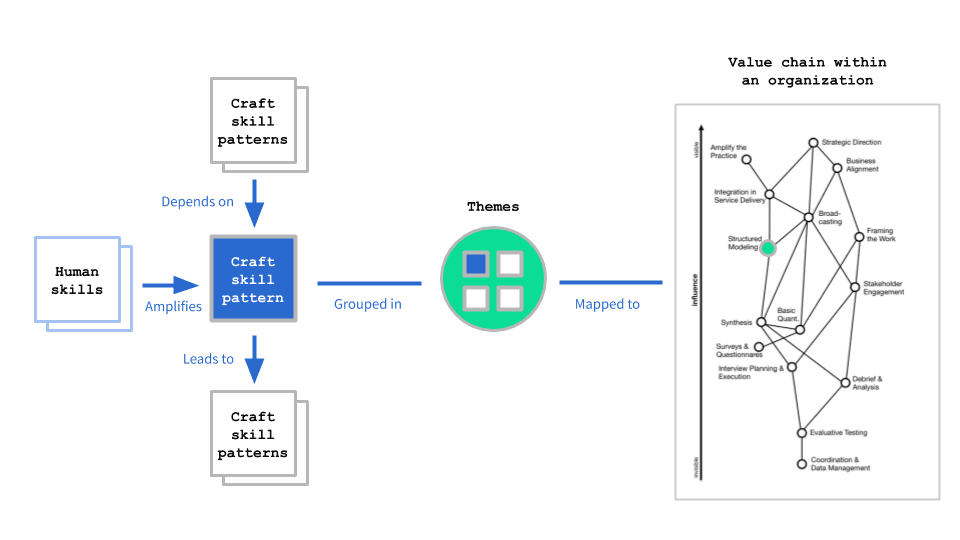
A competency matrix maps craft and human skills against career stages to reveal gaps. Use it to plan hiring and align capabilities with organizational needs. The footgun is treating it as a rigid checklist instead of a customizable reflection tool.
Why it exists
Most teams assess researchers through generic job titles or ad-hoc intuition, which hides the real mix of abilities needed to deliver impact. The ResearchOps Community built the Research Skills Framework because researcher growth is not just about doing methods correctly; it is also about making the work successful inside an organization. The framework captures both execution and influence as a value chain that connects individual practice to team outcomes.
The mental model
Think of a competency matrix as a map with two axes. One axis is craft skills, the abilities that let you execute research successfully. The other axis is human skills, the abilities that let you make that research matter to stakeholders. Progression is not a single ladder; it is a value chain where themes ladder up toward organizational needs. You plot yourself or your team on this map to see where you are strong, where you are exposed, and what realistic next step looks like.
How it works
Start with a skills and themes inventory customized to your team context. You review the skills, build a shared vocabulary, and decide which practices matter for your work. Then you encode findings into a skills progression map that shows archetypes of individual contributor growth. The map becomes a living tool for self-reflection, one-on-one discussions, and goal planning. Over time, teams can also extract patterns of practice into project playbooks, turning repeated competencies into operational muscle memory.
When to use it
Use the matrix when you need to plan team training, scope a hiring profile, or align researcher capabilities with strategic goals. It is especially powerful during career leveling conversations and when operationalizing project types by sequencing the ten to twenty patterns a team actually needs.
When not to use it
Do not use it as a rigid checklist or standardized test. The framework is designed to be bottom-up and customizable. If you force every researcher to hit every cell by a fixed date, you turn a reflection tool into a bureaucratic gate that ignores context.
One canonical example
A research leader wants to staff an experience mapping project. Instead of guessing who is ready, they open the team's progression map and see that one researcher has strong craft in journey mapping but weaker human skills in workshop facilitation. The leader pairs that researcher with a senior teammate for the facilitation piece, turning the matrix into a precise staffing and development decision.
Interview question
A leader sees a researcher is strong in journey-mapping craft but weak in workshop facilitation. Using the matrix as intended, what is the best next step?
- a.Require the researcher to complete facilitation training before joining any project involving workshops
- b.Add facilitation as a fixed requirement that must be checked off before their next review
- c.Pair the researcher with a senior teammate for facilitation while they lead journey mappingCorrect
- d.Reassign the researcher to a solo project where stakeholder interaction is minimized
Why? this is the answer
The matrix is meant to guide precise staffing and development decisions, so pairing complementary strengths turns the map into a living operational tool. Option A is tempting because training feels responsible, but it treats the framework as a rigid gate that blocks participation until a skill cell is completed, which is the exact misuse the card warns against.
Just read this? Test yourself on what you have been reading.
Read the original → researchskills.net
- #ux research
- #team growth
- #career progression
- #researchops
- #competency mapping
You just looked this up. Could you explain it out loud?
That is the part interviews actually test. Tezvyn takes questions like this one and gives you what the interviewer is really checking, the answer that lands, and the mistake that ends the conversation, in the four minutes before your next meeting.
The iPhone app is on the way
We are building it. Until it lands, nothing here is held back from you: every interview card, your saved cards, streaks and the job board all work in Safari, plus hundreds of free practice quizzes of thirty questions each. Sign in and it all carries over to the app the day it arrives.
Want it as an icon? Tap Share at the bottom of Safari, then Add to Home Screen. It opens full screen and the cards you have read stay available offline.
We are hiring for this. Open roles that interview on ux research — each one lists the topics its interview covers.
See open roles