Reward Modeling: Teaching an LLM What 'Good' Means
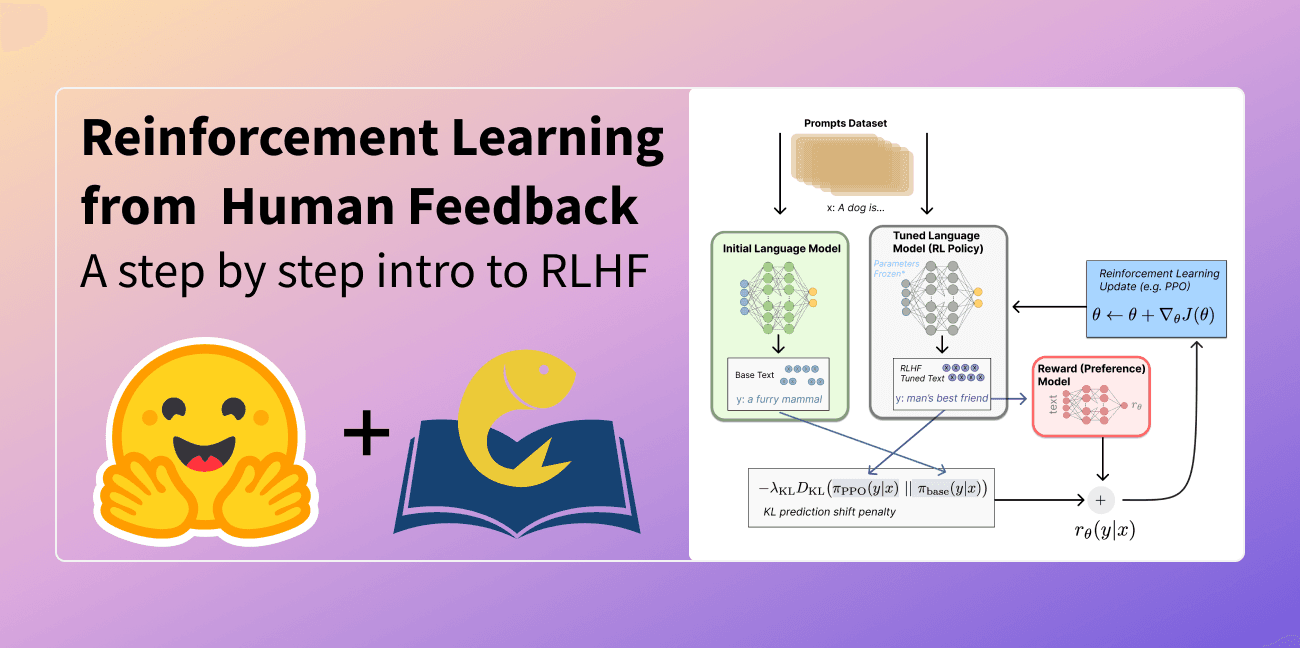
A reward model is a judge that scores an LLM's outputs based on human preferences. It learns to assign a numerical 'goodness' score to text, turning subjective quality into an optimizable signal for training models like ChatGPT.
Why it exists
Standard language model training uses simple objectives like next-token prediction, which doesn't capture subjective human values like helpfulness, creativity, or truthfulness. A mechanism was needed to translate complex, subjective human preferences into a numerical signal that a model can be optimized against, making it 'aligned' with user intent.
The mental model
A reward model is a separate AI model that acts as a judge. It's trained to evaluate the output of another, larger language model. It takes a prompt and a generated response as input, and outputs a single number—a scalar reward—that represents how much a human would likely prefer that response. It essentially learns to quantify 'goodness'.
How it works
The process starts with a pretrained language model. For a given set of prompts, this model generates multiple different responses. Human labelers are then shown these responses and asked to rank them from best to worst. This creates a dataset of human preferences (e.g., for a specific prompt, response B was better than A, which was better than C). The reward model is then trained on this dataset. Its sole job is to predict the human preference score for any given prompt-response pair.
When to use it
Reward modeling is the core component of Reinforcement Learning from Human Feedback (RLHF). Use it to fine-tune a language model to align with complex, subjective goals that are hard to define with a simple loss function. This is essential for making chatbots helpful, honest, and harmless, as seen in models like ChatGPT and Claude.
When not to use it
Avoid reward modeling when a clear, objective, and cheaper metric already exists. For instance, if you're fine-tuning a model to generate code where the only goal is executability, a simple pass/fail test is more direct and less expensive than collecting human preference data. It's overkill for tasks where standard metrics like BLEU scores are sufficient.
One canonical example
The training of InstructGPT, a precursor to ChatGPT, is a classic example. OpenAI took a pretrained GPT-3 model, generated responses to various prompts, and had humans rank those responses. They then trained a reward model on this preference data. This reward model was then used in the reinforcement learning stage to guide the main GPT-3 model toward producing outputs that humans would rate more highly, making it significantly better at following instructions.
Interview question
For which task would a Reward Model likely be considered an inefficient or unnecessary approach?
- a.Guiding a language model to generate more creative and engaging narratives.
- b.Aligning an LLM's outputs with complex, subjective ethical principles.
- c.Improving a chatbot's ability to provide helpful and harmless responses.
- d.Fine-tuning a code generation model to produce executable and bug-free code.Correct
Why? this is the answer
The card explicitly states that reward modeling should be avoided when a clear, objective, and cheaper metric exists, citing code executability as an example. The other options involve subjective qualities like helpfulness, creativity, or ethics, for which reward models are specifically designed.
Just read this? Test yourself on what you have been reading.
Read the original → huggingface.co
- #llm
- #rlhf
- #ai alignment
- #generative ai
You just looked this up. Could you explain it out loud?
That is the part interviews actually test. Tezvyn takes questions like this one and gives you what the interviewer is really checking, the answer that lands, and the mistake that ends the conversation, in the four minutes before your next meeting.
The iPhone app is on the way
We are building it. Until it lands, nothing here is held back from you: every interview card, your saved cards, streaks and the job board all work in Safari, plus hundreds of free practice quizzes of thirty questions each. Sign in and it all carries over to the app the day it arrives.
Want it as an icon? Tap Share at the bottom of Safari, then Add to Home Screen. It opens full screen and the cards you have read stay available offline.
We are hiring for this. Open roles that interview on llm — each one lists the topics its interview covers.
See open roles