Service Delivery Review: The Missing Agile Feedback Loop
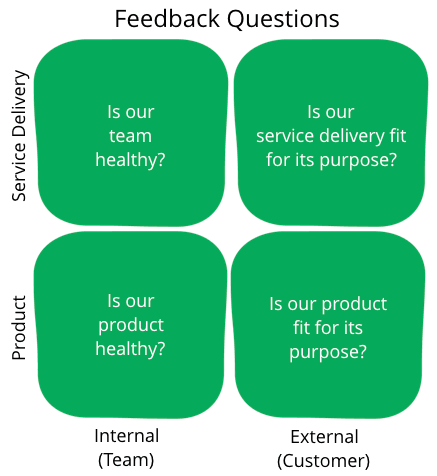
A Service Delivery Review shifts focus from *what* was built to *how* it was delivered. It's a regular meeting where teams and customers review quantitative metrics like lead time and blockers.
The mental model
Think of a restaurant. A customer cares about the food (the product) and the service (the delivery). A product demo is like tasting the food. A Service Delivery Review (SDR) is a conversation with the restaurant manager about how long you waited and why. It's a formal feedback loop focused on the fitness of the delivery service itself, not just the product.
How it works
The SDR is a regular, often weekly, meeting between the delivery team and its customer. Unlike a demo's qualitative feedback or a retro's internal focus, the SDR is a quantitative, collaborative discussion. The conversation centers on flow metrics to assess the health and predictability of the delivery process. Key topics include delivery times (lead/cycle time), blocker analysis, the age of current work-in-progress, the mix of work types (e.g., features vs. bugs), and how the team is performing against service-level expectations.
When to use it
Use an SDR when your standard agile ceremonies fail to address customer concerns about delivery speed, predictability, or responsiveness. It is a core Kanban practice but can be added to any agile framework. It's especially valuable when stakeholders care as much about the delivery timeline and process as they do about the features themselves, which is often the case.
When not to use it
An SDR might be overkill for teams with constant, informal customer communication where these topics are already covered effectively. If your customer's only concern is feature scope and they have no interest in delivery process metrics, the meeting may not provide value. However, this is rare, as most customers care deeply about predictability.
One canonical example
A team consistently delivers features, but the business sponsor is frustrated because they can't predict when work will be done. The team holds its first SDR. They present a cycle time chart showing a wide distribution, from 5 to 50 days. They also show that 40% of their time is spent on unplanned "failure demand" work. Seeing the data, the sponsor agrees to help shield the team from interruptions, and they collaboratively set a service-level expectation (SLE): 85% of new features should be delivered in under 20 days.
Interview question
A software development team faces recurring stakeholder complaints about unpredictable delivery timelines and a lack of insight into the delivery process. Which agile practice is most directly designed to resolve these concerns?
- a.Increasing the frequency of sprint reviews to gather more product feedback.
- b.Refining the product backlog more frequently to ensure clear requirements.
- c.Facilitating more in-depth retrospective meetings with the development team.
- d.Implementing a Service Delivery Review (SDR) with key stakeholders.Correct
Why? this is the answer
A Service Delivery Review (SDR) is specifically designed to provide a formal, quantitative feedback loop between the delivery team and customers about the delivery process itself, focusing on metrics like lead time and blockers to improve predictability and transparency. Other options focus on product feedback, internal team improvement, or requirements, rather than the delivery process with customer involvement.
Just read this? Test yourself on what you have been reading.
Read the original → mattphilip.wordpress.com
You just looked this up. Could you explain it out loud?
That is the part interviews actually test. Tezvyn takes questions like this one and gives you what the interviewer is really checking, the answer that lands, and the mistake that ends the conversation, in the four minutes before your next meeting.
The iPhone app is on the way
We are building it. Until it lands, nothing here is held back from you: every interview card, your saved cards, streaks and the job board all work in Safari, plus hundreds of free practice quizzes of thirty questions each. Sign in and it all carries over to the app the day it arrives.
Want it as an icon? Tap Share at the bottom of Safari, then Add to Home Screen. It opens full screen and the cards you have read stay available offline.
We are hiring for this. Open roles that interview on agile — each one lists the topics its interview covers.
See open roles