Snowflake: Decoupled Storage and Compute
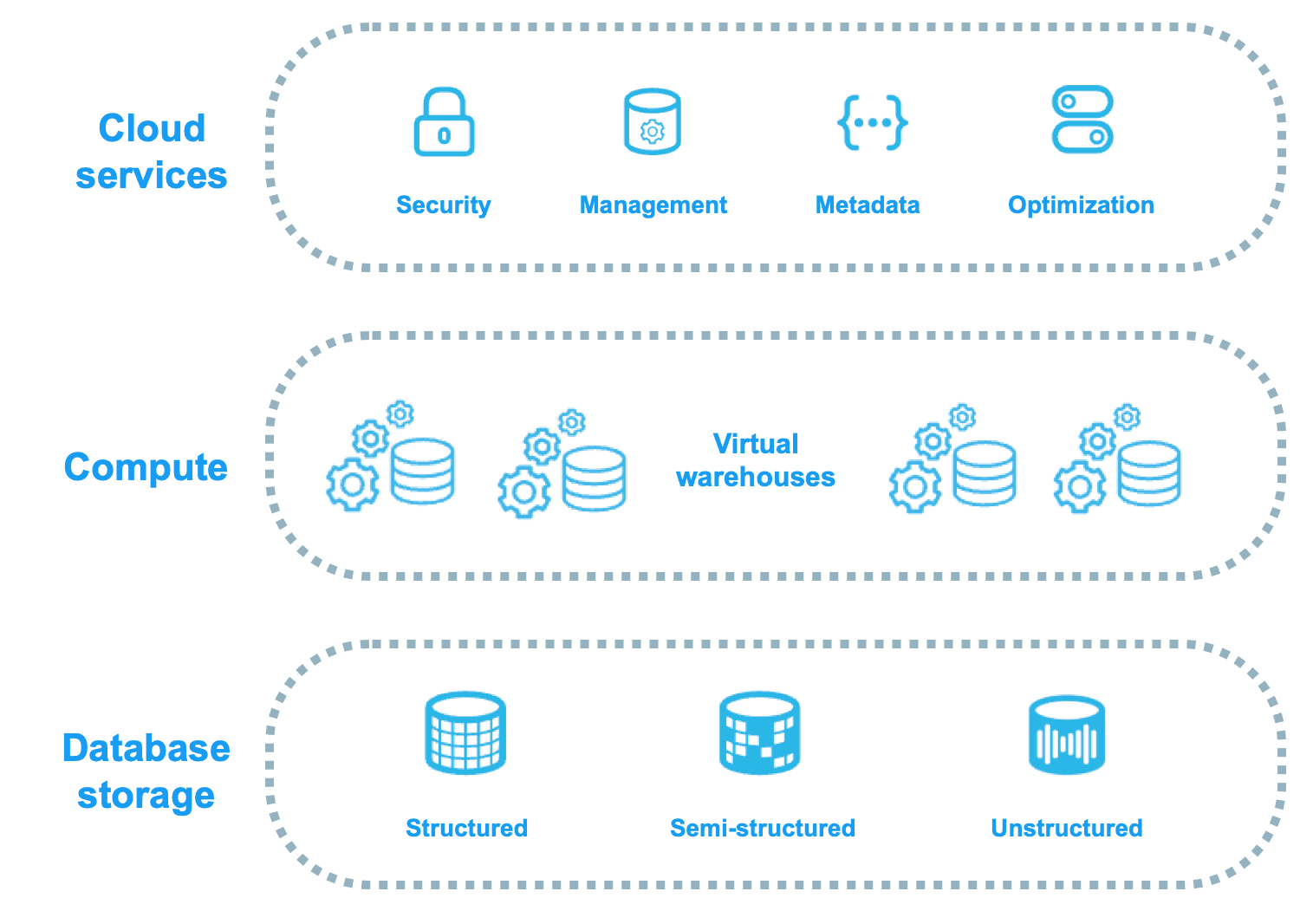
Snowflake decouples storage from compute, acting like a shared-disk system for data management but a shared-nothing system for query performance. This lets you scale compute and storage independently, ideal for variable analytic workloads.
Why it exists
Traditional data warehouses often tightly coupled compute power and data storage. To get more query performance, you had to scale up the entire system, including storage, which was inefficient and expensive. Snowflake was built for the cloud to solve this by separating these two concerns entirely.
The mental model
Think of Snowflake as a library with a massive, central book warehouse (storage) and many independent reading rooms (compute). Any reader can access any book. If a large class needs to study, you can open a new, large reading room just for them without expanding the warehouse. When they're done, you close the room to save on heating and lighting costs. The warehouse is your data; the reading rooms are your 'virtual warehouses' for queries.
How it works
Snowflake's architecture is a hybrid of shared-disk and shared-nothing designs. It has three key layers. First, a central Database Storage layer holds all data, automatically optimized into a compressed, columnar format called micro-partitions. Second, a Compute layer uses 'virtual warehouses'—massively parallel processing (MPP) clusters—to run queries. These are independent of storage and each other. Third, a Cloud Services layer acts as the brain, managing transactions, security, and query optimization. This lets multiple teams query the same data with different-sized warehouses without competing for resources.
When to use it
Use Snowflake for cloud-based data warehousing and analytics, especially with variable workloads. It excels when you need to run large, complex queries for a short time, or when multiple teams need to query the same data without performance interference. It's also strong for building data platforms that unify structured, semi-structured (JSON), and unstructured data.
When not to use it
Snowflake is not primarily designed for high-throughput online transaction processing (OLTP) like a traditional relational database, though its Hybrid Tables feature is addressing this. As a managed service, you cannot run it on-premises or in a private cloud, making it unsuitable for environments with strict data residency rules that forbid public clouds.
One canonical example
A retail company stores years of sales data in Snowflake. The marketing team runs a large virtual warehouse for a few hours to analyze customer behavior for a new campaign. Simultaneously, the finance team uses a smaller, always-on warehouse for routine reporting. Both teams query the same central data without impacting each other. When the marketing analysis is done, its warehouse is suspended, stopping all compute costs.
Interview question
How does Snowflake's decoupled architecture primarily benefit organizations with variable analytical demands?
- a.It enables the platform to be deployed on-premises to meet strict data sovereignty requirements.
- b.It ensures all data is stored in a row-oriented format for optimal transaction processing.
- c.It mandates that all virtual warehouses share the same compute cluster for resource efficiency.
- d.It allows for independent scaling of compute resources without affecting the underlying data storage.Correct
Why? this is the answer
Snowflake's decoupled architecture allows compute resources (virtual warehouses) to be scaled up or down independently of the central data storage. This enables efficient handling of variable analytical workloads by provisioning compute only when needed. Option C is incorrect because virtual warehouses are independent (shared-nothing) to provide performance isolation, not shared.
Just read this? Test yourself on what you have been reading.
Read the original → docs.snowflake.com
- #data warehouse
- #analytics
- #cloud
- #database architecture
You just looked this up. Could you explain it out loud?
That is the part interviews actually test. Tezvyn takes questions like this one and gives you what the interviewer is really checking, the answer that lands, and the mistake that ends the conversation, in the four minutes before your next meeting.
The iPhone app is on the way
We are building it. Until it lands, nothing here is held back from you: every interview card, your saved cards, streaks and the job board all work in Safari, plus hundreds of free practice quizzes of thirty questions each. Sign in and it all carries over to the app the day it arrives.
Want it as an icon? Tap Share at the bottom of Safari, then Add to Home Screen. It opens full screen and the cards you have read stay available offline.
We are hiring for this. Open roles that interview on data warehouse — each one lists the topics its interview covers.
See open roles